In
“Breaking Elgar’s Enigma” published by The New Republic, journalist Daniel Estrin asks the provocative question, “Did a violin teacher from Plano, Texas solve the world’s greatest classical music mystery?” In the virtual pages that follow, he highlights some key discoveries from my seven-year quest to crack two cardinal riddles of Edward Elgar’s Enigma Variations. The first is the identity of a famous secret melody to which the Enigma Theme is a counterpoint, and by extension, the full complement of Enigma Variations. The second is the nature and content of a “dark saying” locked away within the Enigma Theme. Estrin does not directly address a third enigma, namely the unnamed friend portrayed in Variation XIII. I could not have asked for a better journalist to cover my research because Estrin’s work ethic is infused with hard-nosed integrity harnessed to a soft-spoken boldness. When he first asked to write about me and my research, I replied there was no such thing as bad press so long as he spelled my name right. I wish to extend my earnest gratitude to Estrin and The New Republic for covering my story and sharing my discoveries with a much broader audience.In performing his due diligence, Estrin solicited the opinions of recognized experts from the British academic establishment. As expected, unsympathetic appraisals were received from
Julian Rushton,
Clive McClelland, and an anonymous professor at the
University of London. Rushton’s objections were by far the most detailed and extensive, so they will be assessed and redressed. Before responding to his salvos, it must be emphasized there is no comparison between Rushton’s lavish credentials and my scant few. After studying at
Cambridge, he obtained his Doctorate from
Oxford under
J. A. Westrup before starting his teaching career at the
University of East Anglia. He then served as a professor at Cambridge with a fellowship from
King’s College before finally being appointed to the
West Riding Chair of Music at the
University of Leeds. A prolific and respected musicologist, Rushton is an Emeritus Professor of Music at the University of Leeds and a former editor of
The Elgar Society Journal. In stark contrast to Rushton’s lengthy
curriculum vitae, I am merely a provincial music teacher and freelance musician with a high school diploma from
Stevenson School and an undergraduate degree from
Vassar College. If there ever were a
David versus Goliath scenario in the arena of musicology, it would have to be my research pitted against Rushton’s giant resume and
Brobdingnagian intellect. Such an analogy is exquisitely appropriate as David contributed a book of songs to the Old Testament known collectively as the
Psalms, and one among them inspired
Martin Luther to compose his rousing hymn
Ein feste Burg.
Rushton gives two reasons for rejecting my retrograde mapping of Ein feste Burg “
through and over” the entire Enigma Theme’s nineteen bars. The first is the rhythms of Ein feste Burg are “distorted,” meaning some flexibility with note values was required to produce a harmonious fit. The second is Ein feste Burg was adapted to accommodate the minor and major modes of G in which the Enigma Theme is played. His contention about “distorted” note values is really nothing more than a red herring. Someone of his expertise is keenly aware that the shortening and lengthening of note values in counterpoint is known as diminution and augmentation respectively. Elgar studied these and other contrapuntal devices in Cherubini's treatise on fugue and counterpoint. His reverence for Bach's music further assured Elgar was fluent in these standard contrapuntal techniques. There is ultimately no greater authority than Elgar to decisively settle this issue. For the October 1900 edition of The Musical Times, he furnished a counterpoint between God save the King and the 5/4 waltz from Tchaikovsky’s Pathétique (Figure 1).
In his contrapuntal melding of two famous themes, Elgar “distorted” some of the note values of God save the King (originally written in 3/4) to accommodate the 5/4 structure of Tchaikovsky’s waltz. If Rushton’s reasoning were applied to this contrapuntal specimen, it would lead to the risible conclusion that Elgar could not have conceived of it. By itself, this example should be sufficient grounds for Rushton to recant his “music-illogical” heresy against Elgar, yet there is still more evidence to bring to bear on this subject. In another scenario eerily similar to the Enigma Theme, Elgar composed a counterpoint to a famous principal Theme that is not heard. For his overture
Cockaigne Op. 40, he composed the Lover’s Theme as a counterpoint to the “
Wedding March”
from Mendelssohn’s overture A Midsummer Night’s Dream (Figure 2).Elgar takes great liberties with his source melody. Not only does he change the mode of the Wedding March from its original key of C major to B flat major, but he also alters some rhythms and dispenses with some of the notes. These are the very same kinds of alterations Rushton invokes as proof against my retrograde mapping of Ein feste Burg over the Enigma Theme. Like the blending of Tchaikovsky’s waltz with God save the King, Rushton’s strictures regarding the integrity of the source melody would compel us to rule out Elgar’s use of Mendelssohn’s “
Wedding March” as the foundation for his Lover’s Theme counterpoint. The reality is these modifications to rhythm and mode should be expected by someone familiar with Elgar’s contrapuntal style, particularly when the objective is to mask the identity of a source melody as was undoubtedly the aim with the Enigma Variations. The delicious irony is this example of Elgar’s counterpoint appears in the pages of The Cambridge Companion to Elgar, a work co-edited by none other than Julian Rushton. Elgar’s treatment of the Mendelssohn fragments in
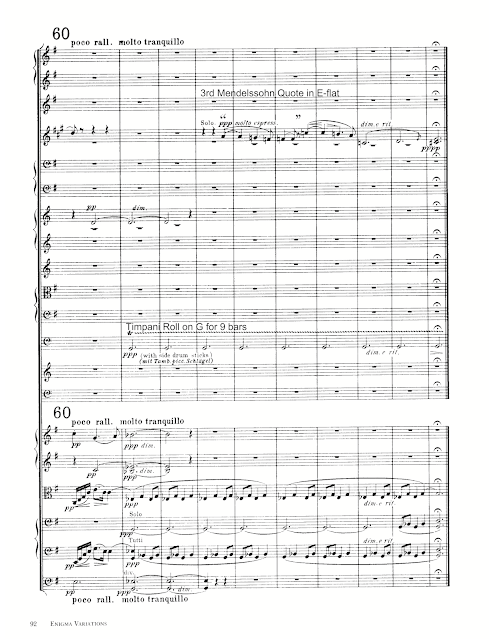
Variation XIII reaffirms this artistic inclination to change a source melody’s range, mode, tempo, and note values. Seventeen measures after Rehearsal D in Mendelssohn’s concert overture
Meeresstille und glückliche Fahrt, the fragment Elgar quotes is first introduced by the cello section in the key of A major. Elgar departs from the original mode by quoting that source fragment twice an octave higher in A flat major, once a sixth higher in F minor, and again a fifth higher in E flat major. The key letters of those fragments (
F-A-E) are a well-known
music cryptogram, an important feature that someone of Rushton’s expertise should have easily spotted. At approximately 112 beats per minute per quarter note, Mendelssohn’s tempo is much faster than Elgar’s quotation with a more leisurely metronome marking of 76. The source fragment’s rhythmic sequence is a half note (C sharp), a dotted quarter (B), an eighth note (A) followed by a whole note (A). While he retains much of the original rhythm, Elgar’s quotations truncate the fourth note to a dotted quarter. Like the Enigma Theme, the Mendelssohn fragments are presented in both major and minor modes. These fragments are accompanied by a pulsating
ostinato figure that replicates the Enigma Theme’s palindromic rhythm with the regular quarter rests stripped out, implying a special connection with the Enigma Theme.
Another problem with Rushton’s opinion calling for a strict adherence to the source melody’s note values is that it is not shared by other musicologists. In his paper
Shadows of the evening: new light on Elgar’s ‘dark saying,’ Clive McClelland warns against making the “false assumption that the hidden melody fits in real time with Elgar’s theme.” This perceptive observation is delectably ironic given that McClelland consulted with Rushton in preparing his paper, thanking him “for much useful advice.” Elgar’s flexible treatment of the Enigma Theme throughout the Variations should make it exceedingly obvious that such a pliable approach would also be extended to his handling of the covert principal Theme, particularly since his intent was to harden his melodic cipher against discovery.
Yet another flaw with Rushton’s assumption Elgar would assiduously preserve the original mode and rhythmic values of the covert Theme is there are multiple iterations of Ein feste Burg with varying rhythmic and melodic patterns (Figure 3).
With so many conflicting versions, Elgar could not have chosen a better source melody if his goal was to complicate its discovery. And who would ever guess that Elgar, a devout Roman Catholic, would adopt as his secretive source melody the battle hymn of the Protestant Reformation, a work composed by a heretic
excommunicated by Pope Leo X? This would provide a motive for its covert rather than overt quotation. With Ein feste Burg, Elgar enjoyed the extraordinary advantage of accessing multiple versions in constructing his perplexing contrapuntal conundrum. Why choose just one version when he could mix and match fragments from all three? By fusing together distinct phrases from Luther’s original and permutations by Bach and Mendelssohn, Elgar produced a unique “tribrid” hymn in homage to these pillars of the German School. It must be emphasized these fragments were detected through a methodical process of identifying sequentially matching notes between
Ein feste Burg and the Enigma Theme’s short score, reconstructing each distinct phrase sequentially in reverse. Such a disciplined procedure effectively rules out these fragments as figments of an overactive imagination. The odds of mapping
Ein feste Burg’s seven phrases note-for-note in a way that precisely matches one of its three established versions in the correct phrase order that harmonizes perfectly with the entire 19 measures of the Enigma Theme is so infinitesimally remote as to rule out a fortuitous assemblage. This could have only been engineered by someone far more talented than myself.
As a student of the German language, it is conceivable Elgar’s “tribrid” version of
Ein feste Burg was motivated by the German expression, “
Aller guten dingen sind drei” (All good things come in threes). The standard German title for Luther's famous hymn consists of three words. It is also possible Elgar's contrapuntal mashup was inspired by the Roman Catholic belief in a Triune God. In his correspondence, Elgar voiced a preference to give his breakout symphonic work the austere title Variations, something that implies the hidden melody was itself a variation. The combination of fragments from three distinct versions of Ein feste Burg produces a fourth permutation, a feature that mirrors Elgar’s use of four languages in his Music Box Cipher. Like ciphers, lockboxes are opened with the right combination. This distinct characteristic extends to Elgar’s contrapuntal cipher that required a combination of different versions of
Ein feste Burg to be unlocked.
Concerning his second objection regarding adjustments to
Ein feste Burg to mirror the minor and major modes of the Enigma Theme, Rushton provides as much basis to justify this grievance as the first. In other words, nothing except his professional opinion devoid of any relevant factual support. There are compelling reasons for dismissing his second objection as resoundingly as the first. First, Elgar was more than willing to change the mode of Mendelssohn’s Wedding March from C major to B flat major when sketching his
Lover’s Theme counterpoint. Second, Elgar abandoned the original A major mode of the Mendelssohn fragment when citing it in both major and minor modes in Variation XIII, favoring alternative keys that conveniently spell the famous music cryptogram FAE. Third, Elgar’s decision to frame the Enigma Theme in the minor and major modes of G involves the construction of a
key cipher that cleverly encodes the initials for the covert principal Theme. This is the case because the accidentals for the key signatures of the G minor and major modes are B flat, E flat, and F sharp. The letters of these accidentals (E, F, and B) are the initials for
Ein feste Burg. The
Mendelssohn fragments in Variation XIII also encode the same three letters, reaffirming the decryption of the mysterious three asterisks (
✡ ✡ ✡) for its mysterious subtitle.
It is critical to recognize Elgar was deliberately shielding the source melody from easy discovery. One way he accomplishes this is by repeatedly modulating the Enigma Theme between the minor and major modes, generating a modal smoke screen that renders the source melody’s key ambiguous. The unconventional bar lengths of each section further confuse matters. The A section has six bars, the B section four, the A’ section seven, and the C bridge section only two. This irregular phrase structure frustrates all attempts at overlaying a standard eight-bar phrase over any particular section of the Enigma Theme to detect a prospective solution. These odd phrase lengths could only have been realized by “distorting” the rhythms of the source melody through the contrapuntal techniques of augmentation and diminution. A retrograde mapping of the source melody “through and over” the Enigma Theme escalates the challenge even further, justifying the sobriquet Enigma. Not only is it necessary to adjust the source melody’s rhythms to achieve a retrograde mapping, but it is also essential to calibrate its mode to mirror that of the Enigma Theme. Context is key, or more precisely, the key is the context. The keys are also a cipher that unlocks Elgar’s melodic safe.
It has been shown in two documented cases that Elgar’s counterpoints exhibit just the opposite of what Rushton demands to authenticate a contrapuntal match between the Enigma Theme and the covert principal Theme. Elgar’s treatment of the Mendelssohn fragments in Variation XIII further proves he was perfectly comfortable with modifying a source melody’s key, octave, tempo, and rhythm to suit his creative needs. Other reputable scholars like Dr. McClelland reject Rushton’s assumptions, correctly pointing out that the covert Theme does not need to remain completely intact to achieve a credible contrapuntal fit. Rushton’s insistence on a rigid consistency is in open conflict with the conflicting versions of
Ein feste Burg available to Elgar when he composed the Enigma Variations. Although revered as a pontiff of Elgar scholarship, Rushton’s pontifications on Elgar’s contrapuntal inclinations prove he is far from infallible. His stubborn refusal to acknowledge the prospect of a retrograde mapping of
Ein feste Burg over the Enigma Theme based on “distorted” rhythms is not rooted in a sober appreciation of the facts, but a myth of his own invention. The only thing being distorted is Rushton’s perverse sense of logic. His unsound objections are best answered by a passage from
Self Reliance by Ralph Waldo Emerson:
A foolish consistency is the hobgoblin of little minds, adored by little statesmen and philosophers and divines. With consistency a great soul has simply nothing to do. He may as well concern himself with his shadow on the wall. Speak what you think now in hard words, and to-morrow speak what to-morrow thinks in hard words again, though it contradict every thing you said to-day. — “Ah, so you shall be sure to be misunderstood.” — Is it so bad, then, to be misunderstood? Pythagoras was misunderstood, and Socrates, and Jesus, and Luther, and Copernicus, and Galileo, and Newton, and every pure and wise spirit that ever took flesh. To be great is to be misunderstood.
Elgar may be added to Emerson’s list of celebrated but misunderstood minds. Blinded by a pedantic obsession for a crushing consistency, Rushton lost the contrapuntal forest for the trees. In the process, he flagrantly misunderstands and misrepresents Elgar’s style of counterpoint, and by extension, my explication of it. If only Rushton had done his homework by actually reading the works he takes credit for editing, he would have quickly realized Elgar’s contrapuntal style permits a more elastic treatment of note values and modes. Is that case not already proven by Elgar’s divergent contrapuntal treatments of the Enigma Theme throughout the Variations? No wonder Elgar was critical of academics, warning their textbooks “
teach building, but not architecture.” In this context, it is questionable whether Rushton even understands building, unless it involves a house of cards.
In describing Rushton’s qualifications to assess my research, Estrin mentions his 1999 book
Elgar: Enigma Variations. In a recent blog post, a number of errors in that treatise are described. One of the most egregious is Rushton’s stubborn insistence that the correct solution to the Enigma Variations – if one exists at all – “
should seem obvious (and not just to its begetter).”
Where he found such a peculiar proviso is not so obvious, for there is no record of Elgar stipulating the solution should be apparent. This faux condition is easily refuted by consulting a dictionary. Merriam-Webster defines enigma as “something hard to understand or explain.” In contrast, the definition of obvious is “easily discovered, seen or understood.” With such diametrically opposed meanings, Merriam-Webster classifies enigma and obvious as antonyms. Following the passage of over a century without discovering a compelling solution to the Enigma Variations, what should be excruciatingly clear (even to a career academic like Rushton) is the correct solution is anything but obvious. Compromised by such a fatal logical flaw in which the principle of contradiction has been suspended, Rushton’s quest for a credible resolution was doomed from the start.There are other outlandish errors plaguing Rushton’s analysis of the Enigma Variations. One of the most glaring is his assumption that Elgar had only a brief three-day period to conceive of any cryptograms. He relies exclusively on Elgar’s correspondence with Jaeger to arrive at such an eccentric conclusion. Rushton
ruminates, “
A tempting avenue leads to ciphers, although the short interval (three days) between conception and the commitment implied by mentioning the existence of the Variations to Jaeger makes elaborate precompositional calculation unlikely.”
This inference openly conflicts with Rushton’s remarks concerning Variation X (Dorabella) which he describes as being of “
possible early origin . . .” An “early origin” would imply some degree of “precompositional calculation,” so Rushton is writing out of both sides of his own mouth. What Rushton alleges is the Variations were essentially a spontaneous, unplanned eruption of Elgar’s genius that would necessarily preclude any elaborately premeditated cryptograms and counterpoints.Does Rushton’s theory harmonize with the historical evidence? A cursory review of the timeline decisively refutes such an arbitrary three-day constraint on the formulation of any cryptograms and counterpoints. Elgar openly began work on the Variations starting
October 21, 1898, only completing the orchestration by February 19, 1899. From the time he first performed the Enigma Theme for his wife until he completed the initial orchestration covered no less than 121 days. This timeline does not take into consideration an extra three weeks in June and July 1899 when Elgar sketched and appended 96 bars to the extended Finale. At a minimum, Elgar enjoyed a leisurely four months to devise and perfect any eventual ciphers and counterpoints, not a scant three days as Rushton bizarrely propounds. The selfsame scholar who conflates the definitions for obvious and enigma apparently lacks the mathematical acuity to differentiate between three days versus four months. To paraphrase Elgar’s not-so-secret friend, it is as if Rushton’s left lobe does not know what the right is thinking. If Rushton is the best England’s renowned universities can muster in the quest to crack the Enigma Variations, no wonder the British academic establishment failed to successfully navigate that melodic labyrinth.
Rushton’s three-day limitation on Elgar’s creative ferment is in marked conflict with Elgar’s lifelong compositional habits. In
The Cambridge Companion to Elgar (edited by Daniel M. Grimley and, somewhat ironically, Julian Rushton), Christopher Kent describes Elgar’s compositional practices in his essay “Magic by mosaic: some aspects of Elgar’s compositional methods.” From early childhood Elgar would record and accumulate his musical ideas on small sheets of staff paper during outdoor excursions, a practice he likely absorbed from his father. Kent designates these musical sketches as “spontaneous jottings.” He offers numerous anecdotes of Elgar deriving musical inspiration from outdoor trips by the River Wye, Lake Windermere, and the reeds of the Severn with “a sheet of paper trying to fix the sounds and longing for something great.” Elgar’s lasting “indebtedness to environmental stimulation” raises the question of whether he conceived of the Enigma Theme and some of the variations while ostensibly extemporizing at the piano on the eve of October 21, 1898, or if his ideas were crystallized earlier during his pastoral forays. Unfortunately, the sketchbook that could document those ideas was burned in July 1921, a year after the passing of Lady Elgar. Nonetheless, there is abundant evidence proving Elgar used material from sketches generated years and even decades before fashioning them into a polished work. Rushton’s observation regarding Variation X as potentially being of an early origin supports this very conclusion.Rushton’s failure to objectively present the most basic facts about the Enigma Variations without imposing artificial constraints on Elgar’s genius casts a long and lingering shadow of doubt over much of his analysis. When citing the original 1899 program note, Rushton wryly
observed,
“This passage raises a ripe mixture of unanswerable questions, not least why the composer indulged in obfuscation as early as 1899.” Unanswerable questions? From the outset, Rushton pigeonholes the only “solution” he finds palatable, namely that the answer should remain uncertain, unknowable, and undecided. His summary of Elgar’s conditions concerning the relationship between the covert Theme and the Enigma Variations is so hopelessly constructed that it reaps a whirlwind of clashing, cacophonous answers. That was undoubtedly Rushton’s intent from the outset, sowing seeds of confusion and doubt to so thoroughly confound his audience that they would inevitably arrive at the only inconclusive conclusion he deems palatable.
Estrin highlights some of the more intriguing discoveries from my original research into the Enigma Variations. He gives a snapshot of the most sophisticated of all the music cryptograms lurking in the Enigma Theme, a
Polybius Square cipher ensconced in its opening measures demarcated by an oddly placed double bar at the terminus of bar 6. This is Elgar’s “dark saying” which was first mentioned in connection to the Enigma Theme in the original 1899 program note. I first began searching in earnest for this cipher after reading Dr. Clive McClelland’s paper
Shadows of the evening: new light on Elgar’s ‘dark saying.’ He perceptively observed the regularly spaced quarter rests punctuating a palindromic rhythm suggest the presence of a cipher:
Elgar's six-bar phrase is achieved by the characteristic four-note grouping, repeated six times with its reversible rhythm of two quavers and two crotchets. This strongly suggests the cryptological technique of disguising word-lengths in ciphers by arranging letters in regular patterns. Elgar's love of puzzles and cryptograms is well documented.
Although McClelland was the first to formally recognize the potential existence of a music cipher in the opening six measures of the Enigma Theme, he lacked the cryptographic expertise to crack it. Another term for this type of cryptogram is a box cipher as the cipher key resembles a checkerboard. Elgar’s unique application of the Polybius box cipher to music puts on full display his
penchant for wordplay, for it may aptly be described as a music box cipher. The four languages used in this cipher are English, Latin, German, and what Elgar would have reasonably believed to be Aramaic (but is actually Hebrew). The first letters of these four languages form an acrostic anagram that cleverly spells
Elgar.
English
Latin
German
Aramaic
In a remarkable cryptographic feat, Elgar signed his cryptogram using a code wrapped within a larger cipher ostensibly to serve as a stealth form of authentication. Contrary to the insistence of mainstream scholars like Rushton and McClelland, Elgar did indeed write down the answer to his melodic riddle within the Enigma Theme to ensure its survival and signed his masterpiece in silent witness.
The
abundance of cryptographic evidence authenticating Ein feste Burg as the covert principal Theme to the Enigma Variations has yet to convince mainstream Elgar scholars such as Rushton and McClelland. This is best explained by the recognition these musicologists are unschooled in the art of cryptography, mistaking their inability to understand these ciphers as proof that they must be the figment of an overactive imagination as claimed by an anonymous professor from the University of London. Rushton’s failure to detect the rather rudimentary FAE cipher openly concealed by the Mendelssohn fragments in Variation XIII is symptomatic of this intellectual blind spot. My response to career academics who maintain it is impossible to crack Elgar’s enigmas is best captured by Franklin D. Roosevelt’s reply to career military commanders when they cautiously advised that a bombing raid on Japan just months after the calamity of Pearl Harbor was impossible. Reduced to sitting in a wheelchair due to the ravages of polio, Roosevelt defiantly locked his leg braces and struggled mightily until he pushed himself to stand upright. He then courageously proclaimed, “
Do not tell me it can’t be done.”
In the baffling quest to crack the Enigma Variations, it has already been done. To learn more about the secrets of the Enigma Variations, read my free eBook Elgar’s Enigmas Exposed. Please help support and expand my original research by becoming a sponsor on Patreon.