Translate

Showing posts with label music cryptogram. Show all posts

Wednesday, July 8, 2020

Elgar's Varying Tempi Nimrod Cipher

Since I’ve been back I have sketched a set of Variations (orkestry) on an original theme: the Variations have amused me because I’ve labelled ’em with the nicknames of my particular friends – you are Nimrod. That is to say I’ve written the variations each one to represent the mood of the ‘party’ – I’ve liked to imagine the ‘party’ writing the var: him (or her) self & have written what I think they wd. have written – if they were asses enough to compose – it’s a quaint idee & the result is amusing to those behind the scenes & won’t affect the hearer who ‘nose nuffin’. What think you?
Edward Elgar in an October 24, 1898 letter to August Jaeger

The autographed score of Variation IX (Nimrod) from Edward Elgar’s Enigma Variations has a metronome marking of 66 quarter beats per minute. The published score reduces that figure to 52 which results in a noticeably slower tempo. Julian Rushton draws attention to this and other discrepancies between the autograph and published scores in the August 2019 issue of The Elgar Society Journal. Remarking on the recovery of a lost score of the Enigma Variations once belonging to August Jaeger, Rushton opines, “. . . nothing bears on the ‘enigma’ — unless, that is, something can be deduced from additional information on Elgar’s indecision about the order of the variations, and metronome markings that differ from the published score . . .” The differences make all the difference as the following analysis unveils.


My original research found that the fifth and final ordering of the variations produces a remarkable matrix of proximate title letters ciphers. These and other cryptograms encode answers to the core questions posed by the Variations concerning the absent principal Theme, a cryptic “dark saying” concealed by the Enigma Theme, and a secret friend commemorated in Variation XIII. Based on these intriguing discoveries, it is reasonable to suspect that the tempo variance between the autographed and published scores of Nimrod may be yet another cipher.


Simon Singh remarks that cryptograms are often cracked by exploiting their anomalies. The differences in tempo between the autographed and published scores of Variation IX is one of those illuminating inconsistencies. The discrete numerals in these divergent tempo markings (52 and 66) are 2, 5, and 6. When those unique numbers are converted into their corresponding letters of the alphabet employing an elementary number-to-letter key (1 = a, 2 = b, 3 = c, etc…), they become B, E and F. Those are the initials of Ein feste Burg (A Mighty Fortress), the covert Theme to the Enigma Variations.
This is not the only cipher at the beginning of Variation IX. The tuning of the timpani is indicated at Rehearsal 33 as E-flat, B-flat, and F. Those three note letters are also an anagram of the hidden theme’s initials — E. F. B. Indeed, a distinct subset of cryptograms within the Enigma Variations encipher those three letters hinted at by three asterisks that form the title of Variation XIII. For instance, the Enigma Theme is written in the parallel modes of G minor and G major. The accidentals for those keys are F-sharp, B-flat, and E-flat. The Enigma Theme’s keys are the key to unlocking Elgar’s melodic safe because they encipher the initials of the hidden melody. To learn more about the innermost secrets of the Enigma Variations, read Elgar’s Enigmas Exposed. Please help support and expand my original research by becoming a sponsor on Patreon.

Soli Yah Gloria


Sunday, June 7, 2020

Elgar's Opus Dei Cipher . . .

Most of my’ sketches’,—that is to say the reduction of the original thoughts to writing, have been made in the open air. I finished the Wye round about Mordiford & completed many pencil memoranda of compositions on the old bridge, of which I have vivid & affectionate memories.
Edward Elgar in a letter to G. H. Jacks

A section in classical music that transitions one movement into another without interruption is called a bridge passage. There are three bridge passages in the symphonic Enigma Variations by the British Romantic composer Edward Elgar. The first situated in bars 18-19 is an elaboration of the final cadence from the iconic Enigma Theme. It begins at Rehearsal 2 and precedes Variation I (C. A. E.) that commences in bar 20. The second in bars 185-188 completes the closing section of Variation V (R. P. A). It starts four bars before Rehearsal 19 and links to Variation VI (Ysobel). The third bridge passage in bars 306-308 begins three measures before Rehearsal 33 and forms the ending phrase of Variation VIII (W. N.). A soulful melodic G from the tonic cadence is sustained by the first violins over the barline into Rehearsal 33 to herald the sublime dawn of the most elegiac of the movements, Variation IX (Nimrod).


It is undeniable that Elgar was an expert in cryptography, the discipline of coding and decoding secret messages. His obsession with that esoteric art merits an entire chapter in Craig P. Bauer’s treatise Unsolved! Much of its third chapter is devoted to Elgar’s brilliant decryption of an allegedly insoluble Nihilist cipher unfurled by John Holt Schooling in the April 1896 issue of The Pall Mall Magazine. Elgar was so delighted with his solution to Schooling’s reputedly insoluble cipher that he mentions it in his first biography published in 1905 by Robert J. Buckley. Elgar painted his decryption in black paint on a wooden box, an appropriate symbol as another name for the Polybius checkerboard is a box cipher. The six-word solution — “He who fears is half dead” — is summarized on a set of nine index cards.
On the sixth card, Elgar relates the task of cracking the cipher to “. . . working (in the dark).” The phrase “in the dark” is enclosed by parentheses, a feature associated with all of the titles from the Enigma Variations except the enigmatic Theme. His use of the word “dark” as a synonym for a cipher is significant because Elgar employs that same phraseology in the original 1899 program note to characterize the Enigma Theme. It is an oft-cited passage that merits revisiting as Elgar lays the groundwork for his tripartite riddle:
The Enigma I will not explain – it’s ‘dark saying’ must be left unguessed, and I warn you that the connexion between the Variations and the Theme is often of the slightest texture; further, through and over the whole set another and larger theme ‘goes’, but is not played . . . So the principal Theme never appears, even as in some later dramas – e.g., Maeterlinck’s ‘L’Intruse’ and ‘Les sept Princesses’ – the chief character is never on the stage.
A compulsion for cryptography is a reigning pillar of Elgar’s psychological profile. A decade of concerted analysis of the Enigma Variations has netted over eighty cryptograms in diverse formats that encode a set of mutually consistent and complementary solutions. While this figure may seem incredible, it is entirely consistent with Elgar’s obsession with ciphers. More significantly, their solutions provide definitive answers to the core questions posed by the Enigma Variations. What is the secret melody to which the Enigma Theme is a counterpoint and serves as the foundation of the ensuing movements? Answer: Ein feste Burg (A Mighty Fortress) by Martin Luther. What is Elgar’s “dark saying” ensconced within the Enigma Theme? Answer: A musical Polybius box cipher embedded in the opening six bars. Who is the secret friend and inspiration behind Variation XIII? Answer: Jesus Christ, the Savior of Elgar’s Roman Catholic faith.
A conspicuous feature of some of those ciphers is their proximity to double barlines, particularly those situated in unexpected or unusual locations. For example, the Enigma Theme has a double bar line at the end of measure 6. The presence of a double bar line so close to the beginning is decidedly anomalous. This condition also applies to the first bridge passage framed by an end bar line at the start of bar 18 and a double bar line at the end of bar 19. The insertion of numerous double bar lines in less than twenty measures is conspicuously unconventional.
Some remarkable examples of cryptograms found within the opening six bars of the Enigma Theme are the Pi Cipher, Locks Cipher, Keys Cipher, and Psalm Cipher. The presence of so many musical ciphers in these inaugural bars before the first double barline supports the tantalizing prospect that other cryptograms could be hidden away between the end and double bar lines of the Enigma Theme’s concluding bridge passage. This hypothesis precipitated an analysis of Enigma Variations’ three bridge passages individually and collectively with the goal of detecting and decrypting prospective ciphers. What follows is the first installment in a series of essays that will cover key findings from this project.

The Opus Dei Cipher

A performance direction is a standardized word or acronym in music that instructs the performer how to execute a particular passage. One notable cipher at the opening of the Enigma Theme exploits the first letters of its performance directions to encode “EE’s Psalm” as an acrostic anagram. Elgar’s ingenious use of these performance directions spawned an analysis of the performance directions in the first bridge passage. Among the performance directions in bars 18-19 of the published score, only three are followed by a period: tempo., unis., and dim.


The word “tempo” appears three times in bar 18 of the full score, yet only one ends with a period. This discrepancy tipped off the presence of a cryptogram constructed from those three performance directions ending with a period. This suspicion was bolstered by the realization that these three words consisting of twelve letters present two remarkable parallels with the common three-word title of the covert Theme (Ein feste Burg) which also has three words and precisely twelve letters. Three performance directions with periods are suggestive of the three Mendelssohn quotations in Variation XIII that has three cryptic asterisks (✡ ✡ ✡) as a title.
An analysis of those three performance directions ending with periods began by arranging its twelve letters in alphabetical order as “deiimmnopstu.” It was quickly realized that these letters harbor an anagram of “Opus Dei.” This Latin phrase means “The work of God.” The coded occurrence of the word “opus” in an orchestral work is contextually suitable because such major works are routinely assigned opus numbers. In the case of the Enigma Variations, that number is 36. The product of those two numerals (3 x 6) is eighteen, the very same measure number in which the first part of this three-word anagram is found. This opus number is further implicated by the breakdown of the performance directions from the first bridge that have periods (3) and those that lack them (6).
The word “Dei” appears in Elgar’s public dedications for his sacred oratorios The Dream of Gerontius, The Apostles, and The Kingdom. On these Master Scores he wrote the initials “A. M. D. G.” These are the initials for the Jesuit motto “Ad majorem dei gloriam” (For the greater glory of God). Elgar’s multifaceted dedications to Jesus throughout the Enigma Variations interface beautifully with the decryption “Opus Dei” because the greatest work of God was atoning for the sin of humankind through the death and resurrection of Christ.
Backing out the letters needed to spell “Opus Dei” (deiimmnopstu) leaves “immnt.” The letters “im” are a phonetic rendering of “I AM.” This reading is bolstered by the fact that Elgar’s personal correspondence contains an array of inventive phonetic spellings. This is an enigmatic name for God revealed in Chapter 3 of the Book of Exodus that theologians refer to as the “Great I AM.” When Moses encountered the Angel of the Lord at the burning bush at Mount Horeb and requested his name, God answered, “I AM who I AM.” God followed this up with a shortened version of his name as simply, “I AM.” Christian theologians classify this divine encounter and others from the Old Testament canon as a pre-incarnate manifestation of Christ known as a Christophany.
The letters “IM” are repeatedly enciphered in Morse code by the palindromic rhythmic pattern of the Enigma Theme’s alternating pairs of two eighth notes and two eighth notes. The faster and shorter rhythm of two eighth notes is akin to two dots (..) that signify the letter I in Morse Code. The two longer quarter notes are the equivalent of two dashes (--) that represent the letter M. These two letters are encoded together by the Enigma Theme’s rhythmic pattern as “IM” in the odd-numbered measures 1, 3, 5, 11, 13, and 15. Their mirror image as “MI” is enciphered in the same manner in the even-numbered measures 2, 4, 6, 12, 14, and 16. The back-to-back encoding of the letters “IM MI” is a phonetic anagram of the double I AM. Elgar was familiar with Morse Code and used the palindromic telegraphic address “Siromoris.” More significantly, he substituted the phrase “I Am” in a letter with the opening bar of the Enigma Theme.
Jesus answered his critics who challenged his divine authority by calling himself “I Am” in an obvious quotation from the Exodus account. The Book of John lists seven other memorable “I am” proclamations by Jesus.
  1. “I am the bread of life.” (John 6:35
  2. “I am the light of the world.” (John 8:12
  3. “I am the door.” (John 10:9
  4. “I am the true vine.” (John 15:1
  5. “I am the good shepherd.” (John 10:11
  6. “I am the resurrection and the life.” (John 11:25
  7. “I am the way, the truth, and the life.” (John 14:6)
A veiled reference in the first bridge passage to the phrase “I am” is a theologically compelling hint regarding the identity of the secret friend covertly commemorated in Variation XIII. A bridge is a place to cross an obstacle, and the symbol of the cross is a universally recognized Christogram. This readily explains why Elgar resorted to portraying a sea crossing in Variation XIII. The initials for Jesus Christ are transparently enciphered by the Roman numerals of his movement using a standard number-to-letter key. X represents ten, and the tenth letter of the alphabet is J. III stands for three, and the third letter is C.
Moses met God at the burning bush on Mount Horeb and later received the Ten Commandments on that holy mountain. Remarkably, there are precisely ten written notes that comprise the opening chord of the first bridge section. Mount Horeb is called the Mountain of God. The letters “mnt” are a phonetic rendition of “mount,” a shortened term for mountain. This finding is consistent with the companion decryption of “IM” as “I AM” because that enigmatic name for God was first provided on a mount. The combination of “mount” with “I AM” is a coded reference to Mount Horeb where Moses first heard this unusual name for God. There is another remarkable connection between the word “mount” and the Enigma Theme. Three of his disciples saw Jesus speaking with Moses on the Mount of Transfiguration.
The image of a mountain is tied to the ministry of Jesus and Psalm 46, the source of the title for the covert Theme. In Matthew 17:20, Jesus pits a small amount of faith against a huge mountain. He taught his disciples that faith the size of a tiny mustard seed is sufficient to move mountains. Jesus said, “I assure you that if you have faith the size of a mustard seed, you could say to this mountain, ‘Go from here to there,’ and it will go.” It is telling that the periods after the performance directions in the first bridge passage actually resemble small seeds. This vivid image of a mountain being moved is also found in a passage from Psalm 46, “Therefore we will not fear though the earth gives way, though the mountains be moved into the heart of the sea...” The Enigma Theme is the melodic equivalent of a mustard grain that is transmuted through a series of variations into a mighty melody. In Variation, Elgar carried it into the midst of the ocean with a sonic portrayal of a calm sea using the Mendelssohn fragments performed over an ostinato figure that reprises the Enigma Theme’s palindromic rhythm.
The word “mount” is inextricably linked to the genesis of the Enigma Variations. Elgar taught violin at an all-girls school called The Mount where his daughter Carice attended. After a long day of teaching there on Friday, October 21, 1898, Elgar returned home and first performed the Enigma Theme on the piano for his wife, Alice. That date is commemorated each year by devout Elgarians as Enigma Day.
The languages unveiled by these three decryptions are Latin (Opus Dei), English (I Am), and English (mount). The first letters of those three languages spell LEE. Shortly after completing the Enigma Variations, Elgar moved into a new residence during March 1899 and named it Craeg Lea. The acrostic anagram LEE derived from the languages unveiled by the decryption is a phonetic version of “Lea.”It also contains Edward Elgar’s initials. A variety of cryptograms within the Enigma Variations are initialed by the composer ostensibly as a form of authentication.

Concluding Remarks

A cryptanalysis was performed on three particular performance directions in the first bridge passage from the Enigma Variations because each ends in a period. These three terms have a total of twelve letters, presenting two parallels with the covert Theme’s title which also consists of three words with a total of twelve letters. The three performance directions ending in periods turn out to be an anagram of “opus dei,” “im,” and “mnt.” The Latin phrase “Opus Dei” means “The work of God.” Elgar used the word “Dei” in dedications to God in numerous sacred oratorios. Compositions are routinely given opus numbers, and the Enigma Variations’ is 36. In the first bridge passage, this number is alluded to by the performance directions as three have periods, and six do not.
The next two terms in the decryption are phonetic renderings of “I AM” (an enigmatic name of God) and “Mount.” The letters i and m are encoded extensively in pairs throughout the Enigma Theme via Morse code. The decryptions “I AM” and “mount” are interrelated because God first shared his mysterious name with Moses on Mount Horeb. This encounter between God and man is interpreted as a Christophany by theologians. In heated encounters with the religious authorities, Jesus invoked that unusual name as his own. At the Mount of Transfiguration, the disciples saw Jesus speaking with Moses. The word “mount” is associated with the Enigma Variations because Elgar spent a full day of teaching at a school called “The Mount” before returning home and performing the Enigma Theme on the piano for his wife that evening. The languages unveiled by the decryption are an acrostic anagram of LEE (a phonetic spelling of Lea) that harbors the composer's initials.
This article is the first in a series that will identify and decrypt an assortment of cryptograms embedded within the three bridge passages of the Enigma Variations. You are invited to check back periodically for the next installment. To learn more about the secrets of the Enigma Variations, read my free eBook Elgar's Enigmas ExposedPlease help support and expand my original research by becoming a sponsor on Patreon.

Friday, March 27, 2020

Elgar’s ‘Craeg Lea’ Enigma Cipher

The new house was named with an anagram of the family’s initials: E, A, C. E L G A R — Craeg Lea’. He sent the new name to Dora Penny, teasing her with the anagram’s secret.
Jerrold Northrop Moore in Edward Elgar: Letters of a Lifetime

There is no doubt Edward Elgar was an expert in cryptography, the discipline of coding and decoding messages. His obsession with that esoteric art merits an entire chapter in Craig P. Bauer’s treatise Unsolved! Much of the third chapter is devoted to Elgar’s brilliant decryption of an allegedly insoluble Nihilist cipher presented by John Holt Schooling in an April 1896 issue of The Pall Mall Magazine. Elgar was so pleased with his solution that he mentions it in his first biography published in 1905 by Robert J. Buckley. Elgar painted his solution in black paint on a wooden box, an appropriate medium as another name for the Polybius checkerboard is a box cipher.
Elgar’s methodical decryption is summarized on a set of nine index cards. On the sixth card, he relates the task of cracking the cipher to “. . . working (in the dark).”


This use of the word dark as a synonym for cipher is significant because he employs that same phraseology in the 1899 program note for the premiere to characterize the Enigma Theme. It is an oft-cited passage that merits revisiting because Elgar lays the groundwork for his tripartite riddle:
The Enigma I will not explain – its ‘dark saying’ must be left unguessed, and I warn you that the connexion between the Variations and the Theme is often of the slightest texture; further, through and over the whole set another and larger theme ‘goes’, but is not played . . . So the principal Theme never appears, even as in some later dramas – e.g., Maeterlinck’s ‘L’Intruse’ and ‘Les sept Princesses’ – the chief character is never on the stage.
A compulsion for cryptography is a reigning pillar of Elgar’s psychological profile. A decade of systematic analysis of the Enigma Variations has netted over seventy cryptograms in diverse formats that encode a set of mutually consistent and complementary solutions. While this figure may seem incredible, it is entirely consistent with a dominant facet of Elgar’s psychological profile—an obsession for ciphers. More significantly, their solutions provide definitive answers to the core questions posed by the Enigma Variations. What is the secret melody to which the Enigma Theme is a counterpoint that serves as the foundation of the ensuing movements? Answer: Ein feste Burg (A Mighty Fortress) by Martin Luther. What is Elgar’s “dark saying” hidden within the Enigma Theme? Answer: A musical Polybius box cipher contained in the opening six bars. Who is the secret friend and inspiration behind Variation XIII? Answer: Jesus Christ, the Savior of Elgar’s Roman Catholic faith.
A conspicuous feature of some of those ciphers is their proximity to double barlines, particularly those situated in unusual locations. For example, the Enigma Theme has an oddly placed double barline at the end of measure 6. The placement of a double barline so close to the beginning of a movement is decidedly anomalous. This condition also applies to the first bridge passage that is framed by an end barline at the outset of bar 18 and a double barline at the terminus of bar 19. The insertion of multiple double barlines in less than twenty measures is inordinate and conspicuous.


An intensive cryptanalysis of the opening six measures of the Enigma Theme uncovered a series of cryptograms that encipher a narrow set of mutually reinforcing and consistent solutions. The most sophisticated is a musical Polybius box cipher that encodes Elgar’s mysterious “dark saying” first mentioned in the original 1899 program note. This secret message is an elaborate anagram of the covert Theme’s 24-letter title (Ein feste Burg ist unser Gott). This anagram reveals the secret friend’s name (Jesus encoded as “GSUS”) within the context of other apposite words and phrases phonetically rendered in Latin, English, and what popular biblical commentaries then identified as Aramaic. This cunning combination of phonetically spelled words in four languages was obviously intended to stifle all attempts at decryption. A less apparent but marvelous explanation is that the first letters of those four languages are an acrostic anagram of Elgar
  1. English 
  2. Latin 
  3. German 
  4. Aramaic
In a brilliant cryptographic coup, Elgar stealthily autographed his cipher via an acrostic anagram embedded within the languages divulged by the correct solution. The decoding of this cryptogram makes it possible to know with supreme confidence that Luther’s hymn Ein feste Burg is the absent melody to the Enigma Variations because it bears Elgar’s coded signature wrapped within another layer of encipherment.


When treated as a pure acrostic anagram, the first letters of these four cipher languages may be rearranged to spell “ELAG”. These four letters are a phonetic rendering of elegy. This construction mirrors the four-letter groupings unveiled by the decryption of the Enigma Theme Polybius Box Cipher. According to Merriam-Webster, an elegy is defined as “a song or poem expressing sorrow or lamentation especially for one who is dead,” and “a short pensive musical composition.” The first definition is fitting because the death of Elgar’s famous secret friend is memorialized in Variation XIII. The other definition is a suitable description of the Enigma Theme which consists of only nineteen measures. At the conclusion of the extended Finale completed in July 1899, Elgar cites a passage from stanza XIV of Longfellow's Elegiac Verse: "Great is the art of beginning, but greater the art is of ending." There is no greater or more permanent ending in life than death, an insight alluded to by Elgar’s Tasso paraphrase from the epic Christian poem Jerusalem Delivered that he dated incorrectly to the year of Tasso’s passing (1595).
The specter of death cast a long shadow over the Enigma Variations. The six-word dedication opens with a homonym of dead, “Dedicated to my Friends pictured within.” The silence of the principal Theme is evocative of a passage from Psalm 31:17 that mentions the silence of the grave. For Elgar, there was an indelible link between music and death because he studied musical scores as a boy at a local churchyard while resting on a tombstone. In Variation XIII, Elgar repeatedly quotes a fragment from Mendelssohn’s concert overture Calm Sea and Prosperous Voyage (Meeresstille und glückliche Fahrt) to portray a ship crossing the open sea. This sonic symbolism was inspired by the poetry of the famed German playwright Goethe whose seemingly benign image of a boat adrift on a windless sea actually depicts the stillness of death (Todestille). In the original program note for the 1899 premiere of the Enigma Variations, Elgar likens the absent principal Theme to the mysterious protagonist who never appears onstage in certain dramas by the Belgian playwright, Maeterlinck. That absent character is death, a central element in Maeterlinck's works described as "marionette" plays as the characters rarely move.
The phonetic words and phrases encoded in bars 1-6 of the Enigma Theme Polybius box cipher are an anagram of the 24-letter German title of the secretive melody: Ein feste Burg ist unser Gott. In the article from The Pall Mall Magazine that Elgar retained in his personal library, John Holt Schooling refers to the Polybius box as “The ‘Checker-board’ Cipher.” The list below shows the first cipher method (Checkerboard) followed by the languages of the full decryption in order of appearance from bars 1-6. This is capped off by the second cipher method (Anagram) needed to unscramble the first decryption (Elgar’s “dark saying”) to reveal the second (the title of the covert Theme):
  1. Checkerboard 
  2. English 
  3. Latin 
  4. English 
  5. English 
  6. Aramaic 
  7. English 
  8. German 
  9. Anagram
The third through sixth sequence of initials (LEEA) stands out from that acrostic of nine terms. In March 1899, Elgar moved his family into a new home that he christened Craeg Lea. This move occurred shortly after he finished orchestrating the Enigma Variations the prior month on February 19. Elgar devised this unusual residential moniker by reversing the letters of his last name (Craeg Lea) and inserting the initials from the first names of his wife Alice (Craeg Lea), daughter Carice (Craeg Lea) and himself (Craeg Lea). The acrostic letter sequence “LEEA” from the above list suggests the last name of Elgar’s home from that very period. Remarkably, the first letters from that list of languages and encipherment techniques furnish all but one letter from these two unusual names, the r. Recall that the second letter in “Aramaic” was required to complete Elgar’s covert signature in the discrete list of cipher languages (English, Latin, German, Aramaic). That same condition applies again in this instance to complete the unique and novel title for Elgar’s residence.
The first letters of the cipher languages (English, Latin, English, English, Aramaic, English German) and cipher types (Checkerboard and Anagram) are an acrostic anagram of “EE CRAEG LEA.” This solution features the composer’s initials (EE) followed by the distinctive name for his residence (Craeg Lea). The discovery of this cryptogram affirms that Elgar conceived of this new name months if not years before moving into his new home in March 1899. Other cryptograms in the Enigma Variations are distinguished by Elgar’s dual initial Es. For instance, the performance directions in the Enigma Theme’s opening bar are an acrostic anagram of “EE’s Psalm.” This cryptogram is called the Enigma Psalms Cipher. Remarkably, there are exactly 46 characters in this cipher that implicates Psalm 46. The encoding of psalm in the Enigma Theme’s inaugural bar serves as a major clue because the title of the covert Theme originates from Psalm 46.


The Enigma Theme’s opening bars harbor other fascinating musical cryptograms such as the Pi Cipher, Locks Cipher, and Keys Cipher. A German sixth chord on the downbeat of bar 5 is noteworthy because the covert Theme's title is six German words. The title Enigma is spelled identically in English and German. It was written on the full score by Elgar’s only German friend portrayed in the Variations, August Jaeger. The first three letters of Enigma are also an anagram of Ein, the first word in the covert Theme’s title. There are undoubtedly other cryptograms yet to be discovered in Elgar's arresting homage to musical cryptography. To learn more about the secrets of the Enigma Variations, read my free eBook Elgar’s Enigmas ExposedPlease help support and expand my original research by becoming a sponsor on Patreon.


Saturday, October 19, 2019

The Mendelssohn Quotations Accidentals Cipher

During railway journeys amuses himself with cryptograms; solved one by John Holt Schooling who defied the world to unravel his mystery.
Robert J. Buckley in Sir Edward Elgar (1905)

Edward Elgar first performed the Enigma Theme at the piano for his wife, Caroline Alice Elgar, on the evening of October 21, 1898. For this reason, the twenty-first of October is commemorated by Elgarians as Enigma Day. This year marks the 121st anniversary of that auspicious occasion. In acknowledgment of that private premiere, Elgar’s wife is the first friend portrayed within the Enigma Variations. The Enigma Theme is linked to her movement by a two-bar bridge, establishing a singular connection to that evocative melody that she singled out on that historic Friday evening.
Another movement that shares a prominent attachment to the Enigma Theme is Variation XIII, a Romanza with an austere title comprised of three enigmatic asterisks (✡ ✡ ✡). This variation features three major melodic quotations and one minor adaption from Felix Mendelssohn’s concert overture Calm Sea and Prosperous Voyage (Meeresstille und glückliche Fahrt) Op. 27. Each fragment is performed as pianissimo (very soft) or pianississimo (very very soft) to symbolize a calm sea. The ebb and flow of the tides are suggested by the accompaniment, an undulating ostinato that reprises the Enigma Theme’s palindromic rhythm of two alternating pairs of two eighth notes and two quarter notes.

The first Mendelssohn quotation in A-flat major


The second Mendelssohn quotation in A-flat major

The Mendelssohn fragment in F minor

The Mendelssohn quotation in E-flat major

The commingling of the Mendelssohn fragments with the Enigma Theme’s distinctive rhythmic motif implies a deeper connection between those two seemingly unrelated themes. The Enigma Theme is a counterpoint to a famous yet absent Theme. In a similar vein, the title of Variation XIII is also absent. Unmasking the links between the Enigma Theme and Variation requires a mastery of music cryptography, an esoteric art that bewilders legacy scholars who stubbornly tout the conventional wisdom that the Mendelssohn fragments are entirely alien to the Enigma Theme. This superficial impression proves to be profoundly misguided.
My search for music cryptograms in the Enigma Variations was sparked by a marvelous discovery by Charles Richard Santa. A retired engineer and amateur musician, Santa realized the scale degrees of the Enigma Theme’s opening four melody notes in measures 1 and 11 encipher the mathematical ratio Pi. The scale degrees of the Enigma Theme's melody notes in measures 1 and 11 are B-flat, G, C, and A in G minor. The scale degrees of those four notes are 3, 1, 4, and 2, respectively. Those scale degrees in melodic order are a coded reference to the number Pi that may be rounded from 3.1415 to four digits as 3.142.
The Enigma Theme Pi Cipher is remarkable because a circle has 360 degrees, presenting a striking parallel with Enigma Variations’ opus number — 36. Santa’s groundbreaking research disclosed for the first time how Elgar deftly inserted a cryptogram into the Enigma Theme, raising the tantalizing prospect of more ciphers. Elgar used the opening four melody notes from the Enigma Theme to encode Pi, providing a numeric convergence with the four-note Mendelssohn fragments in Variation XIII. Could there be other cryptographic connections between these two seemingly extraneous melodies?
There are a total of three Mendelssohn quotations in Variation XIII. Two quotations are in A-flat major, and the third is in E-flat major. A fragment is also performed by the brass section in F minor that lacks quotation marks because it departs from the original major mode.


The key letters of the Mendelssohn fragments are an anagram of a well-known music cryptogram (FAE) coined around 1853 by Joseph Joachim, one of the most celebrated violinists in England and Europe during the latter half of the 19th century. Mendelssohn served as Joachim’s mentor, introducing him to the British public in 1844 at just under 13 years of age in a command performance of Beethoven’s violin concerto for the Royal Philharmonic Society of London. An aspiring violinist in his youth and professional concert violinist as an adult, Elgar idolized Joachim as lucidly documented by Arthur Reynolds in the July 2007 issue of The Elgar Society Journal.
The inability of career academics such as Julian Rushton to detect such an elementary cryptogram hidden so nakedly within the Mendelssohn fragments is ample proof of a punctum caecum, a gaping blind spot in their scholarship. Absent an informed sensitivity to the existence of ciphers, career academics casually dismiss their likelihood on contrived grounds and exert no genuine effort to detect or decrypt them. The academic establishment missed the proverbial boat regarding the cryptographic significance of the Mendelssohn fragments.
The key letters of the Mendelssohn fragments form part of a much larger cache of cryptograms that divulge and authenticate the covert melodic Theme of the Enigma Variations and the secret friend memorialized in Variation XIII. While astonishing in their scope, these ciphers are entirely consistent with Elgar’s expertise in cryptography. This towering trait of his psychological profile merits an entire chapter in Craig Bauer’s recently published history of the world’s greatest ciphers, Unsolved! A meticulous analysis of the Mendelssohn fragments has so far netted twenty cryptograms. This impressive array of ciphers is listed below with links to their detailed descriptions and descriptions:
  1. FAE Cipher 
  2. Mendelssohn FAE Syllables Cipher 
  3. FACE Cipher 
  4. AMF Cipher 
  5. Mendelssohn Fragments Scale Degrees Cipher 
  6. Mendelssohn Keynotes Cipher 
  7. Mendelssohn Scale Degrees Cipher 
  8. Variation XIII Music Anagram Ciphers 
  9. Mendelssohn Clarinet Solo Nominal Notes Cipher 
  10. Clarinet A Major Key Signature Transposition Cipher 
  11. Mendelssohn Pi Cipher 
  12. Mendelssohn Pi-C Cipher 
  13. Mendelssohn Fragments Melodic Intervals Cipher 
  14. Dual Initials Enigma Cipher 
  15. Romanza Cipher 
  16. Dominant-Tonic-Dominant (5-1-5) Cipher 
  17. “See Abba” Mendelssohn Cipher 
  18. Mendelssohn Fragments Clefs Cipher 
  19. Rehearsal 55 Clarinet Solo Cipher 
  20. Mendelssohn-Wagner Melodic Merger Cipher
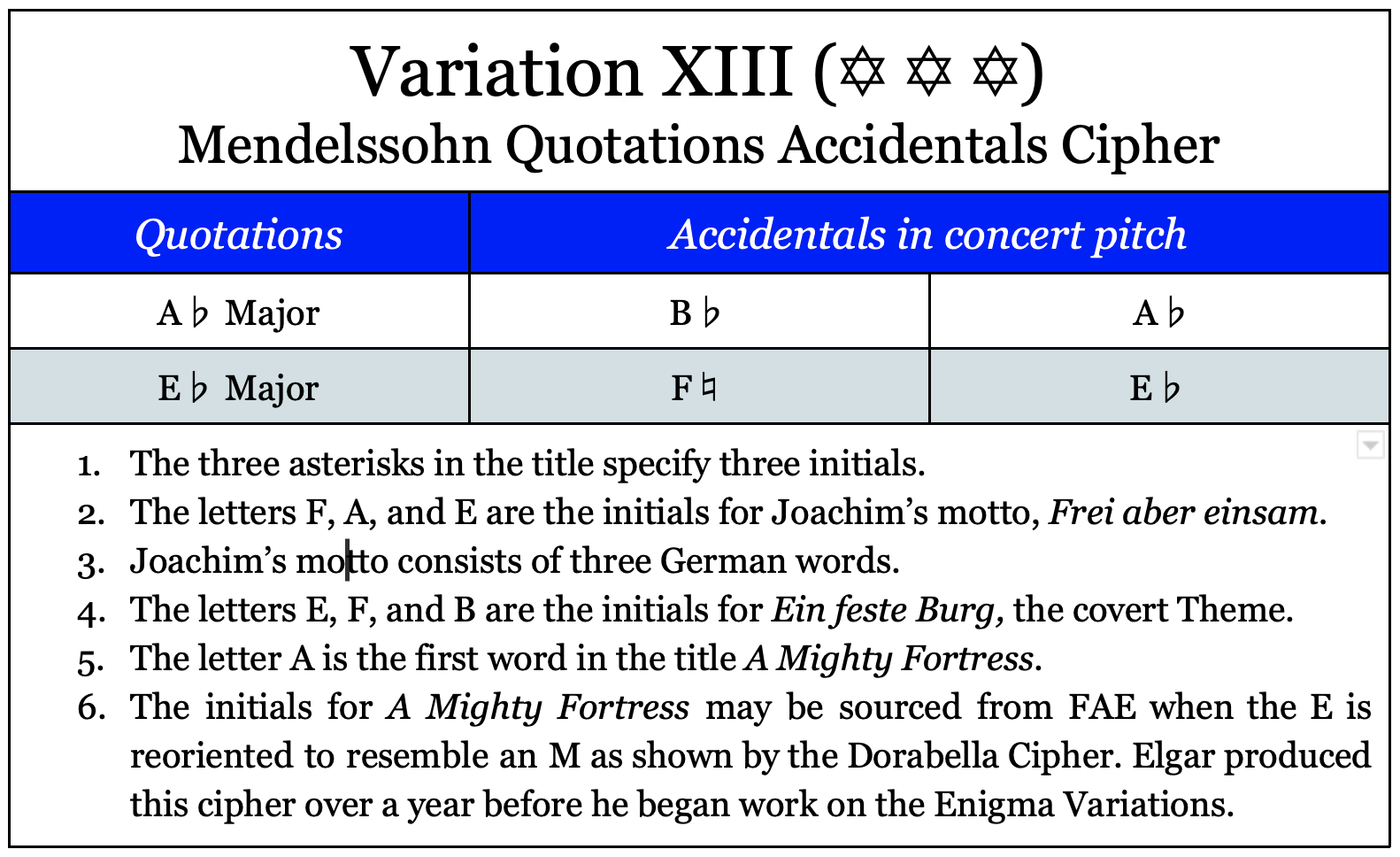
On the 121st anniversary of Enigma Day, it is a privilege to announce the discovery of the 21st cryptogram hiding just beneath the surface of the Mendelssohn quotations. This cipher is based on the accidentals in concert pitch from the A-flat and E-flat major Mendelssohn quotations. For this reason, it is called the Mendelssohn Quotations Accidentals Cipher.

An accidental changes a note’s pitch from the designated key signature. The term accidental is a bit of a misnomer as the designated pitch alteration is purely intentional. With Variation XIII set in G major, the accidentals in concert pitch for the A-flat major Mendelssohn quotation are B-flat and A-flat. Those for the E-flat Mendelssohn quotation are F natural and E-flat. These accidentals correspond to the written and sounding pitches for the Mendelssohn quotations. The discrete letters of those accidentals in alphabetical order are A, B, E, and F. Three of those letters are an anagram of the initials for the covert Theme, Ein feste Burg. The remaining letter is the first word in the title of the English translation, A Mighty Fortress. The initials for Joachim’s maxim may also be assembled from those accidentals, Frei aber einsam (Free but lonely).
Elgar demonstrated with his Dorabella Cipher conceived in 1897 that the glyph for a capital E may be reoriented to approximate a capital M. When the E is treated more flexibly in this manner, the English initials for the covert Theme’s title may be assembled from A, E, and F: A Mighty Fortress. The FAE Cipher derived from the key letters of the Mendelssohn fragments hints at a three-word German title for the covert Theme. The original title for A Mighty Fortress meets those criteria because it is three words in German. The FAE Cipher further highlights two of the three initials for Ein feste Burg with the sole point of divergence being between the contiguous letters A and B.


Various cryptograms embedded within the Enigma Variations feature Elgar’s initials. The Mendelssohn Quotations Accidentals Cipher adds another to this growing category with the repeated E-flats in the third Mendelssohn quotation. Other examples that display his initials are the Enigma Theme Psalms Cipher and the Enigma Theme Locks Cipher. Elgar’s initials undoubtedly serve as a form of authentication for those cryptograms.
The absent letters signified by the three asterisks intimate the presence of those initials somewhere in Variation XIII. The anomalous Mendelssohn fragments pinpoint where to look for those missing letters. The first set to emerge is FAE, the initials for Joachim's maxim. This famous music cryptogram was popularized by the F-A-E Violin Sonata composed for Joseph Joachim by Robert Schumann, Johannes Brahms, and Albert Dietrich. The Mendelssohn Quotations Accidentals Cipher further revealed these same initials and those for the common three-word titles of the covert melody in both German and English. There is an elegant continuity and efficiency to Elgar's use of four accidentals in three four-note Mendelssohn quotations to encipher three sets of three initials.
The Mendelssohn fragments ingeniously encipher the German initials (E. F. B.) for the covert Theme. This is achieved by converting the number of statements of a Mendelssohn fragment in a given key and converting it to the corresponding scale degree of that key. There are two fragments in A-flat major, one in F minor, and one in E-flat major. The second scale degree in A-flat major is B-flat. The first scale degrees of F minor and E-flat major are F and E-flat, respectively. The letters of those scale degrees are B, F, and E. This reverse decryption of Ein feste Burg’s initials serves as a significant clue because the covert Theme plays as a retrograde counterpoint through and over the Enigma Theme.


Another cryptogram that encodes the initials for Ein Feste Burg is the Mendelssohn Solo Passages Melodic Intervals Cipher. This cipher is based on the melodic intervals of the clarinet solo passages that begin with the first A-flat major and final E-flat major Mendelssohn quotations. A melodic interval represents the difference between two adjacent notes in a melody, and only intervals greater than a unison were considered for this melodic interval analysis. There are only three melodic intervals larger than a unison in these clarinet solo passages: 2nd, 5th, and 6th. The application of a simple number-to-letter conversion (A=1, B=2, C=3, etc.) to these melodic intervals yields the letters B, E, and F. These plaintext solution letters are an anagram of the initials for Ein feste Burg, the covert Theme to the Enigma Variations.


Elgar's decision to quote music by Felix Mendelssohn in the Enigma Variations decisively refutes the presumption that his Roman Catholicism would ostensibly bar him from citing the work of a Protestant composer. Although born to Jewish parents, Mendelssohn was baptized a Lutheran on the anniversary of another prominent Lutheran’s birth, Johann Sebastian Bach. The FAE Cipher formed by the Mendelssohn fragments' key letters hints at another Jew who was baptized a Lutheran, the famed violin virtuoso Joseph Joachim. Both of these musicians were composers whose shared Lutheranism implicates the composer of the covert Theme, Martin Luther. The four Mendelssohn fragments are a calculated set of clues because Mendelssohn cites Ein feste Burg in the fourth movement of his Reformation Symphony followed by a set of variations. This realization would readily explain why Elgar suspected the absent Theme would soon be spotted. To learn more about one of Elgar's greatest symphonic works, read Elgar’s Enigmas ExposedPlease help support and expand my original research by becoming a sponsor on Patreon.

About Mr. Padgett

My photo
Mr. Padgett studied violin with Michael Rosenker (a student of Leopold Auer), and Rosenker’s pupil, Owen Dunsford. Mr. Padgett studied piano with Sally Magee (a student of Emanuel Bay), and Blanca Uribe (a student of Rosina Lhévinne). He attended the Stevenson School in Pebble Beach, California, and Vassar College in Poughkeepsie, New York, where he graduated Phi Beta Kappa with a degree in psychology. At Vassar he studied music theory and composition with Richard Wilson. Mr. Padgett has performed for Joseph Silverstein, Van Cliburn, Arnold Schwarzenegger, Maria Shriver, Steve Jobs, Prince Charles, Lady Camilla, Marcia Davenport, William F. Buckley, Jr., and other prominent public figures. His original compositions have been performed by the Monterey Symphony, at the Bohemian Grove, the Bohemian Club, and other private and public venues. In 2008 Mr. Padgett won the Max Bragado-Darman Fanfare Competition with his entry "Fanfare for the Eagles." It was premiered by the Monterey Symphony under Maestro Bragado in May 2008. A member of the Elgar Society, Mr. Padgett is married with five children.