Translate

Showing posts with label Romanza. Show all posts

Friday, September 20, 2024

The “FAE-EFB” Cipher in Variation XIII (✡ ✡ ✡)

Joseph Joachim (circa 1890)
Absence of evidence is not evidence of absence.

The English composer Edward Elgar excelled at cryptography, the science of coding and decoding secret messages. His obsession with ciphers merits an entire chapter in Craig P. Bauer’s book Unsolved! Bauer devotes much of the third chapter to Elgar’s meticulous decryption of a purportedly insoluble Nihilist cipher released by John Holt Schooling in the April 1896 issue of The Pall Mall Magazine. A Nihilist cipher is built on a Polybius square key. Elgar was so gratified by his decryption of Schooling’s impenetrable code that he mentions it in his first biography released by Robert J. Buckley in 1905. Elgar painted his solution in black paint on a wooden box, an appropriate medium as another name for the Polybius square is a box cipher.
Elgar’s meticulous decryption of Schooling’s cryptogram is summarized on a set of nine index cards. On the sixth card, Elgar likens the process to “working (in the dark).” Note his use of the word dark as a synonym for cipher.


Elgar’s parenthetical remark is revealing as he employs that same language in the original 1899 program note to characterize the Enigma Theme. It is an oft-cited passage that warrants revisiting as he lays the groundwork for his tripartite riddle:
The Enigma I will not explain–its ‘dark saying’ must be left unguessed, and I warn you that the connexion between the Variations and the Theme is often of the slightest texture; further, through and over the whole set another and larger theme ‘goes’, but is not played . . . So the principal Theme never appears, even as in some later dramas–e.g., Maeterlinck’s ‘L’Intruse’ and ‘Les sept Princesses’–the chief character is never on the stage.
Elgar wields the words dark and secret interchangeably in a letter to August Jaeger penned on February 5, 1900. He wrote, “Well—I can’t help it but I hate continually saying ‘Keep it dark’—‘a dead secret’—& so forth.” One definition of dark is “secret.” A saying is a series of words that form a coherent phrase or adage. Based on these definitions, Elgar’s odd expression—“dark saying”—may be interpolated as coded language for a cipher. In a roundabout way, Elgar hints that the Enigma Theme conceals a secret message.
Mainstream scholars insist there are no valid solutions to the Enigma Variation because Elgar allegedly concocted the notion of an absent principal Theme as an afterthought, practical joke, or marketing ploy. The editors of the Elgar Complete Edition preemptively deny the likelihood of any stealthy counterpoints or cryptograms. Relying on Elgar’s recollection of playing new material at the piano to gauge his wife’s reaction, they tout the standard lore that he must have extemporized the idiosyncratic Enigma Theme, mirabile dictu, without any forethought or planning:
There seems to have been no specific ‘enigma’ in mind at the outset: Elgar’s first playing of the music was hardly more than a running over the keys to aid relaxation. It was Alice Elgar’s interruption, apparently, that called him to attention and helped to identify the phrases which were to become the ‘Enigma’ theme. This suggests it is unlikely that the theme should conceal some counterpoint or cipher needed to solve the ‘Enigma’.
Such a blanket renunciation conveniently relieves musicologists of any duty to probe for counterpoints and ciphers. Prominent offenders include such luminaries as Robert Anderson, Jerrold Northrop Moore, and Julian Rushton. The unavoidable irony is that proponents of such denialism extol the validity of their position based on a dearth of evidence for which they never executed a diligent or impartial search. Such a ridiculous state of affairs is a textbook case of confirmation bias pawned off as “scholarship.” Carl Sagan warns against that perilous persuasion with the antimetabole, “Absence of evidence is not evidence of absence.”
Embraced by those who take Elgar at his published word, the more sensible view accepts the challenge of a famous melody lurking behind the Variations’ contrapuntal and modal facade. In his sanctioned 1905 biograph, Elgar plainly states, “The theme is a counterpoint on some well-known melody which is never heard . . .” Most scholars insist the answer can never be known because Elgar allegedly took his secret to the grave. This supposition precludes from consideration the prospect that he encoded the solution within the Enigma Variations for posterity to discover. Indeed, such a rigid judgment glosses over or blatantly ignores Elgar’s obsession with cryptography. That incontestable facet of his psychological profile enhances the possibility that solutions are skillfully encoded by the Enigma Variations’ orchestral score.
A compulsion for cryptography is a reigning facet of Elgar’s personality. Trawling the Enigma Variations for over a decade netted over one hundred cryptograms in diverse formats that encode a set of mutually consistent and complementary solutions. Although that figure may seem extraordinary, it is entirely consistent with Elgar’s fascination for ciphers. Solutions encoded by these cryptograms answer the riddles posed by the Enigma Variations. What is the secret melody to which the Enigma Theme is a counterpoint and serves as the melodic foundation for the ensuing movements? Answer: Ein feste Burg (A Mighty Fortress) by the German reformer Martin Luther. What is Elgar’s “dark saying” concealed within the Enigma Theme? Answer: A musical Polybius cipher situated in the opening six bars. Who is the secret friend and inspiration behind Variation XIII? Answer: Jesus Christ, the Lord and Savior of Elgar’s Roman Catholic faith.

Some “EFB” Ciphers
A distinct subset of ciphers sprinkled throughout the Enigma Variations encode the initials of Ein feste Burg. Some noteworthy examples are the Enigma Theme Keys Cipher, Nimrod Timpani Tuning Cipher, Variation XII through XIV Letters Cluster Cipher, Mendelssohn Fragments Scale Degrees Cipher, and the Original and Extended Ending Ciphers. The Enigma Theme is written in the parallel modes of G minor and G major. The accidentals for those two key signatures (B♭, E♭, and F♯) are an anagram of “EFB.” The keys of the Enigma Theme unlock the initials of the covert Theme. It is also significant that the first three letters of the Theme’s title (Enigma) are an anagram of the Ein, the first word from the covert Theme’s title.


Variation IX (Nimrod) begins in measure 308 at Rehearsal 33. Elgar specifies the tuning of the timpani for this elegiac movement as E♭, B♭, and F. Those three note letters are an anagram of “EFB”, the initials of Ein feste Burg. The first three letters in the timpani’s tuning directions (“in E♭ . . .”) is a thinly disguised anagram of Ein, the first word in the covert Theme’s title. This mirrors the same pattern observed with the first three letters of the Theme’s title “Enigma” which form an anagram of “Ein”. The E♭in the timpani’s tuning supplies Elgar’s initial and the three pitches are separated by two perfect fifths. Two intervals of a perfect fifth suggest a coded form of Elgar’s initials (EE) as E is the fifth letter of the alphabet. Consistent with that pattern, the Rehearsal number (33) is also the mirror image of two capital cursive Es.


Variation XIII (✡ ✡ ✡) has a cryptic title of three black hexagrammic asterisks enclosed by parentheses. The absent initials signified by those starry asterisks are conveniently supplied as an acrostic anagram by the titles of the adjoining movements, XII (B. G. N.) and XIV (E. D. U. & Finale). Elgar frames the mystery posed by the cryptic title with the correct solution as an acrostic anagram using the titles of the neighboring movements.


There are four incipits in Variation XIII sourced from a subordinate theme of Felix Mendelssohn’s concert overture Meeresstille und glückliche Fahrt (Calm Sea and Prosperous Voyage). Two quotations are performed in A♭ major, one paraphrase in F minor, and another quotation in E♭ major. These Mendelssohn fragments encode the initials for Ein feste Burg using the number of statements in a given key to designate the scale degree of that particular mode. Two Mendelssohn fragments in A♭ major specify the second scale degree of that key which is B♭. One Mendelssohn fragment in F minor identifies its first degree of F. A single Mendelssohn quotation in E♭ major designates its first scale degree of E♭. The notes selected by this encipherment system—B♭, F, and E♭—are an anagram of “EFB”. These are the same three notes chosen by Elgar to define the timpani’s tuning in Variation IX.


There is an “EFB” acrostic anagram on the final page of the manuscript score with the original ending of Variation XIV. On that closing page, Elgar penned Fine, an Italian paraphrase from Torquato Tasso’s La Gerusalemma Liberata (Jerusalem Delivered) beginning with the word Bramo, and his autograph. The first letters of these three entries (Fine, Bramo, Edward) generate the acrostic anagram “EFB”, the initials of the covert Theme.


The anomalous date on that page—“FEb 18 1898”—furnishes yet another anagram of “EFB” coinciding with the anniversary of Luther’s death in 1546. As documented on the cover of the autograph score, Elgar completed the Enigma Variations on February 19, 1899. The erroneous date on the last page is one year and one day earlier than the actual completion date, a whopping discrepancy of 366 days. Luther is interred in front of the pulpit of Schlosskirche (Castle Church) in the city of Wittenberg. A coded reference to Luther’s death points to his resting place where “EIN FESTE BURG IST UNSER GOTT” is emblazoned around the church tower. Luther’s resting place supplies the title of the covert Theme.

The tower of Schlosskirche (Castle Church)

Like the original ending, Elgar inserted another acrostic anagram of “EFB” on a 96-bar addendum to the Finale composed in June and July 1899. His signature on the final page of this addition is accompanied by the word Fine and the location (Birchwood Lodge) where he completed the manuscript. The first letters of these three entries form an acrostic of “EFB”, the initials of Ein feste Burg. The L in “Lodge” even divulges the initial of its composer (Luther). That same initial is reinforced by the quotation at the upper right of the page from stanza XIV of the poem Elegiac Verse by Longfellow.


Three musical friends depicted in the Enigma Variations attended constituent colleges of Oxford University. The dedicatee of Variation II is the pianist Hew David Steuart-Powell who graduated from Exeter College. The dedicatee portrayed in Variation XII is the cellist Basil George Nevinson, another graduate of that same institution. The friend sketched in Variation V is the pianist Richard Penrose Arnold, a student of Balliol College. All three were active in the Oxford University Musical Society (OUMS) founded in 1872. Another Oxford graduate portrayed in Variation VII of the Enigma Variations is Troyte Griffith who attended Oriel College. Unlike his three Oxford peers, Troyte was unmusical and not actively engaged in the Oxford University Musical Society. The musical trio of Oxford students—Steuart-Powell, Arnold, and Nevison—were friends of Elgar’s wife and entered his social sphere following their marriage in May 1889.
Exeter College was founded in 1314 and adopted the Latin motto “Floreat Exon” (Let Exeter Flourish). Balliol College was founded in 1263 but does not advertise a collegiate motto. It is possible to obtain the initials “EFB” as an acrostic from the first letters of Exeter, its Latin motto “Floreat Exon”, and Balliol.
Exeter
Floreat Exon
Balliol
It is equally feasible to generate the acrostic anagram “EFB” using Exeter’s motto and the name Balliol.
Floreat Exon
Balliol
Elgar ingeniously encodes the initials of Ein feste Burg as an acrostic anagram using the college names and motto associated with three Oxford friends portrayed in Variations II, V, and XII.
This overview showed how Elgar encodes the initials “EFB” through a variety of different cryptograms. Most rely on the use of anagrams and acrostics to encode information. These ciphers represent a set of variations on the covert Theme’s initials. The “EFB” decryption is consistent with the majority of the titles from the Enigma Variations which are comprised of different sets of initials. This pattern of anagrams is consistent with the name “Craeg Lae” coined in March 1899 by Elgar for his new residence. The unusual moniker is an anagram of his forename spelled backward (Craeg Lea) mingled with the initials of Carice, Edward, and Alice (Craeg Lea).

Joachim’s Motto “EFB” Cipher
Another “EFB” cipher was recently discovered In Variation XIII (✡ ✡ ✡) of the Enigma Variations. Before presenting this discovery, it is necessary to revisit two related cryptograms. In Variation XIII, Edward Elgar openly cites a four-note melodic fragment from the concert overture Calm Sea and Prosperous Voyage by Felix Mendelssohn. As shown earlier, the key letters of those Mendelssohn fragments encipher an anagram of “FAE”, the initials of Joseph Joachim’s romantic motto “Frei aber einsam” (Free but lonely). Elgar scholars should have easily spotted this simple musical cryptogram but were too preoccupied with denying the existence of ciphers in the Variations to mount even a cursory search. The “FAE” Cipher furnishes valuable clues about the covert Theme’s title and its composer. The discovery of the “FAE” Cipher embedded within the Mendelssohn fragments verifies that they harbor cryptograms.
There is a slightly more sophisticated cipher in the Mendelssohn fragments that encodes the initials of Ein feste Burg. This cryptogram relies on the number of times an incipit is stated in a given key to encode the scale degree of that particular mode. Two quotations in A♭ major pinpoint its second scale degree of B♭. One paraphrase in F minor points to its first scale degree of F. A third quotation in E♭ major identifies its first scale of E♭. These three note letters (B, F, E) are an anagram of “EFB”, the initials of Ein feste Burg. This set of initials supplies the absent letters in the cryptic title of three hexagrammic asterisks.
The latest “EFB” cipher found in Variation XIII bridges the “FAE” and Mendelssohn fragments “EFB” ciphers. Elgar devised a straightforward method to identify specific scale degrees from the three different keys of the Mendelssohn fragments to encode the covert Theme’s initials (EFB). What makes his formula even more extraordinary is that it also works with Joachim’s motto. The first scale degree of F minor is F, the same as the first letter in Frei. The second scale degree of A♭ major is B♭ which corresponds to the second letter in aber. The first scale degree of E♭ major is E, the same as the first letter of einsam. Applying the specific scale degrees associated with each key letter (one for F and E, and two for A) to letters from each corresponding word in “Frei aber einsam” highlights F, b, and e. These three letters are an anagram of “EFB”, the initials of Ein feste Burg. The methodology used to encode “EFB” in the Mendelssohn fragments also transfers seamlessly to Joachim’s German motto. This synchronous treatment of the FAE and Scale Degrees ciphers located in the Mendelssohn fragments yields identical decryptions that validate both cryptograms and illustrate Elgar’s mastery of cryptography.
To learn more about the secrets of the Enigma Variations, read my free eBook Elgar’s Enigmas Exposed. Please help support and expand my original research by becoming a sponsor on Patreon.

Tuesday, November 15, 2022

Elgar's "HIDE PSALM 46" Titles Cipher

Edward Elgar (Postcard c. 1910) 
During railway journeys amuses himself with cryptograms; solved one by John Holt Schooling who defied the world to unravel his mystery.
Robert J. Buckley in his 1905 biography of Sir Edward Elgar

Today is the 319th day of the year with 46 days remaining until the arrival of 2023. November 15th marks the twentieth anniversary of “I Love To Write Day” founded by John Riddle. Now is an opportune moment to publish my 204th installment exploring the symphonic Enigma Variations by the British romantic composer Edward Elgar. Elgar excelled in coding and decoding secret messages, a discipline formally known as cryptography. His obsession with that esoteric art merits an entire chapter in Craig P. Bauer’s treatise Unsolved! The bulk of its third chapter is devoted to Elgar’s brilliant decryption of an allegedly insoluble Nihilist cipher conceived by John Holt Schooling that was published in an April 1896 issue of The Pall Mall Magazine. A Nihilist cipher is a derivative of the Polybius square. Elgar was so gratified by his solution to Schooling’s reputedly impenetrable code that he specifically mentions it in his first biography released in 1905 by Robert J. Buckley.


Elgar painted his solution in black paint on a wooden box, an appropriate medium as another name for the Polybius square is a box cipher. His methodical decryption is summarized on a set of nine index cards. On the sixth card, Elgar relates the task of cracking the cipher to “. . . working (in the dark).” His parenthetical expression using the word “dark” as a synonym for a cipher is significant because he deploys that same phraseology in the original 1899 program note to characterize the Enigma Theme. It is an oft-cited passage worth revisiting as Elgar lays the groundwork for his tripartite riddle:
The Enigma I will not explain – its ‘dark saying’ must be left unguessed, and I warn you that the connexion between the Variations and the Theme is often of the slightest texture; further, through and over the whole set another and larger theme ‘goes’, but is not played . . . So the principal Theme never appears, even as in some later dramas – e.g., Maeterlinck’s ‘L’Intruse’ and ‘Les sept Princesses’ – the chief character is never on the stage.
Elgar employed the words “dark” and “secret'' interchangeably in a letter to August Jaeger penned on February 5, 1900. He wrote, “Well — I can’t help it but I hate continually saying ‘Keep it dark’ — ‘a dead secret’ — & so forth.” One of the meanings of dark is secret, and a saying is a series of words that form a phrase or adage. Based on these definitions, Elgar’s cryptic expression — “dark saying” — is a coded way of saying there is an enciphered message in the Enigma Theme.
A decade of trawling the Enigma Variations has netted over one hundred cryptograms in diverse formats that encode a set of mutually consistent and complementary solutions. Although that sum may seem extraordinary, it is entirely consistent with Elgar’s obsession with ciphers. More significantly, their solutions give definitive answers to the riddles posed by the Enigma Variations. What is the secret melody to which the Enigma Theme is a counterpoint and serves as the melodic foundation for the ensuing movements? Answer: Ein feste Burg (A Mighty Fortress) by Martin Luther. What is Elgar’s “dark saying” hidden within the Enigma Theme? Answer: A musical Polybius box cipher located in the opening six bars. Who is the secret friend and inspiration behind Variation XIII? Answer: Jesus Christ, the Savior of Elgar’s Roman Catholic faith.
The first persuasive evidence for the existence of musical cryptograms in the Enigma Variations was uncovered by Richard Santa back in 2009. A retired engineer and Elgar enthusiast, Santa (whose name means “Holy” and “Saint”) found the Enigma Theme’s opening bar encodes Pi, a mathematical constant describing the ratio of any circle’s circumference and its diameter. In his groundbreaking research, Santa determined the first four melody notes of the Enigma Theme sequentially approximate a rounded form of Pi (3.142) via its scale degrees in the key of G minor. Its opening melody notes are B-flat, G, C, and A; their corresponding scale degrees are 3, 1, 4, and 2, respectively. Santa generously shared an early draft of his paper with me during the summer of 2009 before it was published by Columbia University’s journal Current Musicology in March 2010.


Santa’s paper offered the tantalizing prospect there could be other cryptograms lurking in the Enigma Variations. That hunch was bolstered in August 2009 when Dr. Clive McClelland of Leeds University kindly forwarded to me his paper Shadows of the evening: New light on Elgar’s ‘dark saying.’ Although his melodic solution fails to satisfy key conditions articulated by Elgar, I eagerly read McClelland’s essay and was impressed by some of his insights. For instance, his analysis of the Enigma Theme’s opening six bars finds circumstantial evidence for a cipher. The basis for this suspicion is that regularly spaced quarter rests at the outset of each bar suggest spaces between words. As McClelland surmises:
Elgar’s six-bar phrase is achieved by the characteristic four-note grouping, repeated six times with its reversible rhythm of two quavers and two crotchets. This strongly suggests the cryptological technique of disguising word-lengths in ciphers by arranging letters in regular patterns.
Following McClelland’s line of reasoning, quarter rests uniformly dispersed over six bars with four melodic notes per bar would suggest that Elgar’s “dark saying” consists of six words with exactly twenty-four letters. Such a conclusion resonates with my thesis that Luther’s Ein feste Burg is the absent Theme because its complete German title is six words with a sum total of twenty-four letters. The numeric parallels are far too precise to be casually chalked up to coincidence. The synergy of Santa’s and McClelland’s insights precipitated an intense search for a musical cryptogram in the opening six bars of the Enigma Theme. My quest began in October 2009 and culminated in the detection and decryption of a musical Polybius cipher in February 2010. My discovery was first announced in September 2010 and has proven to be my most popular article. A more succinct overview of my decryption was released in August 2019. Below is the decryption of that sophisticated Polybius cipher.


The Enigma Theme’s Polybius cipher is the most sophisticated of all the cryptograms in the Variations. It uses 24 pairs of melody and bass notes to encode the 24 plaintext letters from the title Ein feste Burg ist unser Gott. Elgar ingeniously reshuffles those 24 letters into a series of anagrams in English, Latin, and what he reasonably believed to be Aramaic in accordance with popular biblical commentaries near the turn of the century. Four of the six anagrams are spelled phonetically, an unexpected feature consistent with Elgar’s correspondence that incorporates inventive phonetic spellings. Some examples of these atypical spellings are listed below:
  1. Bizziness (business)
  2. çkor (score)
  3. cszquōrrr (score)
  4. fagotten (forgotten)
  5. FAX (facts)
  6. frazes (phrases)
  7. gorjus (gorgeous)
  8. phatten (fatten)
  9. skorh (score)
  10. SSCZOWOUGHOHR (score)
  11. Xmas (Christmas)
  12. Xqqqq (Excuse)
  13. Xti (Christi)
Elgar’s reliance on four languages mingled with phonetic spellings was ostensibly intended to frustrate conventional decryption methods that presume a coded message is restricted to one language and conventional spellings. His education in three Roman Catholic schools ensured he was tutored in both English and Latin. He also studied German in the hopes of attending the Leipzig Conservatory founded by Felix Mendelssohn. Remarkably, the first letters of these four cipher languages is an acrostic anagram of “ELGAr”:
  1. English
  2. Latin
  3. German
  4. Aramaic
In a stunning cryptographic feat, Elgar signed the correct decryption to his musical Polybius box cipher employing a second tier of encryption only revealed by successfully unlocking the first. This is Elgar’s proverbial sealed envelope bearing the melodic solution to his Enigma. Supreme confidence in his unexpected answer is assured by Elgar’s stealth signature. He autographed the solution because he recognized it would be unguessed and polemical.
Elgar deposited subtle clues on the title page of the autograph score hinting at a Polybius square cipher. The most conspicuous is a tilted square on the lower left-hand side of the cover. This geometric figure overlays the same staves on the following page where he orchestrated Enigma Theme’s opening bars that house a musical Polybius square cipher. This is the only known instance where Elgar drew a square on the cover of a symphonic score. Within his tilted square, Elgar inserted multiple anagrams of the initials “EFB” accompanied by the capital letter “L” thinly disguised as a square bracket.

The Enigma Variations Autograph Score Title Page

Another breakthrough in 2013 unveiled the meaning and significance of the three asterisks in the cryptic title of Variation XIII (✡ ✡ ✡). It was determined those absent letters are cleverly encoded by the first initials of the titles from the adjoining movements. The first initials from the titles of Variations XII (B. G. N.) and XIV (E. D. U. & Finale) are an acrostic anagram of the initials for the covert Theme (Ein Feste Burg). Elgar deftly frames the question posed by the three asterisks with the answer hidden in plain view.


Elgar experimented with five different orderings of the movements, a process that, in retrospect, was carried out to construct this particular cipher. Such a possibility eludes musicologists such as Julian Rushton who irrationally speculate that Elgar lacked the time to construct any cryptograms. Such a conclusion conflicts with the established timeline. Elgar began composing the Enigma Variations on the evening of October 21, 1898, and completed the orchestration on February 19, 1899. Later that year, he appended 96 measures to the Finale between June 30 and July 20 for an additional 21 days. In all, Elgar invested 142 days composing the Enigma Variations, a period that afforded more than sufficient time and opportunity for Elgar to indulge his passion for cryptography.
The titles of the Enigma Variations are summarized in the table exhibited below. Its fifteen movements with divergent titles have a grand total of 187 characters. There is one dash, three asterisks, and fourteen pairs of parentheses for a total of 28, and 46 periods. There are nine sets of initials with 27 letters, seven words with 49 letters, and fourteen Roman numerals with 33 letters.


The acrostic anagram from the titles of Variations XII and XIV which unveils the initials of Ein feste Burg is an elementary cryptogram labeled the Letters Cluster Cipher. Its discovery eventually precipitated a much broader analysis of all the titles from the Enigma Variations with the goal of uncovering other meaningful and relevant groupings of proximate title letters. This approach is markedly dissimilar from Stephen Pickett’s surgical cherry-picking of single initials from titles and names to assemble a purported solution for the absent Theme. My investigation uncovered an array of terms linked to the absent Principal Theme, the Enigma’s “dark saying,” and the secret friend. The Letters Cluster Cipher was the proverbial tip of a much larger iceberg of coded information.
Another superlative example of a proximate title letters anagram found in the opening three titles of the Enigma Variations is “PIE CHRISTI ABIDE” (Pious Christ Abide). The first two words are in Latin, and the third is English. Remarkably, the spelling of the first word (PIE) is nearly identical to Pi, the mathematical ration lurking in the Enigma Theme's opening bar. In that same measure, a musical Polybius cipher encodes “GSUS”, a phonetic rendering of Jesus. Merging these companion decryptions from bar 1 yields Pi GSUS” (Pi Jesus), a close approximation of “PIE CHRISTI. It is surely significant that these divergent ciphers generate mutually consistent and corresponding solutions. Between 1863 and 1872, Elgar attended three Roman Catholic schools where he studied both languages. Remarkably, the spelling of the first word (PIE) is nearly identical to Pi, the mathematical ratio discovered by Santa lurking in bars 1 and 11 of the Enigma Theme. The Latin word for Christ appears in the title of Elgar’s first sacred oratorio, Lux Christi Op. 26. Published under the Anglicanized title The Light of Life, it premiered in 1896 and was extensively revised in 1899 — the same year Elgar completed his Enigma Variations.


The “HIDE PSALM 46” Titles Cipher
It is a privilege to report the discovery of yet another set of interlocking anagrams within the opening three titles of the Enigma Variations. Contiguous title letters in those first three movements encode the anagram “HIDE PSAlm.” The first word (HIDE) is formed by letters from Variations I (C. A. E.) and II (H. D. S-P.). The second term (PSAlm) is sourced from letters in the Theme (Enigma), Variation I (C. A. E.), and II (H. D. S-P.). Although there is no letter L in these titles, the Roman numeral for the number one (I) is a homoglyph (l) of a lowercase L. Interpolating the “I” as a lowercase “l” is consistent with Elgar’s pliable treatment of the E glyph in his Dorabella Cipher to duplicate the letters M and W. The anagram “HIDE PSAlm” accords with Elgar’s novel treatment of Ein feste Burg as the covert Theme to the Enigma Variations.


Another possible anagram obtained from proximate title letters in the opening three movements is “C EE HIID PS”. The letters required for this anagram are sourced from the initial of the Theme (Enigma), the first and third initials from Variation I (C. A. E.), the Roman numerals and initials from Variation II (H. D. S-P.). “C” is a homonym of see. “EE” is Elgar’s initials. “HIID” is a phonetic rendering of hide. “PS” is a standard abbreviation of Psalm. The proximate title letters anagram “C EE HIID PS” may be fully decoded as “See Edward Elgar hide Psalm.”


There are 150 chapters in the Book of Psalms. Out of so many possibilities, which Psalm did Elgar conceal? The answer is furnished by the number of letters in the titles of Variations I and II. There are four letters in the title of the first variation (ICAE), and six in the second (IIHDSP). When paired together, the attendant sums of these title letters from these contiguous movements convey a coded version of the number 46. When considered in the context of the “HIDE PSAlm” anagram, that figure implicates chapter 46 of the Psalms, the afflatus for Martin Luther's Ein feste Burg. This conclusion is bolstered by the “D” in Variation II which stands for David, the author’s name for Psalm 46.

David Playing the Harp by Jan de Bray (1670)

In a revealing gesture, Elgar substitutes the Star of David for standard asterisks in the title of Variation XIII (✡ ✡ ✡). This marine movement with the anomalous Mendelssohn quotations from the overture Calm Sea and Prosperous Voyage is dedicated in secret to Jesus Christ. Elgar’s choice of stars is deeply symbolic as one of the many titles for Jesus is “Son of David” (e.g., Matthew 1:1, Matthew 9:27, Matthew 12:22-23, Matthew 15:21-22, Matthew 20:30-31). Stars are closely associated with Christ. A star announced his birth (Matthew 2:1-2) to the wise men from the East. In a vision, John of Patmos saw Jesus holding seven stars in his right hand (Revelation 1:16). Yet another title for Jesus is the “bright morning star” (Revelation 22:16). Relying on these biblical references, there is a sound theological foundation for concluding that stars are emblematic of Christ.
The titles anagram “HIDE PSAlm” may be elaborated by the inclusion of chapter 46, the initial “E” from Enigma, and “C” from Variation I. With these additional initials, it expands to “C E HIDE PSAlm 46.” C is a homonym of see. E is the initial for Elgar employed extensively in his correspondence and wifes diary. Armed with these insights, this enhanced anagram may be read phonetically as “See Elgar hide Psalm 46.” Appending that chapter number to the alternate anagram yields “C EE HIID PS 46” which reads as “See Edward Elgar hide Psalm 46.” The precision and specificity of these anagrams are nothing short of extraordinary, supplying an apt characterization of Elgar’s novel treatment of Ein feste Burg as the hidden principal Theme. As a stealth form of authentication, Elgar inserted his initials within this proximate title letters cryptogram. Elgar enjoyed signing his work. 


Elgar initialed other cryptograms embedded within the Enigma Variations. For example, seven discrete performance directions in the first bar of the Enigma Theme generate the acrostic anagram “EE’s Psalm.” There are precisely 46 characters in this remarkable cryptogram, a sum that implicates Psalm 46. Like the titles anagram cipher previously described, this decryption unveils the author’s initials.


To learn more about the secrets of the Enigma Variations, read my free eBook Elgar’s Enigmas ExposedPlease help support and expand my original research by becoming a sponsor on Patreon.

Tuesday, September 22, 2020

Elgar's "I See A Face" Cipher in Variation XIII

Though everything else may appear shallow and repulsive, even the smallest task in music is so absorbing, and carries us so far away from town, country, earth, and all worldly things, that it is truly a blessed gift of God.

Edward Elgar in Variation XIII as extraneous to the Enigma Theme, and by extension the whole of the Enigma Variations. This view is fueled by the recognition that they come from an entirely foreign work, Felix Mendelssohn’s Calm Sea and Prosperous Voyage Op. 27. That concert overture is approximately thirteen minutes long, a duration that presents an intriguing parallel with the Roman numerals of Variation XIII. Its original German title — Meeresstille und glückliche Fahrt — is drawn directly from two poems by Goethe that were extremely popular when Mendelssohn composed his programmatic piece. There is a bit of irony in that deceptively serene title because Goethe was an early proponent of the literary movement known as Sturm und Drang which means “storm and drive.” With such an obvious foreign provenance, scholars reason the Mendelssohn fragments in Variation XIII must be unrelated to the covert principal Theme, the “dark saying” mentioned by Elgar in the original 1899 program note, and the secret friend memorialized in Variation XIII. The scholars could not be more wrong.
A contrarian view is raised by Elgar’s decision to superimpose the Mendelssohn fragments over a pulsating ostinato sourced from the Enigma Theme’s palindromic rhythm of alternating pairs of eighth and quarter notes. This rhythmic figure that portrays an undulating sea is composed of harmonic sixths alternating by melodic thirds. This combination of harmonic and melodic intervals encodes the opus number (36) of the Enigma Variations. In a remarkable parallel, Martin Luther composed 36 hymns. This orchestrated mingling of the Enigma Theme’s rhythmic structure with the Mendelssohn fragments raises the possibility of a more nuanced connection between these two outwardly unrelated themes.
The quotations in Variation XIII from Mendelssohn's concert overture Calm Sea and Prosperous Voyage portray a serene and windless sea. Without wind, a sailing vessel becomes stranded in a watery desert. The nautical term for this treacherous condition for sailors is known as the doldrums. It is remarkable that these Mendelssohn quotations are accompanied by a metallic roll on the timpani, a drum. The orchestration of the Mendelssohn quotations subtly captures Elgar’s penchant for wordplay (doldrums vis-à-vis drums).
The cursory impression the Mendelssohn fragments are unconnected to the Enigma Theme is undermined by various factors. First and foremost is the intentional and obvious pairing of these fragments with the Enigma Theme’s rhythmic ostinato. Elgar cautioned in the original 1899 program note, “. . . I warn you that the apparent connexion between the Variations and the Theme is often of the slightest texture . . .” This admonition is not granted sufficient weight by those who casually dismiss any potential links between the Enigma Theme and the Mendelssohn fragments. That no overt associations between the two may be easily spotted does not automatically render them aesthetically or cryptographically misaligned. It is paramount to recognize these fragments are quoted as prominent features of a variation, so this contextually implies they must be in some way related to the Enigma Theme if not also its underlying mysteries. Uncovering those interconnections requires a familiarity with music cryptography, a baffling discipline for legacy scholars.
The Mendelssohn fragments are like a small thread that, when tugged, unravels a much larger tapestry of intersecting musical cryptograms and counterpoints. Far from being extraneous, the Mendelssohn fragments conceal a rich cache of cryptograms that disclose and authenticate the covert melodic Theme and the secret friend memorialized in Variation XIII. A comprehensive survey shows they harbor no less than eighteen cryptograms. These diverse ciphers encode a highly specific set of mutually reinforcing solutions that divulge and authenticate the covert Theme of the Enigma Variations and the secret friend memorialized in Variation XIII. This distinct subset of ciphers is listed below with links to their descriptions and decryptions:
  1. FAE Cipher
  2. Mendelssohn FAE Syllables Cipher
  3. FACE Cipher
  4. AMF Cipher
  5. Mendelssohn E.F.B. Cipher
  6. Mendelssohn Keynotes Cipher
  7. Mendelssohn Scale Degrees Cipher
  8. Variation XIII Music Anagram Ciphers
  9. Mendelssohn Clarinet Solo Nominal Notes Cipher
  10. Clarinet A Major Key Signature Transposition Cipher
  11. Mendelssohn Pi Cipher
  12. Mendelssohn Pi-C Cipher
  13. Mendelssohn Fragments Melodic Intervals Cipher
  14. Dual Initials Enigma Cipher
  15. Romanza Cipher
  16. Dominant-Tonic-Dominant (5-1-5) Cipher
  17. “See Abba” Mendelssohn Cipher
  18. Mendelssohn Fragments Clefs Cipher
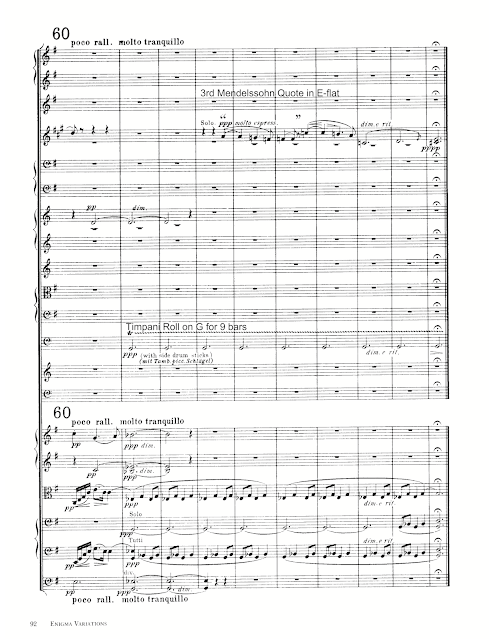
These cipher discoveries are consistent with Elgar’s expertise with coding and decoding secret messages. His passion for that esoteric art is a principal feature of his psychological profile and merits an entire chapter in Unsolved! by Craig P. Bauer. It is exciting to report that further research has unmasked another cryptogram previously unseen and unappreciated lurking among the Mendelssohn fragments within the orchestral score of Variation XIII. This cryptogram is derived from the key letters of each Mendelssohn quotation (A-flat, A-flat, and E-flat), the notes on which the timpani rolls during these quotations (C, C, and G), and the total number of bars that the timpani performs each roll (9, 6, and 9) converted into their corresponding letters in the alphabet (I, F, and I).
The first Mendelssohn quotation is performed by the principal clarinet starting four bars after Rehearsal 56. A timpani roll on C sets the tone for this incipit starting two bars after Rehearsal 56 and continues for nine bars (504-512) before being interrupted by a whole rest one bar before Rehearsal 57. The letter C is a homonym of sea and see. The application of a number-to-letter key to this bar total (9) produces the matching letter I as this is the ninth letter in the alphabet. The combination of the letter I with the key letter of the first Mendelssohn quotation (A) and the note rolled by the timpani (C) produces an anagram of “ICA”. This is a phonetic spelling of the phrase, “I see a . . .” This phonetic decryption is supported by Elgar’s use of inventive spellings in his personal correspondence. For example, he substituted “frazes” for phrasesgorjus” for gorgeous, and xqqq” for excuse. Elgar also employed phonetic spellings in his Enigma Theme Polybius Box Cipher.


The second Mendelssohn quotation is played by the principal clarinet and begins just after Rehearsal 57. Like the first, it is in A-flat major. A timpani roll on C begins at Rehearsal 57 and continues for six bars before stopping at Rehearsal 58. The matching letter in the alphabet for 6 is F. The combination of the letter F with the key letter of the second Mendelssohn quotation (A) and rolled note by the timpani (C) is an anagram of “FAC”. This word appears in the title Elgar’s early motet of the Latin hymn Domine salvam fac. The letters “FAC”present a phonetic spelling of face. The combined decryptions in order of appearance from the first and second Mendelssohn quotations produces the phrase, “I see a face.”


The third Mendelssohn quotation is performed by the principal clarinet in E-flat major starting four bars after Rehearsal 60. A timpani roll on G begins two bars after Rehearsal 60 and continues for nine measures (536-544) to the end of the movement. The conversion of nine to its corresponding letter in the alphabet yields I. The combination of I with the key letter of the third Mendelssohn quotation (E) and the note rolled by the timpani (G) is an anagram of “IEG”. The first two letters are the Latin abbreviation for id est, a phrase that means “that is.” Elgar used that Latin abbreviation in his personal correspondence. The letter G is an initial for both God and Gesù, an Italian spelling for Jesus. Two possible readings of “IEG” are “that is God” and “that is Gesù (Jesus).” Variation XIII is dedicated in secret to Jesus whose initials are transparently enciphered by its Roman numerals. X represents ten. The tenth letter of the alphabet is J. III stands for three.  The third letter of the alphabet is C. The Roman numerals XIII is a coded version of the initials JC.


The key letters of the three Mendelssohn fragments, the notes rolled by the timpani accompaniment, and the bar lengths of these timpani rolls encode three letters for each of the three Mendelssohn quotations. The first Mendelssohn quotation encodes the letter “ICA”, a phonetic version of the phrase “I see a. . .” The second Mendelssohn quotation encodes the letters “FAC”, a phonetic spelling of face. The third Mendelssohn quotation encodes the letters “IEG”. The first two letters (ie) are the Latin abbreviation for id est, a phrase that means “that is.” The third letter G is the initial for God and Gesù (Jesus). The combined decryptions from the three Mendelssohn fragments produce the phrases “I see a face that is God’ and “I see a face that is Gesù (Jesus).” These readings are complementary because Roman Catholicism teaches that Jesus is the physical incarnation of God.
Why would Elgar encipher the phrase “I see a face that is God” in Variation XIII? The answer is provided by a major event in the Roman Catholic Church that transpired five months before Elgar began composing the Enigma Variations. In May 1898, the Italian photographer Secondo Pia took the first official photographs of the Turin Shroud. The photographic negatives revealed a miraculous positive image of the crucified man on the Shroud whose wounds match those described in the gospel accounts. Pia’s photographic negatives became an international sensation in the secular and religious press because they revealed for the first time a lifelike image of the face and crucified body of Jesus. The negative image on the Turin Shroud is miraculous as it predates the invention of photography by more than a millennium.
Other cryptographic evidence from the Variations confirms that Elgar was inspired by the Turin Shroud. For example, the Mendelssohn quotations in Variation XIII encode a reference to the Turin Shroud using an ingenious elimination cipher. When discrete note letters from the three Mendelsson quotations (A, B, C, E, F, G) are used to eliminate matching letters from the title of the covert Theme (Ein fest Burg), the remaining letters form an anagram of TURIN S.


The meaning of the initial S is revealed by the recognition that its remaining letters are shrouded. Vivid red stains of human blood are visible on the Turin Shroud. Remarkably, the performance directions three bars before Rehearsal 61 are an acrostic anagram of red (dim. e. rit.). Four bars after Rehearsal 55 and again after Rehearsal 59, the bass section performs the notes D-E-A-D (dead). The first two melody notes of Variation XIII are G-D, a phonetic spelling of God. To learn more about the secrets of the Enigma Variations, read my free eBook Elgar’s Enigmas ExposedPlease help support and expand my original research by becoming a sponsor on Patreon.

Soli Yah Gloria

About Mr. Padgett

My photo
Mr. Padgett studied violin with Michael Rosenker (a student of Leopold Auer), and Rosenker’s pupil, Owen Dunsford. Mr. Padgett studied piano with Sally Magee (a student of Emanuel Bay), and Blanca Uribe (a student of Rosina Lhévinne). He attended the Stevenson School in Pebble Beach, California, and Vassar College in Poughkeepsie, New York, where he graduated Phi Beta Kappa with a degree in psychology. At Vassar he studied music theory and composition with Richard Wilson. Mr. Padgett has performed for Joseph Silverstein, Van Cliburn, Arnold Schwarzenegger, Maria Shriver, Steve Jobs, Prince Charles, Lady Camilla, Marcia Davenport, William F. Buckley, Jr., and other prominent public figures. His original compositions have been performed by the Monterey Symphony, at the Bohemian Grove, the Bohemian Club, and other private and public venues. In 2008 Mr. Padgett won the Max Bragado-Darman Fanfare Competition with his entry "Fanfare for the Eagles." It was premiered by the Monterey Symphony under Maestro Bragado in May 2008. A member of the Elgar Society, Mr. Padgett is married with five children.