
Though everything else may appear shallow and repulsive, even the smallest task in music is so absorbing, and carries us so far away from town, country, earth, and all worldly things, that it is truly a blessed gift of God.
Edward Elgar in Variation XIII as extraneous to the Enigma Theme, and by extension the whole of the Enigma Variations. This view is fueled by the recognition that they come from an entirely foreign work, Felix Mendelssohn’s Calm Sea and Prosperous Voyage Op. 27. That concert overture is approximately thirteen minutes long, a duration that presents an intriguing parallel with the Roman numerals of Variation XIII. Its original German title — Meeresstille und glückliche Fahrt — is drawn directly from two poems by Goethe that were extremely popular when Mendelssohn composed his programmatic piece. There is a bit of irony in that deceptively serene title because Goethe was an early proponent of the literary movement known as Sturm und Drang which means “storm and drive.” With such an obvious foreign provenance, scholars reason the Mendelssohn fragments in Variation XIII must be unrelated to the covert principal Theme, the “dark saying” mentioned by Elgar in the original 1899 program note, and the secret friend memorialized in Variation XIII. The scholars could not be more wrong.
A contrarian view is raised by Elgar’s decision to superimpose the Mendelssohn fragments over a pulsating ostinato sourced from the Enigma Theme’s palindromic rhythm of alternating pairs of eighth and quarter notes. This rhythmic figure that portrays an undulating sea is composed of harmonic sixths alternating by melodic thirds. This combination of harmonic and melodic intervals encodes the opus number (36) of the Enigma Variations. In a remarkable parallel, Martin Luther composed 36 hymns. This orchestrated mingling of the Enigma Theme’s rhythmic structure with the Mendelssohn fragments raises the possibility of a more nuanced connection between these two outwardly unrelated themes.
The quotations in Variation XIII from Mendelssohn's concert overture Calm Sea and Prosperous Voyage portray a serene and windless sea. Without wind, a sailing vessel becomes stranded in a watery desert. The nautical term for this treacherous condition for sailors is known as the doldrums. It is remarkable that these Mendelssohn quotations are accompanied by a metallic roll on the timpani, a drum. The orchestration of the Mendelssohn quotations subtly captures Elgar’s penchant for wordplay (doldrums vis-à-vis drums).
The cursory impression the Mendelssohn fragments are unconnected to the Enigma Theme is undermined by various factors. First and foremost is the intentional and obvious pairing of these fragments with the Enigma Theme’s rhythmic ostinato. Elgar cautioned in the original 1899 program note, “. . . I warn you that the apparent connexion between the Variations and the Theme is often of the slightest texture . . .” This admonition is not granted sufficient weight by those who casually dismiss any potential links between the Enigma Theme and the Mendelssohn fragments. That no overt associations between the two may be easily spotted does not automatically render them aesthetically or cryptographically misaligned. It is paramount to recognize these fragments are quoted as prominent features of a variation, so this contextually implies they must be in some way related to the Enigma Theme if not also its underlying mysteries. Uncovering those interconnections requires a familiarity with music cryptography, a baffling discipline for legacy scholars.
The Mendelssohn fragments are like a small thread that, when tugged, unravels a much larger tapestry of intersecting musical cryptograms and counterpoints. Far from being extraneous, the Mendelssohn fragments conceal a rich cache of cryptograms that disclose and authenticate the covert melodic Theme and the secret friend memorialized in Variation XIII. A comprehensive survey shows they harbor no less than eighteen cryptograms. These diverse ciphers encode a highly specific set of mutually reinforcing solutions that divulge and authenticate the covert Theme of the Enigma Variations and the secret friend memorialized in Variation XIII. This distinct subset of ciphers is listed below with links to their descriptions and decryptions:
- FAE Cipher
- Mendelssohn FAE Syllables Cipher
- FACE Cipher
- AMF Cipher
- Mendelssohn E.F.B. Cipher
- Mendelssohn Keynotes Cipher
- Mendelssohn Scale Degrees Cipher
- Variation XIII Music Anagram Ciphers
- Mendelssohn Clarinet Solo Nominal Notes Cipher
- Clarinet A Major Key Signature Transposition Cipher
- Mendelssohn Pi Cipher
- Mendelssohn Pi-C Cipher
- Mendelssohn Fragments Melodic Intervals Cipher
- Dual Initials Enigma Cipher
- Romanza Cipher
- Dominant-Tonic-Dominant (5-1-5) Cipher
- “See Abba” Mendelssohn Cipher
- Mendelssohn Fragments Clefs Cipher
These cipher discoveries are consistent with Elgar’s expertise with coding and decoding secret messages. His passion for that esoteric art is a principal feature of his psychological profile and merits an entire chapter in Unsolved! by Craig P. Bauer. It is exciting to report that further research has unmasked another cryptogram previously unseen and unappreciated lurking among the Mendelssohn fragments within the orchestral score of Variation XIII. This cryptogram is derived from the key letters of each Mendelssohn quotation (A-flat, A-flat, and E-flat), the notes on which the timpani rolls during these quotations (C, C, and G), and the total number of bars that the timpani performs each roll (9, 6, and 9) converted into their corresponding letters in the alphabet (I, F, and I).
The first Mendelssohn quotation is performed by the principal clarinet starting four bars after Rehearsal 56. A timpani roll on C sets the tone for this incipit starting two bars after Rehearsal 56 and continues for nine bars (504-512) before being interrupted by a whole rest one bar before Rehearsal 57. The letter C is a homonym of sea and see. The application of a number-to-letter key to this bar total (9) produces the matching letter I as this is the ninth letter in the alphabet. The combination of the letter I with the key letter of the first Mendelssohn quotation (A) and the note rolled by the timpani (C) produces an anagram of “ICA”. This is a phonetic spelling of the phrase, “I see a . . .” This phonetic decryption is supported by Elgar’s use of inventive spellings in his personal correspondence. For example, he substituted “frazes” for phrases, “gorjus” for gorgeous, and “xqqq” for excuse. Elgar also employed phonetic spellings in his Enigma Theme Polybius Box Cipher.


The second Mendelssohn quotation is played by the principal clarinet and begins just after Rehearsal 57. Like the first, it is in A-flat major. A timpani roll on C begins at Rehearsal 57 and continues for six bars before stopping at Rehearsal 58. The matching letter in the alphabet for 6 is F. The combination of the letter F with the key letter of the second Mendelssohn quotation (A) and rolled note by the timpani (C) is an anagram of “FAC”. This word appears in the title Elgar’s early motet of the Latin hymn Domine salvam fac. The letters “FAC”present a phonetic spelling of face. The combined decryptions in order of appearance from the first and second Mendelssohn quotations produces the phrase, “I see a face.”


The third Mendelssohn quotation is performed by the principal clarinet in E-flat major starting four bars after Rehearsal 60. A timpani roll on G begins two bars after Rehearsal 60 and continues for nine measures (536-544) to the end of the movement. The conversion of nine to its corresponding letter in the alphabet yields I. The combination of I with the key letter of the third Mendelssohn quotation (E) and the note rolled by the timpani (G) is an anagram of “IEG”. The first two letters are the Latin abbreviation for id est, a phrase that means “that is.” Elgar used that Latin abbreviation in his personal correspondence. The letter G is an initial for both God and Gesù, an Italian spelling for Jesus. Two possible readings of “IEG” are “that is God” and “that is Gesù (Jesus).” Variation XIII is dedicated in secret to Jesus whose initials are transparently enciphered by its Roman numerals. X represents ten. The tenth letter of the alphabet is J. III stands for three. The third letter of the alphabet is C. The Roman numerals XIII is a coded version of the initials “JC”.
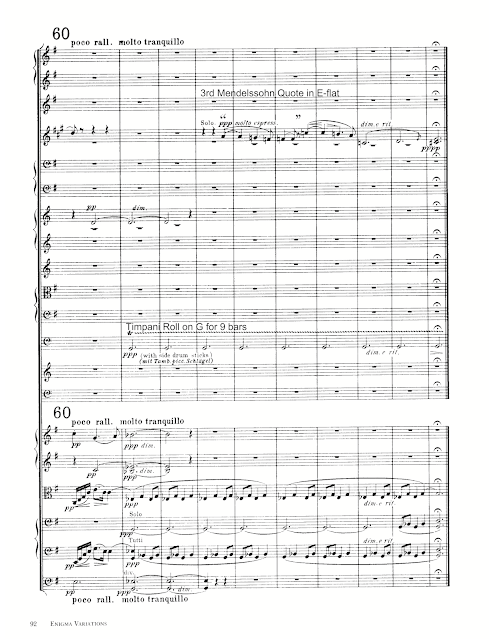
The key letters of the three Mendelssohn fragments, the notes rolled by the timpani accompaniment, and the bar lengths of these timpani rolls encode three letters for each of the three Mendelssohn quotations. The first Mendelssohn quotation encodes the letter “ICA”, a phonetic version of the phrase “I see a. . .” The second Mendelssohn quotation encodes the letters “FAC”, a phonetic spelling of face. The third Mendelssohn quotation encodes the letters “IEG”. The first two letters (ie) are the Latin abbreviation for id est, a phrase that means “that is.” The third letter G is the initial for God and Gesù (Jesus). The combined decryptions from the three Mendelssohn fragments produce the phrases “I see a face that is God’ and “I see a face that is Gesù (Jesus).” These readings are complementary because Roman Catholicism teaches that Jesus is the physical incarnation of God.
Why would Elgar encipher the phrase “I see a face that is God” in Variation XIII? The answer is provided by a major event in the Roman Catholic Church that transpired five months before Elgar began composing the Enigma Variations. In May 1898, the Italian photographer Secondo Pia took the first official photographs of the Turin Shroud. The photographic negatives revealed a miraculous positive image of the crucified man on the Shroud whose wounds match those described in the gospel accounts. Pia’s photographic negatives became an international sensation in the secular and religious press because they revealed for the first time a lifelike image of the face and crucified body of Jesus. The negative image on the Turin Shroud is miraculous as it predates the invention of photography by more than a millennium.
Other cryptographic evidence from the Variations confirms that Elgar was inspired by the Turin Shroud. For example, the Mendelssohn quotations in Variation XIII encode a reference to the Turin Shroud using an ingenious elimination cipher. When discrete note letters from the three Mendelsson quotations (A, B, C, E, F, G) are used to eliminate matching letters from the title of the covert Theme (Ein fest Burg), the remaining letters form an anagram of “TURIN S”.

The meaning of the initial S is revealed by the recognition that its remaining letters are shrouded. Vivid red stains of human blood are visible on the Turin Shroud. Remarkably, the performance directions three bars before Rehearsal 61 are an acrostic anagram of red (dim. e. rit.). Four bars after Rehearsal 55 and again after Rehearsal 59, the bass section performs the notes D-E-A-D (dead). The first two melody notes of Variation XIII are G-D, a phonetic spelling of God. To learn more about the secrets of the Enigma Variations, read my free eBook Elgar’s Enigmas Exposed. Please help support and expand my original research by becoming a sponsor on Patreon.


