Translate

Showing posts with label timpani. Show all posts

Sunday, August 5, 2018

Elgar's Enigma Theme "EFB" Ciphers

Ask, and it shall be given you; seek, and ye shall find; knock, and it shall be opened unto you.
Yeshua quoted in Matthew 7:7 KJV

The tempo marking for the Enigma Theme indicates 63 quarter note beats per minute. It appears on the Master Score as shown below:
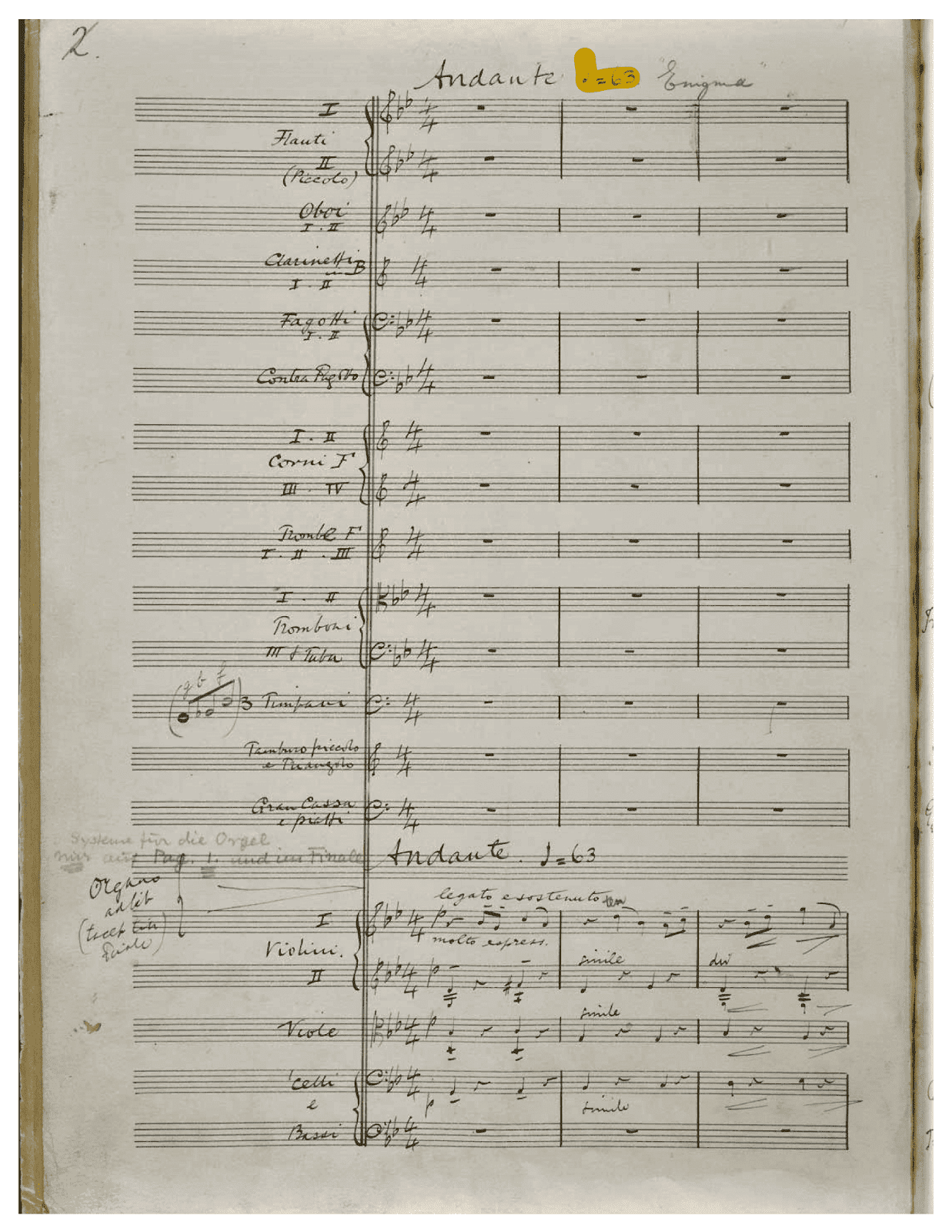

At first glance, this tempo marking seems ordinary enough. However, a lingering question arises as to why Elgar would select an oddly numbered tempo of 63 rather than an even one (pun intended) such as 62 or 64. The variance between tempo markings ranging between 62 and 64 is so minuscule that it remains virtually indistinguishable to the vast majority of listeners. A vigilant examination of the Enigma Theme’s tempo marking reveals that Elgar carefully crafted it to encode the initials for the covert Theme, Ein feste Burg. This comes as no surprise because multiple lines of cryptographic and contrapuntal evidence point to Luther’s famous hymn as the secret melody underlying Elgar’s breakout symphonic tour de force.
The Enigma Theme’s Tempo Marking Cipher is rather simple. Working in reverse, the number three is the mirror image of a capital cursive E. This becomes exceedingly apparent when considered in the context of Elgar’s pliable treatment of this glyph in his Dorabella Cipher, a cryptogram created fifteen months before he first played the Enigma Theme at the piano for his wife in October 1898. The next in the sequence is the number 6. When subjected to a basic number-to-letter key, that numeral converts to its alphabetical equivalent, the letter F. Before the six is the mathematical symbol for equals sign (=). This symbol is comprised of two parallel lines that resemble a sideways rendering of the number two in Roman numerals. In a parallel vein, the term equals has two syllables. Subjecting the number two to a number-to-letter key produces the letter B. In a remarkable confluence, the equals sign is preceded by a quarter note, the mirror silhouette of a lowercase b. Two of the four characters in this cipher mirror the reverse image of the letters that they encode, while the remaining two are decrypted using a number-to-letter key. This leaves the distinct impression of an even, balanced, and deliberate construction.


The initials of Ein fest Burg are encoded in reverse as B, F, and E by the Enigma Theme Tempo Marking Cipher. This inversion of the covert Theme’s initials is significant because research confirms that the covert Theme plays in retrograde “through and over” the Enigma Theme’s nineteen bars. Recall that two of the four characters, namely the 3 and the quarter note, are reverse images of the letters that they encode. This is significant because the letters “FEb” appear twice on the coversheet of the Master Score, and a third time on the last page of the original Finale. In each instance, the F and E are capitalized while the b is lowercase. This corresponds with the decryption of the Enigma Theme’s Tempo Marking Cipher because the 3 is a reverse twin of a capital cursive E favored by Elgar, and the quarter note is a mirror shadow image of a lowercase b.
The Enigma Theme Timpani Tuning Cipher is not an isolated case. There is a second “EFB” cipher on the first page of the Master Score of the Enigma Theme. The tuning for the three timpani drums is shown as g, b, and f. The B is flat, yet is only written as a lowercase b above the actual note (a German convention as documented by Bachs spelling of his name in Die Kunst der Fuge). Two of the three note letters (B and F) are initials from Ein feste Burg. Next to the note f is the number 3, a mirror image of Elgar's capital cursive E associated with his initials. When read from left to right, they appear sequentially as b, f, and 3 (E). This may be interpreted as a coded reference to the initials of the covert Theme in reverse. That is a remarkable observation because extensive research documents that Ein feste Burg plays in retrograde through and over the Enigma Theme. This cryptogram is known as the Enigma Theme Timpani Tuning Cipher.


This is not the only cipher in the Enigma Variations that is constructed from the tuning directions for the timpani. The tuning of the timpani for Variation IX Nimrod is shown as E flat, B flat, and F. It is remarkable that these note letters are an anagram of the covert Theme’s initials. Those three notes cover the range of two perfect fifths, a coded reference to Elgar’s initials as E is the fifth letter of the alphabet. The Nimrod Timpani Cipher is positioned at Rehearsal 33, and those two threes are another thinly encrypted form of the composer’s initials. Like many other cryptograms in the Enigma Variations, Elgar cleverly initialed his work for posterity to unseal at the appropriate time. That time is now. Indeed, there are over 60 cryptograms in the Enigma Variations that encipher the solutions to the paramount riddles posed by the Enigma Variations. To learn more about the secrets of the Enigma Variations, read my free eBook Elgar’s Enigmas ExposedPlease help support and expand my original research by becoming a sponsor on Patreon.


Thursday, August 29, 2013

Elgar's "EFB" Ciphers

The Tower of London.
You are not only responsible for what you say, but also for what you do not say. 

A thorough investigation of the Enigma Variations by Edward Elgar uncovered a cornucopia of cryptograms, and it is highly probable there are even more awaiting to be detected and decrypted. These secret codes are incredibly important because they encode the answers to Elgar’s sphinxian riddles. What is the secret melody behind the Enigma Theme? What is the secret dark saying hidden ensconced within the Enigma Theme? Who is the secret friend portrayed in Variation XIII? The covert principal Theme is Ein feste Burg (A Mighty Fortress), the famous Reformation hymn by Martin Luther. No one would ever guess a Roman Catholic composer like Elgar would surreptitiously quote the battle hymn of the Reformation, a piece composed by a heretic excommunicated by the Pope. The Enigma Theme’s dark sayingis an incredibly ingenious Music Box Cipher. The secret friend portrayed in Variation XIII is Jesus Christ, the Lord of Elgar’s Roman Catholic faith. A discreet subset of these ciphers identifies the Turin Shroud, the most studied religious artifact in history that is believed to be the burial cloth of Christ.


The Nimrod Timpani Cipher
 
There are at least seventeen ciphers that encode the letters EFB, the initials for the covert Theme (Ein feste Burg). The first is the Enigma Theme Keys Cipher. The second is the Enigma Theme Tempo Marking Cipher. The third is the Enigma Theme Timpani Tuning Cipher. The fourth is the Enigma Theme Clefs Cipher. The fifth is the Enigma Theme Relative Modes Cipher. The sixth is the Nimrod Timpani Cipher in which the tuning for the three timpani drums for Variation IX is indicated as E-flat, B-flat, and F.
The seventh is the FAE Cipher in Variation XIII. The eighth is the Letter Cluster Cipher in the titles for Variations XII and XIV. The ninth is the Enigma Date Cipher at the end of the original score. The tenth is the Dominant-Tonic-Dominant (5-1-5) Cipher embedded in the Mendelssohn fragments of Variation XIII. The eleventh is the Cover Page Cipher where Elgar traced a box and wrote the letters FEb not once, but twice, on the original cover page of the Enigma Variations.
The twelfth is the Enigma Date Cipher appearing on the final page of the original Finale where Elgar wrote FEb for a third time. The thirteenth is the Enigma Variations Key Numbers Cipher. The fourteenth is the Mendelssohn Melodic Intervals Cipher. The fifteenth is the Clarinet Mendelssohn Solo Nominal Notes Cipher. The sixteenth is the Clarinet Key Signature Transposition Cipher in Variation XIII. The seventeenth is the Extended Finale Acrostic Anagram Cipher. With so many ciphers encoding the identical set of initials, it would be ridiculous to insist they could collectively be the product of coincidence or contrivance.

Cover Page to the Enigma Variations (Autograph Score)

Original ending to the Enigma Variations (Autograph Score)

The interrelated decryptions of the Enigma Variations Ciphers are mutually consistent and reinforcing, erecting an elaborate yet rational set of solutions to one of musicology’s enduring mysteries. With so many ciphers pinpointing the same answers, there is no room for doubt. The ciphers are genuine, and on that basis, we may be confident that the answers they encode are true and accurate. These solutions to Elgar’s enigmas are highly unpalatable to secular scholars like Julian Rushton who reflexively attribute them to coincidence, confirmation bias, and even contrivance. Ultimately the only thing that is contrived is Rushtons vacuous and flawed objections. Like the Bible they routinely disparage, academics contend the Enigma ciphers and their decryptions must all be concocted in some elaborate ruse to misinform and mislead rather than to enlighten and guide. If the ciphers are merely the product of an overactive or determined imagination, how then does one account for their precise and consistent solutions? The secret melody to the Enigma Variations is Ein feste Burg by Martin Luther. The secret friend of Variation XIII is Jesus Christ, Elgar’s inspiration behind not only the Enigma Variations but also his sacred oratorios (The Light of LifeThe Dream of GerontiusThe Apostles, and The Kingdom) and Violin Concerto in B minor. To learn more about the secrets of the Enigma Variations, read my free eBook Elgar’s Enigmas Exposed.  Please help support and expand my original research by becoming a sponsor on Patreon.


Elgar's Enigma Variations Title Anagram Ciphers


About Mr. Padgett

My photo
Mr. Padgett studied violin with Michael Rosenker (a student of Leopold Auer), and Rosenker’s pupil, Owen Dunsford. Mr. Padgett studied piano with Sally Magee (a student of Emanuel Bay), and Blanca Uribe (a student of Rosina Lhévinne). He attended the Stevenson School in Pebble Beach, California, and Vassar College in Poughkeepsie, New York, where he graduated Phi Beta Kappa with a degree in psychology. At Vassar he studied music theory and composition with Richard Wilson. Mr. Padgett has performed for Joseph Silverstein, Van Cliburn, Arnold Schwarzenegger, Maria Shriver, Steve Jobs, Prince Charles, Lady Camilla, Marcia Davenport, William F. Buckley, Jr., and other prominent public figures. His original compositions have been performed by the Monterey Symphony, at the Bohemian Grove, the Bohemian Club, and other private and public venues. In 2008 Mr. Padgett won the Max Bragado-Darman Fanfare Competition with his entry "Fanfare for the Eagles." It was premiered by the Monterey Symphony under Maestro Bragado in May 2008. A member of the Elgar Society, Mr. Padgett is married with five children.