Translate

Showing posts with label retrograde. Show all posts

Friday, June 12, 2026

Elgar’s Enigma Theme with “Ein feste Burg”

Möbius Strip with music tape for a 15-note music box

Amidst the worldly comings and goings, observe how endings become beginnings.

A veritable phalanx of ciphers authenticates Ein feste Burg (A Mighty Fortress) by Martin Luther as the covert principal Theme of Edward Elgar’s Enigma Variations. Precisely how that martial melody plays “through and over” the Enigma Theme has been the subject of intense and prolonged deliberation. It was initially suspected that a precise horizontal fit between both themes would be sufficient to substantiate this discovery, yet the absence of a credible counterpoint raised legitimate doubts about that melodic mapping. An alternative approach mapped Ein feste Burg over the Enigma Theme by applying free rhythm and varying its phrase order, producing a more credible vertical contrapuntal match. Even so, that mapping was greeted by some with skepticism. These and other questions fueled an ongoing reassessment, one that has now yielded a definitive mapping of Ein feste Burg above the Enigma Theme by applying a rarely used contrapuntal device: retrograde motion. Before presenting this contrapuntal solution, let us consider two crucial breakthroughs that precipitated that epiphany.

The first key insight concerns just how far Elgar’s counterpoint actually extends. The conventional wisdom, as expressed by Dr. Clive McClelland, holds the counterpoint goes no further than the first six measures of the Enigma Theme, Section A of its ABA’ ternary structure. The problem with that presumption is that it contradicts Elgar’s published position regarding the Enigma Theme’s actual length. In the late 1920s, he provided descriptive notes for a set of Aeolian Company pianola rolls issued in 1929. Regarding Variation I, he advised, “There is no break between the theme and this movement.” That disclosure is critical because it confirms that the Enigma Theme does not terminate until Variation I begins. As the first iteration of the Enigma Theme begins in bar 20, this must mean that the analytical scope of any contrapuntal mapping must cover bars 1–19.


Based on his published statement, Elgar did not consider the bridge in measures 18 and 19 to be part of Variation I (something deceptively implied by the layout of the published score), but rather an elaboration of the Enigma Theme’s ending. A conspicuous tie between the notes of measures 17 and 18 validates this observation, linking the Enigma Theme and bridge in a manner not seen with Variation I. The bridge serves to unwind the Picardy cadence and return the harmony to the minor mode. Relying on Elgar’s published position, any credible melodic mapping of the covert principal Theme must not only account for the Enigma Theme’s ternary ABA’ structure in measures 1 through 17, but also the two-bar bridge (section C) in measures 18 and 19 that precede the launch of Variation I. In recognition of this fact, all proposed melodic solutions that neglect any part of Enigma Theme’s ABA’C structure may be safely ruled invalid. This preclusion applies to the usual suspects as well as a proliferation of attempted “solutions” featured in Wikipedia’s article on the Enigma Variations.


My Friends Pictured Within by Elgar: Variation I. (C. A. E.)

The second breakthrough was the recognition that at various points throughout the Enigma Variations, Elgar places a coded emphasis on the ending phrase of Ein feste Burg. For instance, at Cue 68 in the Finale, that ending phrase is stated as a counterpoint to the opening of the Enigma Theme. The first four notes of that ending phrase appear at the beginning of the countermelody in the bass staff, and the remaining six emerge two bars later. This bifurcation of the ending phrase into four and six-note fragments alludes to “46,” the chapter from the Psalms that inspired Martin Luther to compose his most famous hymn. The four-note fragment also corresponds to the four-note melodic quotations in Variation XIII from Felix Mendelssohn’s concert overture Calm Sea and Prosperous Voyage (Meeresstille und glückliche Fahrt).


The pairing of the covert Theme’s ending phrase with the Enigma Theme’s beginning prompted a meticulous reassessment of the latter. On closer inspection, it was found that the first six notes of the Enigma Theme’s bass line state the last six notes of the covert Theme’s concluding phrase in reverse order.


This notable correspondence raises the very real prospect that Elgar composed his counterpoint with the unstated principal Theme in retrograde. This would mean that rather than mapping out the missing melody forwards as everyone would naturally expect, Elgar adopted the opposite tactic by crafting his counterpoint with the absent theme played backward. The Enigma Theme’s ABA’C structure subtly hints at this prospect because when read phonetically, “ABAC” sounds like aback. That term was originally used to describe the moment when a ship’s sails are blown backward into the mast. In present usage, it refers to being taken by surprise. Both definitions — “backward” and “by surprise” — exquisitely express Elgar’s mapping of the covert principal Theme in retrograde over the Enigma Theme, and are entirely consistent with his well-documented fondness for wordplay.

The structure of the Enigma Theme hints at the strategy Elgar deployed to foil straightforward attempts at decoding his counterpoint. According to Kent Kennan, Professor Emeritus of Music at the University of Texas at Austin, retrograde motion is rarely encountered in fugal writing. That Elgar was openly contemplating various contrapuntal techniques is reflected by the fact that on an early sketch of the Enigma Theme, he wrote the phrase “for fuga” above the first bar. Fuga means fugue in Italian and Latin. Considering the relative scarcity of retrograde counterpoint, mapping the covert principal Theme in this manner would be an extraordinarily effective ploy to foil detection. The combination of retrograde motion and free rhythm presents a robust, multilayered strategy for concealing the principal Theme from straightforward detection.

At the conclusion of the extended Finale, Elgar cites a passage by Henry Wadsworth Longfellow from his Elegiac Verse: “Great is the art of beginning, but greater the art is of ending.” That literary fragment affirms the supremacy of the ending over the beginning — a principle reasserted by the coded recognition that the ending phrase of Ein feste Burg marks the beginning rather than the end of Elgar's counterpoint with the Enigma Theme via retrograde motion. The key to unraveling Elgars enigma is to begin at the end and work backward to the beginning.

After determining the scope of Elgar’s counterpoint and the potential of mapping the hidden melody from end to beginning, a new mapping of Ein feste Burg in retrograde over all nineteen measures of the Enigma Theme was completed. Starting at the end of the bridge (Bar 19), Ein feste Burg is played backward to the beginning with the reverse phrase order of BFEDCBA. It is intriguing that the opening three phrases spell “BFE,” a mirror of “EFB,” the acronym of Ein feste Burg. The ending phrase (B) appears at both the opening and final cadence of the Enigma Theme, while the opening phrase (A) is deftly inserted over the bridge. This mapping mirrors the minor and major modes employed by Elgar to obfuscate the key of the hidden Theme. An audiovisual demonstration of this contrapuntal mapping supports the efficacy of this solution.


The version of Ein feste Burg used in Elgar’s retrograde counterpoint is drawn from multiple sources. A side-by-side comparison of Luther’s original composition with iterations by Bach and Mendelssohn reveals that Elgar incorporated elements of all three to assemble his hidden source melody.


When combined with retrograde counterpoint, this “tribrid” theme was undoubtedly devised to complicate detection and decryption while paying homage to three paragons of the German School. The phrase-by-phrase sourcing is as follows:

  1. Phrase A (measures 17–19): sourced from Mendelssohn’s more austere version, characterized by rising and falling thirds — an attribute endemic to the A phrase of the Enigma Theme itself.
  2. Phrase B (measures 14–16): bears the melodic imprimatur of Luther’s original hymn.
  3. Phrase C (measures 12–14): matches both Bach’s and Mendelssohn’s versions, which are virtually indistinguishable from one another.
  4. Phrase D (measures 10–11): reflects Luther’s original as well as Mendelssohn's faithful replica.
  5. Phrase E (measures 9–10): based on Mendelssohn’s more florid adaptation.
  6. Phrase F (measures 6–8): corresponds with Bach’s rendering.
  7. Phrase B (measures 1–5): corresponds with Bach’s rendering.

A systematic compilation of shared melody and harmony notes between Ein feste Burg and the Enigma Theme was conducted. Notes shared between both melodies are represented by diamond-shaped noteheads and classified as melodic conjunctions. Notes shared between the melody of Ein feste Burg and non-melodic harmony notes in the Enigma Theme's short score are represented by triangular noteheads and classified as harmonic conjunctions. Both melodic and harmonic conjunctions must sound simultaneously to qualify as a match.


The retrograde mapping documents 31 shared melody notes between Ein feste Burg and the Enigma Theme. Melodic conjunctions are present in bars 1-3, 5, 7-10, 12-16, 18, and 19, for a total of 15 out of 19 measures or nearly 80% of the movement. There are seven note types with frequencies ranging from 2 to 8, the tonic G and dominant D being the most prevalent.

There are 45 harmonic conjunctions between Ein feste Burg and the short score of the Enigma Theme for an average of 2.4 per measure. Ten shared note types have frequencies ranging from 1 to 13, the dominant D being the most common. The combined total of melodic and harmonic conjunctions is 76, covering 40 out of a total of 50 melody notes from Ein feste Burg. Remarkably, the total number of melody notes in the Enigma Theme across all 19 bars is 88 — precisely the number of keys on a standard piano keyboard. Furthermore, 80% of the melody notes from the covert Theme are embedded sequentially into the melody and harmony of the Enigma Theme.


Conclusion

The preponderance of the evidence outlined in the above Figures and Tables demonstrates that the Enigma Theme is a clear and convincing counterpoint to Ein feste Burg in retrograde. The contrapuntal mapping documented in Figure 6 reveals a relationship of remarkable depth and consistency. Thirty-one melodic conjunctions confirm that the melody of Ein feste Burg in reverse aligns directly with the uppermost voice of the Enigma Theme across 15 of its 19 measures. Forty-five harmonic conjunctions establish that the covert theme is embedded still more pervasively in the inner voices and bass, with harmonic support present across every measure of the movement without exception. That harmonic conjunctions outnumber melodic conjunctions is entirely consistent with a deliberate strategy to obfuscate the principal Theme beneath the harmonic texture of the score, where it would resist detection by the casual listener and analyst alike. Together, these 76 melodic and harmonic conjunctions account for 40 of the 50 melody notes of Ein feste Burg in retrograde — a sequential coverage rate of 80% that far exceeds what random coincidence or the casual application of free rhythm could plausibly produce.

Every bar containing a melodic conjunction is simultaneously reinforced by harmonic support, reflecting a compositional discipline consistent with deliberate design. The hidden source melody itself is a unique "tribrid" construction, assembled from complete phrases drawn from three distinct versions of Ein feste Burg — those of Luther, Bach, and Mendelssohn — fused into a single composite whole. Such a strategy is redolent of Ecclesiastes 4:12, “A cord of three strands is not quickly broken.” That Elgar wove together three strands from the German School into a single covert theme, then concealed it in retrograde within the very movement that introduces one of his most celebrated orchestral works, suggests the musical architecture carries profound personal and spiritual significance. In his original 1899 program note, Elgar advised that the solution to the Enigma Theme “must be left unguessed.” That carefully chosen phrase implies that the answer cannot be uncovered by random speculation or intuition alone, but only through systematic decryption. Like a fortress, a cipher secures and conceals. Of all the cryptograms embedded in the Enigma Variations, none is more audacious than the one hiding as a retrograde counterpoint at the threshold of the work itself.

To learn more about the secrets of the Enigma Variations, read my free eBook Elgar’s Enigmas Exposed. Please help support and expand my original research by becoming a sponsor on Patreon.

Thursday, May 25, 2023

Elgar’s “RX EFB ” Cipher: A Prescribed Solution

During railway journeys amuses himself with cryptograms; solved one by John Holt Schooling who defied the world to unravel his mystery.
Robert J. Buckley in his biography Sir Edward Elgar (1905)

It is fifty years since you, in Regent Street, purveyed five violin pieces to a “prescription” by Pollitzer for me. I remember the pride & pleasure I had in presenting the “order”.
Elgar in a letter to Charles Volkert, the head of Shott Music (May 30, 1927)

The late romantic composer Edward Elgar excelled in cryptography, the science of coding and decoding secret messages. His obsession with that esoteric discipline merits an entire chapter in Craig P. Bauer’s book Unsolved! Bauer devotes much of the third chapter to Elgar’s meticulous decryption of an allegedly insoluble Nihilist cipher presented by John Holt Schooling in the April 1896 issue of The Pall Mall Magazine. A Nihilist cipher is based on a Polybius square key. Elgar was so gratified by his solution to Schooling’s purportedly impenetrable code that he specifically mentions it in his first biography released by Robert J. Buckley in 1904.
Elgar painted his decryption in black paint on a wooden box, an appropriate medium considering that another name for the Polybius square is a box cipher. His process for cracking Schooling’s cryptogram is summarized on a set of nine index cards. On the sixth card, Elgar likens the task to “. . . working (in the dark).” It is significant that he used the word “dark” as a synonym for cipher.


This parenthetical remark is revealing as he employs that same language in the original 1899 program note to characterize his eponymous Enigma Theme. It is an oft-cited passage that deserves revisiting as Elgar lays the groundwork for his tripartite riddle:
The Enigma I will not explain – its ‘dark saying’ must be left unguessed, and I warn you that the connexion between the Variations and the Theme is often of the slightest texture; further, through and over the whole set another and larger theme ‘goes’, but is not played . . . So the principal Theme never appears, even as in some later dramas – e.g., Maeterlinck’s ‘L’Intruse’ and ‘Les sept Princesses’ – the chief character is never on the stage.
Elgar uses the words dark and secret interchangeably in a letter to August Jaeger penned on February 5, 1900. He wrote, “Well—I can’t help it but I hate continually saying ‘Keep it dark’—‘a dead secret’—& so forth.” One of the definitions for dark is “secret,” and a saying is a series of words that form a coherent phrase or adage. Elgar’s odd expression — “dark saying” — is coded language for a cipher. In an oblique manner, Elgar hints there is a secret message enciphered by the Enigma Theme.
A compulsion for cryptography is a reigning facet of Elgar’s psychological profile. A decade of systematic analysis of the Enigma Variations has netted over a hundred cryptograms in diverse formats that encode a set of mutually consistent and complementary solutions. Although this figure may seem astronomical, it is entirely consistent with Elgar’s fascination for ciphers. More significantly, their solutions provide definitive answers to the core questions posed by the Enigma Variations. What is the secret melody to which the Enigma Theme is a counterpoint and serves as the melodic foundation for the ensuing movements? Answer: Ein feste Burg (A Mighty Fortress) by the German protestant reformer Martin Luther. What is Elgar’s “dark saying” concealed within the Enigma Theme? Answer: A musical Polybius cipher situated in the opening six bars. Who is the secret friend and inspiration behind Variation XIII? Answer: Jesus Christ, the Savior of Elgar’s Roman Catholic faith.
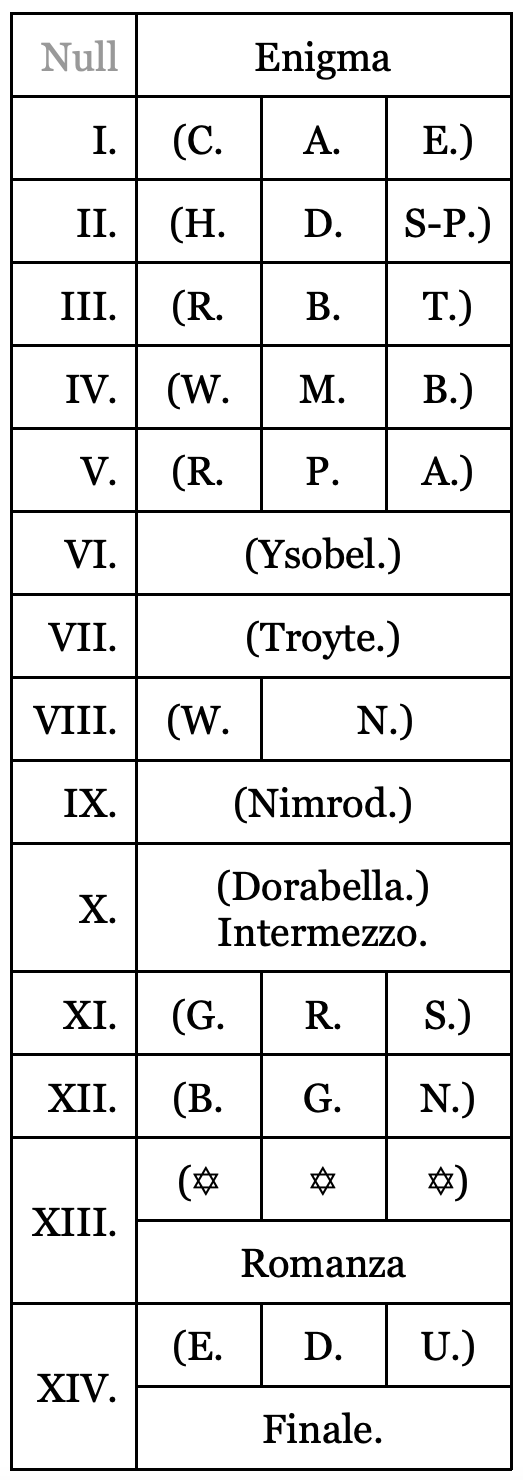
The initials of Elgar’s secret friend are transparently encoded by the Roman numerals of Variation XIII using an elementary number-to-letter key (1 = A, 2 = B, 3 = C, etc.). “X” is the Roman numeral for ten. The tenth letter of the alphabet is J. “III” represents three, and the third letter is C. This cryptanalysis shows that the Roman numerals XIII are a coded form of “JC,” the initials for Jesus Christ. This is not an isolated instance of this encipherment technique in the Enigma Variations. Elgar uses the same number-to-letter key to encode August Jaeger’s initials in Variation IX (Nimrod). “I” is the Roman numeral for one. The first letter of the alphabet is A. “X” stands for ten, and the tenth letter is J.
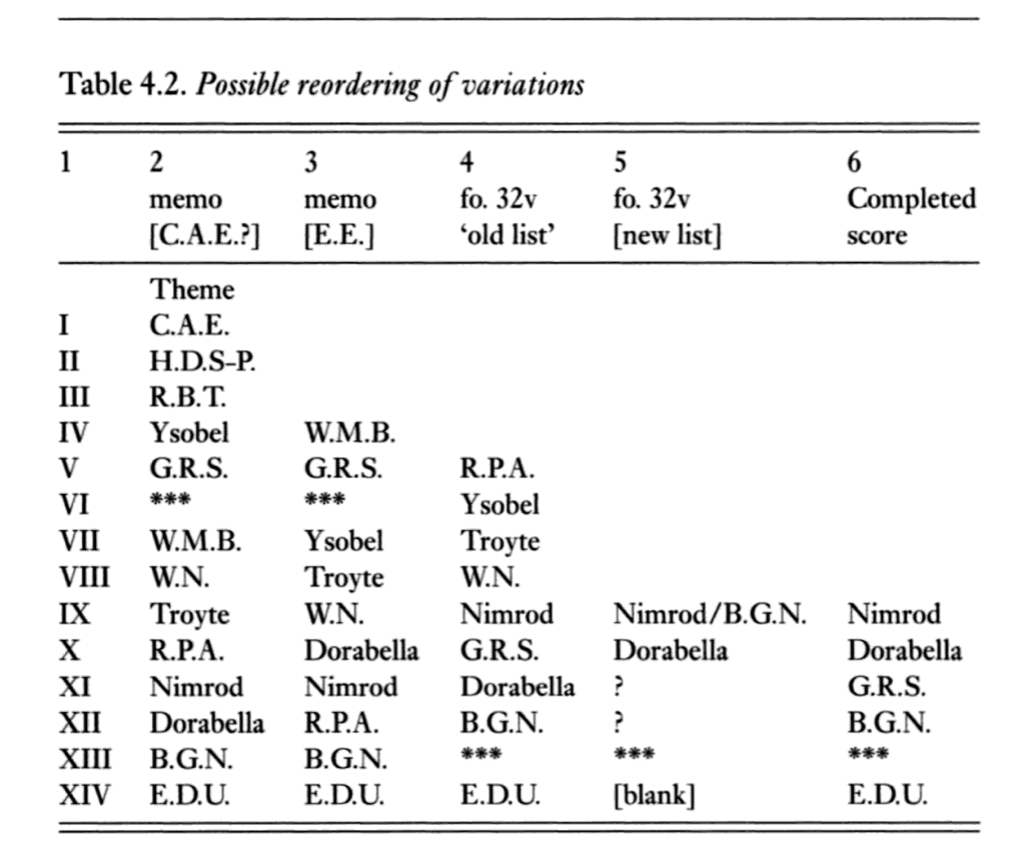
With the secret friend’s initials thinly disguised by the Roman numerals of Variation XIII, what could be the significance of its cryptic title consisting of three hexagrammatic asterisks (✡ ✡ ✡)? That question was resolved in July 2013 by the discovery of the Letters Cluster Cipher, a cryptogram that reveals the three asterisks represent the initials of Elgar’s mysterious missing melody. Those absent initials are encoded by the first letters from the titles of the adjoining movements: Variations XII (B.G.N.) and XIV (E. D. U., and Finale). These first letters are an acrostic anagram of “EFB,” the initials for Ein Feste Burg. Elgar deftly frames the question posed by the three asterisks with the answer hidden in plain sight. This is one of many instances of Elgar encoding information using proximate title letters.


Elgar’s sketches document five lists of the movements for the Enigma Variations. The discovery of the Letters Cluster Cipher verifies that these divergent lists were generated to construct that particular cryptogram. This prospect eluded scholars like Julian Rushton who naively insist Elgar lacked the time to construct any ciphers. Rushton’s speculative rush to judgment is unsupported by the known timeline. Elgar began composing the Enigma Variations in earnest on October 21, 1898. The orchestration was completed on February 19, 1899. From inception to completion, the process consumed 121 days or four months. Such a lengthy period afforded more than ample time and opportunity for Elgar to indulge his passion for cryptography.


By proffering the false supposition that there was insufficient time for Elgar to devise any cryptograms within the Enigma Variations, scholars like Julian Rushton relieve themselves of the obligation to mount a systematic search for ciphers. The inevitable result is an absence of evidence that is myopically misconstrued as proof that there are no ciphers to detect or decrypt. The decision to preemptively rule out the possibility that Elgar incorporated ciphers in the Enigma Variations is a transparent case of confirmation bias.


The acrostic anagram “EFB” from the titles of Variations XII and XIV that encodes the initials of Ein feste Burg is an elementary cryptogram called the Letters Cluster Cipher. Its discovery precipitated a broader analysis of the Enigma Variations’ titles with the goal of uncovering other meaningful and relevant groupings of proximate title letters. This approach is markedly dissimilar from Stephen Pickett’s surgical cherry-picking of single initials from titles and names to assemble a purported solution for the absent Theme. My investigation uncovered words linked to the absent Principal Theme, the Enigma’s “dark saying,” and the secret friend. The Letters Cluster Cipher proved to be the tip of a much larger iceberg of coded information. This assessment uncovered thirty-six cryptograms embedded within the titles of the Enigma Variations. One of the most sophisticated is formed by title letters from the opening four movements and encodes “PIE CHRISTI ABIDE” (Pious Christ Abide).


The “RX EFB” Anagram Cipher
Further analysis identified the acrostic anagram “RX” in the title of Variation XIII. As the ensuing discussion will show, the context of this “RX” anagram cipher presents stunning ramifications about Elgar’s prescription of Ein feste Burg as the covert Theme and its unusual contrapuntal treatment.


Rx is the transliteration of ℞, a pharmaceutical symbol used by physicians and pharmacists for medical prescriptions. The right leg of the capital R is crossed to indicate it is an abbreviation of the Latin verb recipe (“take thou”). Rx first appeared in 16th century manuscripts. Copious examples abound in Dr. William Salmon's book Pharmacopœia Bateana published in London in 1720. Dr. Otto Augustus Wall documents the origin and use of the Rx symbol for medical prescriptions in his 1890 book The Prescription. His textbook affirms that doctors and pharmacists used the Rx abbreviation for medical prescriptions in the 1890s when Elgar composed the Enigma Variations. As a therapeutic or corrective agent, a prescription is a remedy for a particular ailment. In this context, Elgar’s prescription identifies the melodic remedy for his contrapuntal malady.

Rx with mortar and pestle

The merger of the title letters anagrams “RX” and “EFB” from the concluding three movements of the Enigma Variations produce the larger anagram “RX EFB.” As previously noted, “RX” means “take thou.” “EFB” is the initials for Ein feste Burg. Based on this interpretation, “RX EFB” may be read as the statement “Take thou Ein feste Burg.” Elgar’s prescription for solving the enigma of the absent principal Theme is ingeniously encoded by an acrostic anagram drawn from the sequential titles of Variations XII, XIII, and XIV. Like the majority of the titles from the Enigma Variations, the solution consists of varying sets of initials.


The association of “RX” with the absent Theme’s initials “EFB” cleverly hints that the composer of the absent Theme was a doctor. A prescription is issued by a doctor, a title awarded to Luther who was routinely addressed in conversation and official correspondence as “Dr. Martin Luther.” In a stunning parallel, a string of letters threaded through the titles of Variations II through VIII spells out “DR MARTIN” with the last name absent. None of the titles use the capital letter L, precluding the possibility of encoding Luther. The initials “DR” are obtained from Variations II (H. D. S-P.) and III (R. B. T.). The letters for “MARTIN” come from Variations IV (W. M. B.), V (R. P. A.), VI, VII (Troyte), and VIII (W. N.). The proximate title anagram “DR MARTIN” is a massive clue about the composer of the hidden melody. 


In addition to its application in medicine, Rx is used in astrology as the abbreviation for the Latin word retrogradus meaning backward. Placing Rx after the symbol for a particular planet indicates that it is moving in retrograde motion. An example of this convention appears on page 15 of the 1881 book The Science of the Stars by Alfred J. Pearce published in London. In this illustration, the symbol for Mars is followed by Rx to specify that it is in retrograde.


Elgar hints at an astronomical context for his “RX” cipher by displaying three conspicuous stars in the title of Variation XIII. When the anagram “RX EFB” is reversed as “EFB RX,” it may be decoded as “Ein feste Burg in retrograde.” A melody that is played backward is described as being in retrograde. Prior research determined that Elgar mapped Ein feste Burg backward above the Enigma Theme as a retrograde counterpoint. The acrostic anagram “EFB RX” is verified by the discovery that Elgar plotted the course of Ein feste Burg in reverse “through and over” the Enigma Theme.
In his essay Measure of a Man: Catechizing Elgar’s Catholic Avatars, Charles McGuire confirms that Elgar attended three Roman Catholic schools between 1863 and 1872.
Elgar began his education in 1863 and over the course of the next few years attended three distinctly different types of schools: a Dame school primarily for girls, a mixed school at Spetchley Park; and, from about 1869 to 1872, a school for young gentlemen at Littleton House. All three schools were Catholic, and all three emphasized elements of religion over all other subjects—at least according to the evidence that has survived. 
During this period, the Tridentine Mass was recited in Latin. For this reason, students like Elgar were required to study Latin as part of their religious education. As a student of Latin, Elgar was undoubtedly familiar with the Latin terminology associated with the Rx symbol.
Elgar was a voracious reader with a detailed knowledge of subjects through the 18th century. He recounted his reading materials and habits for an interview published by The Strand Magazine in May 1904:
I had the good fortune to be thrown among an unsorted collection of old books. There were books of all kinds, and all distinguished by the characteristic that they were for the most part incomplete. I busied myself for days and weeks arranging them. I picked out the theological books, of which there were a great many, and put them on one side. Then I made a place for the Elizabethan dramatists, the chronicles including Barker’s and Hollinshed’s, besides a tolerable collection of old poets and translations of Voltaire and all sorts of things up to the eighteenth century. Then I began to read. I used to get up at four or five o’clock in the summer and read—every available opportunity found me reading. I read till dark. I finished reading every one of those books—including the theology. The result of that reading has been that people tell me that I know more of life up to the eighteenth century than I do of my own time, and it is probably true.
Elgar’s exposure to a diverse array of literary sources likely acquainted him with the use of the Rx symbol in medicine and astrology.

Summation
Elgar learned the Latin terms associated with the Rx symbol when he studied Latin at three Roman Catholic schools between 1863 and 1872. His extracurricular reading materials and habits would have further exposed him to the use of that symbol in medicine and astrology. Adjacent title letters from the last three movements of the Enigma Variations form the acrostic anagram “RX EFB.” The Rx symbol is an abbreviation of the Latin word recipe (“take thou”) employed by physicians and pharmacists to instruct patients to “take” a particular therapeutic drug or cure. Published records document that this symbol first emerged in the 16th century and entered common usage long before Elgar conceived of the Enigma Variations in 1898-99. The initials “EFB” are those for Ein feste Burg, the covert Theme of the Enigma Variations. Armed with these insights, the acrostic anagram “RX EFB” may be expanded to read as “Take thou Ein feste Burg.” This coded remedy is Elgar’s prescription for resolving or “curing” his contrapuntal conundrum.
Elgar’s pairing of “RX” with the initials “EFB” cleverly implies that the composer of the missing principal Theme was a doctor. The author of Ein feste Burg was addressed as “Dr. Martin Luther” in conversation and letters. Remarkably, contiguous title letters in Variations II through VIII spell out “DR MARTIN” with his last name omitted. This remarkable title letters anagram furnishes a revealing clue about the composer of the absent Theme. As the leader of the German Reformation, Dr. Luther offered many prescriptions for the ills that plagued the Roman Catholic Church.
Rx is also applied in astrology as the abbreviation of retrogradus, the Latin word for retrograde. An astronomical context is implied by Elgar’s use of three stellar asterisks (✡ ✡ ✡) as the nebulous title for Variation XIII. Reshuffling the acrostic anagram “RX EFB” as “EFB RX” permits the remarkable decryption “Ein feste Burg in retrograde.” This solution is affirmed by the discovery that Elgar mapped the covert Theme backward as a retrograde counterpoint above the Enigma Theme. The precision and specificity of these decryptions are absolutely stunning. To learn more about the secrets of the Enigma Variations, read my free eBook Elgar’s Enigmas Exposed. Please help support and expand my original research by becoming a sponsor on Patreon.


Wednesday, May 5, 2021

Another Piece Of Elgar's Retrograde Puzzle

Your course as a candidate was perfectly clear. You took your canto fermo and on it built several species, and several cunning mixtures of species, of strict counterpoint. You took your fugal theme, and having to treat it tonally or otherwise, a vital point, you wrote your exposition, your episodes, your stretto and your pedal, by no means forgetting your augmentation and your diminution, and particularly remembering that while consecutive fifths meant relegation to the darkest depths of Tartarus, no university professor could resist the magic of a canon cancrizans, say in the Hypomixolydian mode.
Robert J. Buckley in Sir Edward Elgar (1905)

The British composer Edward Elgar composed his orchestral Enigma Variations in 1898-99. That masterpiece transformed his reputation from a provincial itinerant music teacher to a world-class composer. The Enigma Variations is a riddle in three parts:
  1. An absent principal Theme
  2. “dark saying” in the Enigma Theme, and
  3. secret friend commemorated in Variation XIII.
Elgar advised the Enigma Theme is a counterpoint to a famous melody that is not heard yet plays “through and over” the set of Variations. The search for that absent tune spawned a speculative frenzy that continues unabated to this day. No purported melodic solution has ever gained widespread acceptance because scholars claim Elgar took his secret to the grave in February 1934. Even if the correct tune was proposed, the conventional wisdom insists there is no viable way to authenticate it.
Musicologists presume Elgar never wrote down the answer for posterity to discover. That presumption fails to take into account his lifelong obsession for cryptography. Elgar’s fascination for ciphers merits an entire chapter in Craig P. Bauer’s treatise Unsolved! The bulk of its third chapter is devoted to Elgar’s meticulous decryption of an allegedly insoluble Nihilist cipher presented by John Holt Schooling in the April 1896 issue of The Pall Mall Magazine. That particular cryptogram is a derivative of the Polybius square. Elgar was so delighted with his solution to Schooling’s reputedly impenetrable code that he brags about cracking it in his first biography published in 1905. Those inclined to downplay Elgar’s expertise in cryptography are urged to consult the third chapter of Bauer’s book.
The recognition of Elgar’s cryptographic expertise raises the prospect that he encoded the solutions to the Enigma Variations within the score. A decade of concerted analysis has netted over ninety cryptograms in diverse formats. These ciphers encode a narrow set of mutually consistent and complementary solutions that provide definitive answers to its core riddles. What is the secret melody to which the Enigma Theme is a counterpoint and serves as the foundation of the ensuing movements? Answer: Ein feste Burg (A Mighty Fortress) by Martin Luther. What is Elgar’s “dark saying” ensconced within the Enigma Theme? Answer: A musical Polybius box cipher embedded in the opening six bars. Who is the secret friend and inspiration behind Variation XIII? Answer: Jesus Christ, the Savior of Elgar’s Roman Catholic faith and subject of his first sacred oratorio, The Light of Life (Lux Christi).
The Enigma Variations embody a fusion of Elgar’s twin loves for counterpoint and cryptography. A stark gulf between these two disciplines prevents experts in those respective fields from uncovering and authenticating the answers. On the one hand, musicologists lack the expertise to plumb the depths of Elgar’s cryptographic genius. Their inability to detect and decrypt ciphers is routinely misattributed as proof against their existence. On the other hand, cryptographers are commonly recruited from the ranks of mathematicians and computer scientists with little or no background in music composition or counterpoint. Bridging the divide between these two divergent specialties demands an intimate familiarity with counterpoint and cryptography.
Scholars routinely argue that Elgar provided little or no guidance regarding the nature of his contrapuntal puzzle. On the contrary, he publicly challenged the world to decrypt his melodic cipher by offering a series of detailed clues. These criteria appear in four primary sources:
  1. The original 1899 program note
  2. An October 1900 interview in The Musical Times
  3. His 1905 biography, and 
  4. His descriptive notes for the 1929 pianola rolls.
The public record provides six precise conditions about the relationship between the Enigma Variations and the covert principal Theme. These specific clues are summarized below:
  1. The Enigma Theme is a counterpoint to the principal Theme.
  2. The principal Theme is not heard.
  3. The principal Theme is famous.
  4. Fragments of the principal Theme are present in the Variations.
  5. The principal Theme is a melody that can be played through and over the whole set of Variations including the entire Enigma Theme.
  6. The Enigma Theme consists of measures 1 through 19.
Elgar never elaborated on the exact nature of the counterpoint between the Enigma Theme and its secretive source melody. Virtually every proposed tune begins its contrapuntal mapping by overlaying the opening of both melodies. This reflexive approach fails to appreciate the possibilities afforded by contrapuntal techniques. Counterpoint offers some ingenious methods for manipulating a melody. Composers during the late Romantic period routinely modified melodic subjects using the standard contrapuntal techniques of stretto, augmentation, diminution, inversion, contrapuntal motion, and retrograde. According to Kent Kennan, the author of the textbook Counterpoint, the most rarified form is retrograde motion in which a melody is played in reverse from back to front. He explains:
Retrograde motion (cancrizans) is rare in tonal music. Not only is it difficult to write, but the average ear has trouble recognizing a melodic line when it is played backwards; consequently the point of the device tends to be lost.
Playing the covert Theme in reverse as a retrograde counterpoint sounds like the most effective tactic for camouflaging a melody. The word cancrizans is medieval Latin for crab, a crustacean noted for its unusual ability to walk backward. For this reason, a retrograde counterpoint is also known as a crab counterpoint. In Variation XIII, Elgar repeatedly cites a melodic fragment of a subordinate theme from Felix Mendelsohn’s concert overture Calm Sea and Prosperous Voyage. The ostinato figure accompanying those melodic fragments reprises the Enigma Theme’s palindromic rhythm, providing a discernible link between these two ostensibly unrelated melodies. The Mendelssohn fragments sonically portray a calm sea, an environment inhabited by crabs. By conveying a marine atmosphere tied to the Enigma Theme’s distinctive rhythm, Elgar cleverly hints at a retrograde counterpoint.
Multiple lines of evidence point to such an unexpected backward counterpoint. For example, the ABA’C structure of the Enigma Theme is a phonetic spelling of aback, a word that means “backward” and “by surprise.” A retrograde counterpoint satisfies both of those definitions. Phonetic spellings are an idiosyncrasy of Elgar’s personal correspondence. The first six notes of the Enigma Theme’s bass line replicate in reverse order the last six notes of the ending phrase from Ein feste Burg. The discrete note letters of the Mendelssohn quotation in A-flat major (C, B-flat, and A-flat) provide three of the four letters in crab. Only the R is absent as the musical alphabet is restricted to the first seven letters. The Mendelssohn fragments encode the initials of Ein feste Burg in reverse order. Confirmation is provided by a retrograde mapping of Ein feste Burg above the Enigma Theme applying such standard techniques as augmentation and diminution.
A new piece of the cryptographic puzzle was recently found that intimates a retrograde mapping of the covert melody above the Enigma Theme. This discovery builds on prior research that determined proximate title letters encode answers to the Enigma Variations. Elgar’s sketches document five differing orderings of the movement, a process carried out to construct these varied cryptograms. The earliest example is the Letters Cluster Cipher that enciphers the initials of Ein feste Burg in the immediate vicinity of Variation XIII (***). A more recent revelation is how Elgar encodes the title of Ein feste Burg by proximate title letters in the Enigma Theme, Variations I-III, and XII-XIV. The latest discovery consists of adjacent title letters in Variations I, II, and III. As shown below, nearby letters produce anagrams of CRAB, STEP, and HID.


The first and second initials of Variations I and III are an anagram of “CRAB.” The first two initials of Variation II in combination with a Roman numeral “I” is an anagram of “HID.” The last initials of Variations I, II, and III are an anagram of “STEP.” Factoring in “Enigma” with these three anagrams permits the construction of the following remarkable phrases:
  1. “Enigma hid crab step.”
  2. “Crab step hid Enigma.”
These two decryptions implicate a crab counterpoint within the Enigma Theme. This latest cryptographic discovery bolsters the conclusion that Elgar deliberately concealed the covert Theme by disguising it as a retrograde counterpoint. To learn more about the secrets of the Enigma Variations, read my free eBook Elgar’s Enigmas Exposed. Please help support and expand my original research by becoming a sponsor on Patreon. Please help support and expand my original research by becoming a sponsor on Patreon.

Soli Yah Gloria


Tuesday, September 29, 2020

Elgar's Enigma Theme "GAG" Ciphers

This work, commenced in a spirit of humour & continued in great seriousness, contains sketches of the composer’s friends. It may be understood that these personages comment or reflect on the original theme & each one attempts a solution of the Enigma, for so the theme is called.
Edward Elgar (Turin, October 1911)

The British romantic composer Edward Elgar visited the Italian city of Turin in October 1911 to conduct a performance of the Enigma Variations. He informed his audience that the Variations were “commenced in a spirit of humour. . .” The irony of this explanation is that the Enigma Theme does not sound comical or even remotely whimsical. Elgar relished practical jokes that he dubbed japes, and he sometimes deployed them in his music. For instance, he mocked the prosaic compositions of Charles Villiers Stanford by enciphering the epithet “Satanford” in the Demon’s Chorus of his sacred oratorio The Dream of Gerontius. There is new evidence for Elgar's melodic japery in his Enigma Theme.
Although imbued with a sorrowful aura, the Enigma Theme has two melodic note sequences that ironically spell “gag” as G-A-G. The first sequence appears in bar 6 on beats 3-4 at the end of Section A of the Enigma Theme’s ABA’C structure. The second repeats ten bars later in bar 16 on beats 3-4 of Section A’. Elgar is known to have spelled names and words in his music. “Satanford” is one example. He also composed his Allegretto on G-E-D-G-E with a musical motif that spelled the last name of two sisters.


Merriam-Webster defines a gag as “a laugh-provoking remark or act,” a “prank” or “trick.” A gag is a synonym for jape. Unlike jape, gag is easily spelled by musical notes that are restricted to the first seven letters (A-G) of the alphabet. Elgar advised in the original 1899 program note that the Principal Theme to the Variations is not heard or played. An absent Principal Theme is a type of musical trick or prank. Tasked with preparing the program note for the premiere, Charles Ainslie Barry wrote to Elgar in an April 1899 letter in which he likened the Enigma Variations to a trick:
I will send you some Variations of mine of thirty years ago. Don’t think me impudent in saying that I think I discovered a ‘trick’, which I will impart to you. You won’t guess it, so I am glad to think that there is something enigmatical about my Variations, as well as yours.
Why would Elgar encode the word gag twice in his Enigma Theme? He advised the work was started in a humorous mood, but what could be the source of Elgar’s amusement? Elgar’s expertise in cryptography bolsters the suspicion that the G-A-G note sequences in bars 6 and 16 hint at the presence of musical ciphers. An analysis of all of the notes in bar 6 reveals that it is an ingenious musical anagram. Besides the G-A-G melodic sequence on the short score, the remaining notes in bar 6 are two E-flats, two Cs, one G, and one B-flat. In all, there are nine note letters in bar 6: ABCCEEGGG.


When treated as an anagram, these letters may be rearranged as “EE CC BG GAG.” This sequence may be sounded out as the phrase, “EE sees big gag.” A phonetic decryption is supported by Elgar’s personal correspondence that contains inventive phonetic spellings. For example, he substituted “frazes” for phrasesgorjus” for gorgeous, and xqqq” for excuse. Another possible arrangement of the note letters in bar 6 is “CC EE BG GAG.” This may be read phonetically as “Sees EE’s big gag.” Both decryptions of the musical note anagram in bar 6 point to an enormous jape that Elgar devised and observed. Like other cryptograms within the Variations, this one divulges the initials of the composer in the decryption. For example, the performance directions in the first bar of the Enigma Theme are an acrostic anagram of “EE’s Psalm.” The musical anagram in bar 6 does not reveal the catalyst of Elgar’s levity. The answer to that question is given in bar 16 where the second melodic sequence G-A-G is reprised.
Like bar 6, the melody line in bar 16 also spells “gag” on beats 3-4. Elgar’s explanation that the Enigma Theme began in a spirit of humor highlights the significance of this conspicuous melodic sequence. It was previously shown how the notes in bar 6 may be reshuffled to produce credible phonetic anagrams. The same analytical approach was applied to the notes of bar 16 where there are a total of 14 note letters: ABBCCDEEEEFGGG.


It is remarkable that the melodic G-A-G sequence in bar 16 is immediately preceded by the notes E-flat, F, and B-flat. Those particular letters are an anagram of the initials for Ein feste Burg, the covert Theme to the Enigma Variations. The proximity of these two note sequences — EFB and GAG — suggests “EFB gag” or “Ein feste Burg gag.” A consideration of all of the note letters in bar 16 permits the larger anagram “ED CC BG EFB GAG EE.” This may be decrypted phonetically as the phrase, “Ed sees big Ein feste Burg gag” with the initials “EE” appended at the end in lieu of a signature. Elgar commonly signed his correspondence using his initials. A subset of cryptograms in the Variations is initialed or signed by Elgar as a stealth form of authentication. From the note letters in bar 16, it is equally possible to fashion the alternative anagram, “ED CC EE BG EFB GAG.” This may be decrypted phonetically as “Ed sees EE’s big Ein feste Burg gag.”
Elgar was a proud Roman Catholic when he composed the Enigma Variations in 1898-99. It is immensely ironic that the Variations surreptitiously cites the battle hymn of the Reformation. Ein feste Burg was composed by Martin Luther, a renegade priest excommunicated by Pope Leo X. This explanation easily accounts for the comedic impetus behind the Enigma Variations. Elgar’s inventive music anagram ciphers in bars 6 and 16 reveal the precise nature of his musical jest, for no sensible person would suspect that a Roman Catholic composer would cite a notorious Protestant hymn.
The thrust of Elgar’s musical jape is that he, a prominent Roman Catholic composer, covertly cites a Lutheran anthem in the Enigma Variations. The initials of Ein feste Burg are encoded in bar 16, a measure with five discrete performance directions: rit., unis., mesto, pp, and dim. The first letters of these performance terms are an acrostic anagram of “rumpd.” This is a phonetic spelling of “rumped.”


The term “rumped” is derived from “rump” which is defined as the buttocks or backside, or “a small inferior remnant or offshoot.” The Music Anagram GAG Ciphers in bars 6 and 16 point to Ein feste Burg as the butt of Elgar’s musical joke. When used as slang, “rumped” refers to someone exposed to another’s bare posterior. In this context, it suggests that Elar is exposing the butt-end of Ein feste Burg in bar 16. Consistent with this interpretation, the descending four-note figure G-F-E-flat-D in Enigma Theme’s countermelody replicates the first four notes from Ein feste Burg’s ending (Phrase B) transposed into the parallel minor mode.


This coded emphasis on the ending of Ein feste Burg is significant because research confirms that Elgar began his counterpoint with the Enigma Theme using that final phrase. This is contrary to the customary expectation that the beginning of the hidden melody must start with the opening of the Enigma Theme. In an unexpected move, Elgar mapped Ein feste Burg above the Enigma Theme as a retrograde counterpoint. Rather than playing forward in the ordinary manner, the secret melody plays in reverse from the end to its beginning. This rarely used contrapuntal technique amply deserves the title “Enigma.” Playing the secret melody in reverse above the Enigma Theme is tantamount to a musical trick or prank.
The adjacent notes E-flat, F, and B-flat in the first and second violin parts of bar 16 are just one of three ways in which Elgar encodes the initials of Ein feste Burg in that measure. E-flat, F, and B-flat sound together on beat 1 where the violas play E-flat and B-flat as the second violins and cellos play F. The written notes F, B-flat, and E-flat also populate the second beat of bar 16. The clarinets have a written F natural (sounding a 2nd lower as E-flat), the French horns a written B-flat (sounding a 5th lower as E-flat), and the second violins and cellos an E-flat. Although these three concert pitches are all E-flat, they appear in the written score as E-flat, F, and B-flat. The unison E-flat played by the second violins and cellos on beat 2 suggests the composer's initials. In the full score, the clarinets are identified as B-flat Clarinets and the French horns are labeled Horns in F. The combination of the concert pitch E-flat with the key letters of the clarinets (B-flat) and horns (F) further implicates the initials of the covert Theme.
The orchestration on the first and second beats of bar 16 features the concurrent written and/or sounding notes E-flat F, and B-flat. These two coded references to the initials of the covert Theme on beats 1-2 of bar 16 immediately precede the melodic note sequence G-A-G on beats 3-4. With these same notes played by the first and second violins, Elgar encodes the initials for Ein feste Burg in three different ways on the opening two beats of bar 16.
There is credible evidence that Elgar encoded his first name in two different ways in bar 16 where he positioned his musical notes anagram cipher. The short form of Edward (Ed) is spelled on the second and third beats by the notes in the second violin and cello lines (E-flat and D). On the third beat, the notes D and E-flat sound concurrently for another coded rendition of Ed. Elgar signed his cryptogram, a phenomenon found with other ciphers in the Variations. The term mesto appears above these two coded forms of Elgar's first name. Mesto means sad and pensive. Elgar explained that the Enigma Theme “expressed when written . . . my sense of the loneliness of the artist.” Feelings of isolation and abandonment are bound to impart sadness.

Concluding Remarks
Elgar advised that the Enigma Variations were commenced in a spirit of humor. In stark contrast to that disclosure, the mood of the Enigma Theme remains solemn and meditative. What could be the source of Elgar’s humor? An analysis of the melodic line revealed that the word “gag” is spelled by the note sequence G-A-G on beats 3-4 of bars 6 and 16. A gag is a practical joke or prank, something that would be humorous and consistent with Elgar’s description of the genesis of the Variations. This discovery is consistent with Elgar’s known record of spelling names and words in his music.
An analysis of the nine note letters in bar 6 shows they are the foundation of two related phonetic anagrams. The first is “EE sees big gag.” This statement conveys Elgar’s inside knowledge of his musical jest. The second is “Sees EE’s big gag.” This phrase describes the vantage point of those who detect and decrypt his musical cipher. The source of Elgar’s amusement is encoded in bar 16 where the second melodic G-A-G sequence resurfaces. The initials of Ein feste Burg, the covert Theme, are encoded in bar 16 immediately before the word “gag.” Like the note letters in bar 6, the note letters in bar 16 form a phonetic anagram that forms a short note. It reads, “Ed sees big EFB gag,” and is signed with the initials “EE.” The source of Elgar’s gag is that he, a Roman Catholic, secretly cites a renowned Protestant hymn.
The performance directions in bar 16 are an acrostic anagram of “rumpd,” a phonetic spelling of “rumped.” This term refers to revealing the backside of someone or something. Consistent with this definition, the opening four notes of the ending phrase from Ein feste Burg are played in the parallel minor mode by the countermelody in bar 16. This is the precise place in the score where Elgar enciphered the initials of the covert Theme in three different ways. On the downbeat, the violas play E-flat and B-flat as the second violins and cellos play F. On the second beat, the first violins play B-flat as the second violins, cellos, clarinets, and principal horn play a concert E-flat. The written notes for the B-flat clarinets and F horn on beat two of bar 16 are F and B-flat respectively. The combination of the concert pitch with these written notes encodes the initials of Ein feste Burg.
The music anagram GAG Ciphers in bars 6 and 16 of the Enigma Variations furnish a credible explanation for the source of Elgar’s humor. Elgar was a confident Roman Catholic when he composed the Enigma Variations, and yet he unexpectedly turned to a famous Protestant anthem for its melodic foundation. This is the origin of his musical jape. The initials of Ein feste Burg are encoded in bar 16 in conjunction with a four-note fragment of its endings phrase in the countermelody. These discoveries further seal the case for Luther’s most popular hymn as Elgar’s elusive tune.
Dora Powell (née Penny) is the dedicatee of Variation X. She surmised in her memoir Memories of a Variation, “My own opinion is that when the solution has been found, there will be no room for any doubt it is the right one.” For my critics who have chided and belittled my research, my modest reply is to invoke that timeless adage, “He who laughs last laughs best.” Elgar’s gag is on the career academics who failed to perceive something so obvious as a melodic note sequence that spells “gag.” Pulling on that melodic thread unraveled a mystery. To learn more about the secrets of the Enigma Variations, read my free eBook Elgar’s Enigmas ExposedPlease help support and expand my original research by becoming a sponsor on Patreon.

Soli Yah Gloria

About Mr. Padgett

My photo
Mr. Padgett studied violin with Michael Rosenker (a student of Leopold Auer), and Rosenker’s pupil, Owen Dunsford. Mr. Padgett studied piano with Sally Magee (a student of Emanuel Bay), and Blanca Uribe (a student of Rosina Lhévinne). He attended the Stevenson School in Pebble Beach, California, and Vassar College in Poughkeepsie, New York, where he graduated Phi Beta Kappa with a degree in psychology. At Vassar he studied music theory and composition with Richard Wilson. Mr. Padgett has performed for Joseph Silverstein, Van Cliburn, Arnold Schwarzenegger, Maria Shriver, Steve Jobs, Prince Charles, Lady Camilla, Marcia Davenport, William F. Buckley, Jr., and other prominent public figures. His original compositions have been performed by the Monterey Symphony, at the Bohemian Grove, the Bohemian Club, and other private and public venues. In 2008 Mr. Padgett won the Max Bragado-Darman Fanfare Competition with his entry "Fanfare for the Eagles." It was premiered by the Monterey Symphony under Maestro Bragado in May 2008. A member of the Elgar Society, Mr. Padgett is married with five children.