Translate

Showing posts with label Craig Bauer. Show all posts

Tuesday, November 29, 2022

Mozart's K. 147 in Elgar's Dorabella Cipher

W. A. Mozart in 3D by Hadi Karimi
The first real sort of friendly leading I had, however, was from ‘Mozart’s Thorough-bass School.’ There was something in that to go upon—something human. It is a small book—a collection of papers beautifully and clearly expressed—which he wrote on harmony for a niece of a friend of his. I still treasure the old volume.
Edward Elgar in The Strand Magazine (May 1904)

The English composer Edward Elgar (1857–1934) and his wife enjoyed a long weekend visit in mid-July 1897 with the family of Reverend Alfred Penny (1845–1934), the rector of St. Peter’s Collegiate Church in Wolverhampton. Caroline Alice Elgar (1848–1920) was a childhood friend of the Reverend’s wife, Mary Frances Baker, who married the widower in 1895 and became the stepmother of his only daughter, Dora Penny (1874–1964). On their return to Great Malvern, Alice penned a letter thanking the Penny family for their hospitality. Elgar added a short enciphered missive to his wife’s correspondence, addressing it to “Miss Penny” on the back. The incisive salutation is a classic Elgarian pun. “Miss” is an honorific title for an unmarried woman or girl, but it also functions as the verb “miss” to express regret or sadness over a person’s absence. Elgar was clearly missing Miss Penny when he created his cryptographic pièce de résistance. Dora was unable to decipher Elgar’s enigmatic script and filed it away for over 40 years before eventually publishing it in her 1937 biography, Edward Elgar: Memories of a Variation.
Elgar’s coded message to Dora Penny is popularly known as the Dorabella Cipher. The name comes from Variation X of the Enigma Variations (1899), a movement dedicated to her that bears the title “Dorabella.” Elgar procured that playful pseudonym from a soprano role for a young unmarried woman in the opera Così fan tutte by Wolfgang Amadeus Mozart. An operatic nickname for Dora was befitting because she was an avid vocalist who sang in the Wolverhampton Choir Society and her father’s rectory choir. As she recalled in her biography, “I was so mixed up with tunes in those days; Choral music, Church music, and orchestral music – and my own solo-singing, scenes from opera, songs, ballads –, and so on.” Four months before his visit to her father’s rectory, Elgar penned a letter to Dora in which he humorously comments about her weekly singing practices. He wrote, “Alice tells me you are warbling wigorously in Worcester wunce a week (alliteration archaically Norse).” This amusing excerpt is one of many examples where Elgar employs idiosyncratic spellings in his correspondence.

Variation X (Dorabella) from “My Friends Pictured Within”

The Dorabella Cipher consists of 87 curlicue symbols arranged in three rows of varying character lengths followed by a fourth row providing the date “July 14 [18]97”. There are 29 characters in row one, 31 in row two, 27 in row three, and 8 in row four. A conspicuous dot appears over the sixth symbol in row three. Three others appear in row four with small dots to the right of “1” and “4”, and a larger dot affixed to the bend in “7”. In all, there are 87 symbols, four rows, four dots, four letters, and four numbers on the Dorabella Cipher.

The Dorabella Cipher

Fortunately for investigators, the key to translating this confounding cast of characters into recognizable cleartext is preserved in one of Elgar’s surviving notebooks. A facsimile of that key is displayed below:

Elgar’s notebook cipher key

Elgar created three distinct glyphs using the lowercase c as the primary building block. His motive for selecting that particular letter is easy to surmise because c is the initial for cipher and cryptogram. There is persuasive evidence in support of this hypothesis as Elgar wrote some of those identical symbols around the word “Cryptogram” on an index card dating from 1896.

Elgar's “Cryptogram” card with ciphertext (circa 1896)

With his three prototypes assembled from one, two, and three stacked cs, Elgar systematically arranged them into eight different triplets using various angles and orientations to generate 24 alphabetic avatars. Elgar assigned the English alphabet’s 26 letters to these 24 odd characters by conflating i with j, and u with v. Combining similar glyphs is a standard convention of cryptography. The resemblance of some of Elgar's curlicue characters to the capital cursive “E” from his initials is deliberate, embellishing the cipher with his imprimatur in contrasting guises and angles. Relying on Elgar’s notebook key, the Dorabella Cipher converts into the following cleartext:


Elgar used twenty symbols from his lineup of twenty-four characters, omitting those for m, n, o, and z. The three contiguous absent letters (m, n, o) are an anagram of nom, the French term for “name.” That word appears in nom de plume, a French expression for a pseudonym or pen name. Elgar’s signature is conspicuously absent from his coded missive. Could this nom anagram sourced from his missing letters be a clue that Elgar’s name is hidden within the ciphertext? The absence of these four letters parallels the structural emphasis placed on that number by four rows, four dots, four letters, and four numbers. Elgar is clearly hinting at the importance of the number four. The explanation could be that the fourth letter of the alphabet is D, the initial for Dora, the four-letter name of the recipient of Elgar's message.
Cryptographers are baffled by the Dorabella Cipher’s seemingly incoherent cleartext. In his history of unbroken cryptograms titled Unsolved!, mathematics professor Craig P. Bauer concedes that the Dorabella Cipher appears to be a simple monoalphabetic substitution cipher (MASC) in which one letter is replaced by one symbol. Gaps between words are excised to make the code even more difficult to unravel. Like modern ciphers, ancient Greek and Classical Latin text omit spaces between words in a practice called scriptio continua. Bauer laments that when applied to the Dorabella Cipher, none of the standard techniques for solving a MASC yield any sensible or credible results. Even the most advanced computer programs fail to make any inroads. A limitation of this approach is the presumption that Elgar’s message is a MASC restricted to English. Bauer briefly describes and dismisses purported solutions by Eric Sams, Tony Gaffney, and Tim S. Roberts, before concluding that the Dorabella Cipher has not yet been solved because Elgar’s system of encipherment must be “something more complicated.”
Recent cryptanalysis of the seemingly impregnable Dorabella Cipher determined that its dotted symbols encode solutions in Latin (AMDG) and German (Magd). Elgar penned the Latin abbreviation “AMDG” on some of his master scores as a sacred dedication, most notably The Dream of Gerontius. Used to refer to a young unmarried woman, the German word Magd means “maid” and “virgin.” This solution is consistent with the recipient of Elgar’s coded missive, Miss Dora Penny, the young unmarried daughter of Reverend Penny. The Dorabella Cipher also presents some English words as the note is addressed to “Miss Penny” and the month is shown as “July”. Remarkably, these three languages — English, Latin, and German — are an acrostic anagram of the first three letters of “ELGAR.” The linguistic sophistication of the Dorabella Cipher readily explains why experts failed to penetrate it since they naively assumed it was confined to English. Such a unidimensional mindset is utterly incompatible with an autodidactic polymath like Elgar. Unconventional methods, like Elgar’s odd spellings, are the keys to unraveling the Dorabella Cipher.


Three of the four absent letters (m, n, o, z) from the Dorabella Cipher are an anagram of nom, the French word for “name.” Remarkably, the dot above the sixth character in row three of the Dorabella Cipher pinpoints a familiar nickname for Elgar. Relying on Elgar’s notebook key, the raw decryption of the character below the dot in row three is the letter E. One dot in International Morse Code is also E. Consequently, the dot and the symbol encode Elgar’s initials (EE). Immediately following the encoded E, the next two characters encode the letters d and u/v. The small dot above the ciphertext in the third row tags the text sequence “Edu” which is one of Elgar’s primary nicknames.


Elgar’s wife coined the pet name “Edoo” using the first three letters of the German version of her husband’s forename, Eduard. Elgar assigned this pseudonym to his musical self-portrait in the Enigma Variations (1899), the martial Finale with the title “E. D. U.” Dora Penny was familiar with this pet name as she spent a substantial amount of time around the Elgar family and heard Alice call her husband “Edoo.” This fragmentary decryption confirms that the Dorabella Dots Dedication Cipher is covertly signed by its author. The solution comports with the feasibility of spelling nom from absent letters in the cipher and the glaring absence of Elgar’s signature from his note. The discovery of Elgar’s nickname is consistent with other cryptograms in the Enigma Variations that are similarly tagged by his name or initials.
Far from being a completely random assortment of letters as posited by investigators like Dr. Keith Massey, the cleartext presents a coded form of Elgar’s name expertly woven into the fabric of the cleartext. Elgar made it an obvious place to look because of the anomalous dot above the sixth character in row three. This “EDU” Dot Cipher furnishes the author's signature conspicuously missing from his missive to Miss Penny. It is astonishing that his signature remained undetected since the cipher was first publicized 85 years ago. One reasonably wonders what else the so-called experts failed to detect lurking just beneath the surface of the Dorabella Cipher cleartext. After all, Elgar's encoded signature was not difficult to spot.
A recent reassessment of the Dorabella Cipher uncovered yet another cryptogram connected with the anomalous dots in the fourth row where Elgar dated his mystifying message as “July 14 97”. There is no comma between the day and year, and the century (18) is omitted. One small dot appears next to the upper right of “1”, and another next to the lower right of “4”. There is a third larger dot next to the crook in “7” that constitutes the final character in the cipher. Scanning from left to right, these dotted numerals form the number “147”. The fourth row has four letters (July), four numbers (14 & 97), and three dots. Translating the number eleven into its corresponding letter of the alphabet using an elementary number-to-letter key (1 = A, 2 = B, C = 3, etc.) generates the letter “K.” Uniting that coded letter with the dotted numerals yields “K 147.”
Before attempting to decode the significance of “K 147”, it is first necessary to become acquainted with the work of the Austrian musicologist Ludwig Köchel. He established a chronology of Mozart’s compositions and assigned them sequential numbers. For example, the Requiem in D Minor is Mozart’s 626th work and is assigned the number 626. In 1862, Köchel published a comprehensive listing of all known compositions by Wolfgang Amadeus Mozart called the Köchel Catalogue. This first edition remained the standard reference source until undergoing revisions in 1905. Each Köchel number is preceded by his initial “K.” Consequently, “K 147” may be confidently read as “Köchel 147.”
Out of so many diverse possibilities, which one of Mozart’s works is listed by Köchel as the 147th? Could it be a piano sonata, a string quartet, a divertimento, or a symphony? On the contrary, it is a diminutive song for soprano and piano called “Wie unglücklich bin ich nit” (How unlucky I am). At only fifteen bars, it is a “sentimental love song . . . in which the fifteen-year-old Mozart pointedly depicts the sighs of a slighted lover . . .” The ensemble for “Wie unglücklich bin ich nit” is perfectly paired with Dora (a soprano) and Elgar (a skilled pianist and accompanist). Shortly after their first encounter, Elgar played piano for Dora. He soon bestowed on her the nickname Dorabella, a soprano role from Mozart’s Opera Così fan tutte. Elgar clearly associated Dora with Mozart’s music. The discovery of a coded reference to one of Mozart’s songs in the Dorabella Cipher indicates Elgar made this connection shortly after their first meeting at her father’s rectory.

Autograph Score of "Wie unglücklich bin ich nit" K. 147 (1772)

A published version of Wie unglücklich bin ich nit K. 147

“Wie unglücklich bin ich nit” was composed by Mozart in Salzburg during the summer of 1772. The author of the libretto is unknown and could be Mozart himself. A copy of this song appears in an 1869 book by John Ella published in London called Musical Sketches Abroad And At Home. A talented violinist, Ella inaugurated in 1845 an annual series of instrument and vocal concerts under the title the “Musical Union.” These gatherings often featured established artists who were new to English society. The appearance of Mozart’s song in Ella’s book suggests it was performed at one or more of these concerts. Such attention by a prominent member of London’s musical scene ensured that this gem was not neglected. Dora’s education and extensive experience in the vocal arts likely exposed her to Mozart’s early Lieder including “Wie unglücklich bin ich nit”.


The original German lyrics of “Wie unglücklich bin ich nit” are shown below with an English translation:
Wie unglücklich bin ich nit,
Wie schmachtend sind meine Tritt
,
Wenn ich mich nach dir lenke.
Nur die Seufzer trösten mich,
Alle Schmerzen häufen sich,
Wenn ich auf dich gedenke.

How unhappy I am,
How heavy are my steps,
When I direct them toward you.
Only sighs comfort me,
All my worries pile up,
When I think of you.
The lyrics artfully convey Elgar’s sadness over his recent parting from Dora Penny. Such a musical declaration from an older married man to a younger unmarried lady is flattering and suitable following their first meeting. With so many common interests and family connections, Elgar and Dora soon became good friends. Their friendship is movingly depicted by Variation X (Dorabella), a coruscating gem in the Enigma Variations. As one of the longest movements at 73 bars, Elgar clearly longed for Dora’s attention and company.
There is a secret melody that serves as the contrapuntal cornerstone of the Enigma Variations. Dora pleaded with Elgar to share the title of that mysterious melody, but he steadfastly declined her persistent overtures. When she begged for the solution, he replied, “Oh, I shan’t tell you that, you must find it out for yourself.” “But I’ve thought and racked my brains over and over again,” she insisted. He answered, “Well, I’m surprised. I thought that you of all people would guess it.” The reason Elgar suspected Dora, the daughter of an Anglican Rector who actively sang in church, would guess the hidden melody is because it is the famous hymn A Mighty Fortress (Ein feste Burg) by German Reformer Martin Luther. Little did Dora realize that the ending phrase from that Protestant anthem is quoted twice in Variation X by the inner voice. If only she had searched for the mysterious tune’s ending rather than its beginning, she would have soon unmasked the solution for herself, for she sang it many times in church.


The Enigma Variations conceal a principal Theme that is unheard and yet serves as the contrapuntal cornerstone of the entire work. Like the Variations, Elgar's Dorabella Cipher also harbors a secret melody, one that could be performed by Dora Penny's soprano voice and Elgar's facility at the piano. The Spanish Gaps Code in the Dorabella Cipher encodes the anagram “DORA CC GEM” (Dora sees gem). The dual Cs are remarkable because the soprano opens “Wie unglücklich bin ich nit” with an eighth note C followed by a half note C – two Cs. This “C-C” motif is reprised two more times in Mozart’s diminutive lied with one interrupted by a quarter rest that is conveniently covered by a solitary C in the piano accompaniment. Consequently, the “CC” in the solution to the Spanish Gaps Code cleverly alludes to the opening notes of the secret melody encoded by the Dorabella Cipher.
 

To learn more about the secrets of the Enigma Variations, read my free eBook Elgar’s Enigmas ExposedPlease help support and expand my original research by becoming a sponsor on Patreon.


Sunday, November 27, 2022

The Dorabella Cipher's Spanish Gaps Anagrams

This sketch is an attempt to portray, in the compass of a few bars, the humours of a Spanish fête.
From Elgar’s program note for Sevillana (Scene Espagnole) 

“AQUI ESTÁ ENCERRADA EL ALMA DE . . . . .”
(Herein is enshrined the soul of . . . . .)
Elgar’s Spanish dedication to his Violin Concerto

The English composer Edward Elgar (1857–1934) and his wife enjoyed a long weekend visit in mid-July 1897 with the family of Reverend Alfred Penny (1845–1934), the rector of St. Peter’s Collegiate Church in Wolverhampton. Caroline Alice Elgar (1848–1920) was a childhood friend of the Reverend’s wife, Mary Frances Baker, who married the widower in 1895 and became the stepmother of his only daughter, Dora Penny (1874–1964). On their return to Great Malvern, Alice penned a letter thanking the Penny family for their hospitality. Elgar added a short enciphered missive to his wife’s correspondence, addressing it to “Miss Penny” on the back. The incisive salutation is a classic Elgarian pun. “Miss” is an honorific title for an unmarried woman or girl, but it also functions as the verb “miss” to express regret or sadness over a person’s absence. Elgar was clearly missing Miss Penny when he created his cryptographic pièce de résistance. Dora was unable to decipher Elgar’s enigmatic script and filed it away for over 40 years before eventually publishing it in her 1937 biography, Edward Elgar: Memories of a Variation.
Elgar’s coded message to Dora Penny is popularly known as the Dorabella Cipher. The name comes from Variation X of the Enigma Variations (1899), a movement dedicated to her that bears the title “Dorabella.” Elgar procured that playful pseudonym from a soprano role for a young unmarried woman in the opera Così fan tutte by Wolfgang Amadeus Mozart. An operatic nickname for Dora was befitting because she was an avid vocalist who sang in the Wolverhampton Choir Society and her father’s rectory choir. As she recalled in her biography, “I was so mixed up with tunes in those days; Choral music, Church music, and orchestral music – and my own solo-singing, scenes from opera, songs, ballads –, and so on.” Four months before his visit to her father’s rectory, Elgar penned a letter to Dora in which he humorously comments about her weekly singing practices. He wrote, “Alice tells me you are warbling wigorously in Worcester wunce a week (alliteration archaically Norse).” This amusing excerpt is one of many examples where Elgar employs idiosyncratic spellings in his correspondence.

Variation X (Dorabella) from “My Friends Pictured Within”

The Dorabella Cipher consists of 87 curlicue symbols arranged in three rows of varying character lengths followed by a fourth row providing the date “July 14 [18]97”. There are 29 characters in row one, 31 in row two, 27 in row three, and 8 in row four. A conspicuous dot appears over the sixth symbol in row three. Three others appear in row four with small dots to the right of “1” and “4”, and a larger dot affixed to the bend in “7”. In all, there are 87 symbols, four rows, four dots, four letters, and four numbers on the Dorabella Cipher.

The Dorabella Cipher from Dora's 1937 memoir.

Fortunately for investigators, the key to translating this confounding cast of characters into recognizable cleartext is preserved in one of Elgar’s surviving notebooks. A facsimile of that key is displayed below:

Elgar’s notebook cipher key

Elgar created three distinct glyphs using the lowercase c as the primary building block. His motive for selecting that particular letter is easy to surmise because c is the initial for cipher and cryptogram. There is persuasive evidence in support of this hypothesis as Elgar wrote some of those identical symbols around the word “Cryptogram” on an index card dating from 1896.

Elgar's “Cryptogram” card with ciphertext (circa 1896)

With his three prototypes assembled from one, two, and three stacked cs, Elgar systematically arranged them into eight different triplets using various angles and orientations to generate 24 alphabetic avatars. Elgar assigned the English alphabet’s 26 letters to these 24 odd characters by conflating i with j, and u with v. Combining similar glyphs is a standard convention of cryptography. The resemblance of some of Elgar's curlicue characters to the capital cursive “E” from his initials is deliberate, embellishing the cipher with his imprimatur in contrasting guises and angles. Relying on Elgar’s notebook key, the Dorabella Cipher converts into the following cleartext:


Elgar used twenty symbols from his lineup of twenty-four characters, omitting those for m, n, o, and z. The three contiguous absent letters (m, n, o) are an anagram of nom, the French term for “name.” That word appears in nom de plume, a French expression for a pseudonym or pen name. Elgar’s signature is conspicuously absent from his coded missive. Could this nom anagram sourced from his missing letters be a clue that Elgar’s name is hidden within the ciphertext? The absence of these four letters parallels the structural emphasis placed on that number by four rows, four dots, four letters, and four numbers. Elgar is clearly hinting at the importance of the number four. The explanation could be that the fourth letter of the alphabet is D, the initial for Dora, a four-letter name.
Cryptographers are baffled by the Dorabella Cipher’s seemingly incoherent cleartext. In his history of unbroken cryptograms titled Unsolved!, mathematics professor Craig P. Bauer concedes that the Dorabella Cipher appears to be a simple monoalphabetic substitution cipher (MASC) in which one letter is replaced by one symbol. Gaps between words are excised to make the code even more difficult to unravel. Like modern ciphers, ancient Greek and Classical Latin text omit spaces between words in a practice called scriptio continua. Bauer laments that when applied to the Dorabella Cipher, none of the standard techniques for solving a MASC yield any sensible or credible results. Even the most advanced computer programs fail to make any inroads. A limitation of this approach is the presumption that Elgar’s message is a MASC restricted to English. Bauer briefly describes and dismisses purported solutions by Eric Sams, Tony Gaffney, and Tim S. Roberts, before concluding that the Dorabella Cipher has not yet been solved because Elgar’s system of encipherment must be “something more complicated.”
Recent cryptanalysis of the seemingly impregnable Dorabella Cipher determined that its dotted symbols encode solutions in Latin (AMDG) and German (Magd). Elgar penned the Latin abbreviation “AMDG” on some of his master scores as a sacred dedication, most notably The Dream of Gerontius. Used to refer to a young unmarried woman, the German word Magd means “maid” and “virgin.” This solution is consistent with the recipient of Elgar’s coded missive, Miss Dora Penny, the young unmarried daughter of Reverend Penny. The Dorabella Cipher also presents some English words as the note is addressed to “Miss Penny” and the month is shown as “July”. Remarkably, these three languages — English, Latin, and German — are an acrostic anagram of the first three letters of “ELGAR.” The linguistic sophistication of the Dorabella Cipher readily explains why experts failed to penetrate it since they naively assumed it was confined to English. Such a unidimensional mindset is utterly incompatible with an autodidactic polymath like Elgar. Unconventional methods, like Elgar’s odd spellings, are the keys to unraveling the Dorabella Cipher.


Three of the four absent letters (m, n, o, z) from the Dorabella Cipher are an anagram of nom, the French word for “name.” Remarkably, the dot above the sixth character in row three of the Dorabella Cipher pinpoints a familiar nickname for Elgar. Relying on Elgar’s notebook key, the raw decryption of the character below the dot in row three is the letter E. One dot in International Morse Code is also E. Consequently, the dot and the symbol encode Elgar’s initials (EE). Immediately following the encoded E, the next two characters encode the letters d and u/v. The small dot above the ciphertext in the third row tags the text sequence “EDU” which is one of Elgar’s primary nicknames.


Elgar’s wife coined the pet name “Edoo” using the first three letters of the German version of her husband’s forename, Eduard. Elgar assigned this pseudonym to his musical self-portrait in the Enigma Variations (1899), the martial Finale with the title “E.D.U.” Dora Penny was familiar with this pet name as she spent a substantial amount of time around the Elgar family and heard Alice call her husband “Edoo.” This fragmentary decryption confirms that the Dorabella Dots Dedication Cipher is covertly signed by its author. The solution comports with the feasibility of spelling nom from absent letters in the cipher and the glaring absence of Elgar’s signature from his note. The discovery of Elgar’s nickname is consistent with other cryptograms in the Enigma Variations that are similarly tagged by his name or initials.
Far from being an entirely random assortment of letters as posited by investigators like Dr. Keith Massey, the cleartext presents a coded form of Elgar’s name expertly woven into the fabric of the cleartext. Elgar made it an obvious place to look because of the anomalous dot above the sixth character in row three. This “EDU” Dot Cipher furnishes the author's signature conspicuously missing from his missive to Miss Penny. It is astonishing that his signature remained undetected since the cipher was first publicized 85 years ago. One reasonably wonders what else the so-called experts failed to detect lurking just beneath the surface of the Dorabella Cipher cleartext. After all, Elgar's encoded signature was not difficult to spot.


Elgar’s earliest compositions such as Sevillana (1884) and Spanish Serenade (1891) gravitate to Spanish themes. Composed at the zenith of his career, his Violin Concerto (1910) offers a cryptic dedication in the Spanish language. Elgar’s interest in Spanish spurred further cryptanalysis of the Dorabella Cipher cleartext in search of Spanish terms. This endeavor uncovered eight discrete Spanish words: Peca, y, ir, cerré, se, essed, and ser.
The first (peca) in row one means “spot” and conforms with the conspicuous spots on the Dorabella Cipher. Occurring twice in the first row, the second (y) means “and.” The third (ir) in row one means “to go,” suggesting that one should go to the singular spot above the sixth character in the third row where Elgar’s nickname is unveiled. The fourth (cerré) in row two means “I closed,” an apt characterization of enciphering a message to conceal its contents. The position of cerré in the second row is directly above Elgar’s pseudonym in row three, visually confirming the source of this cryptic statement. The fifth (se) that bridges the second and third rows means “I know”, affirming that Elgar knows the solution to his concealed message. The sixth (es) as the beginning of row three means “is.” The seventh (sed) in row three means “thirst,” overlapping with the first two letters of “EDU.” The eighth (ser) in row three is the verb “to be.” The discovery of these Spanish words in the Dorabella cleartext indicates the participation of Elgar’s wife who was fluent in that romance language. These cryptograms evaded detection because cryptographers incorrectly assumed Elgar’s message could only be in English.
The word y (and) is the only single letter term among the other Spanish words with letter lengths of two (ires and se), three (sed and ser), four (peca), and five (cerré). Remarkably, the Spanish pronunciation of y sounds exactly like the letter e. Consequently, two ys in row one present a coded version of Elgars initials (EE).


There are a total of eleven Spanish terms in the cleartext of the Dorabella Cipher with some duplicates (se) and overlaps (se and es). Four correctly spelled Spanish terms with lengths of three letters or more (cerré, peca, sed, and ser) endorse the inclusion of shorter Spanish words of two letters or less (ir, esse and y). These words consume 22 out of 87 characters for just over 25 percent of the ciphertext. Such a high percentage makes it highly improbable that so many Spanish words are coincidental and the unintended result of a random text string. Assuming uniform selection from a 26-letter alphabet and accounting for 22 unique positions due to overlaps, Grok.ai estimates the joint probability of these eleven Spanish terms in the Dorabella cleartext at approximately 7.42 × 10⁻³¹, or about 1 in 135 nonillion. That joint probability is akin to winning dozens of lotteries in a row. Such a remote probability effectively rules out a random explanation and supports an inference of design.
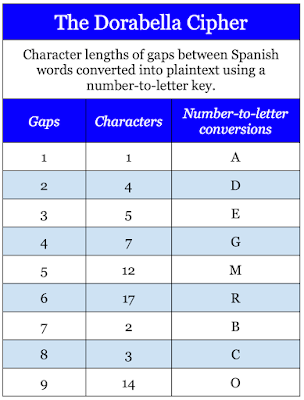
With so many Spanish terms dispersed throughout the ciphertext, it was theorized that gaps of varying lengths between them could encode further information. To assess that possibility, a tabulation of character lengths for all gaps between Spanish words was compiled.
The cipher begins in row one with the first gap of one character before peca. The second gap has four characters between peca and y. The third gap has five characters between y and ir. The fourth gap has seven characters between ir and a second y. The fifth gap has twelve characters between y in row one and cerré in row two. The sixth and largest gap has seventeen characters between cerré and se that spans the second and third rows. The seventh gap has three characters between se and sed. The eighth gap has three characters between sed and ser. The ninth and final gap consists of fourteen characters that conclude row three. There are nine gaps with a total of 65 characters with sizes ranging from one to seventeen.


The first four gap lengths are 1, 4, 5, and 7. These sums correspond to the dotted numerals in the date (1, 4, and 7), and the dotted character in row three which represents e, the fifth letter of the alphabet. When the numbers 1, 4, 5, and 7 are converted into letters of the alphabet using a basic number-to-letter key  (1 = A, 2 = B, 3 = C, etc.), they yield the plaintext A, D, E, and G. These letters pinpoint the four strings of the violin (E, A, D, and G). Elgar served as an orchestral violinist and taught that instrument at various schools. The splayed V-pattern of the dots in the date suggest the violin’s initial.
The next step in the cryptanalysis was to convert character lengths of the nine gaps in the cleartext between Spanish terms into corresponding letters of the alphabet using a number-to-letter key. This conversion relies on Elgar’s notebook key which condenses the cipher alphabet from 26 to 24 by conflating similar letters (i/j and u/v). The results of this number-to-letter conversion are summarized in the table below:


The application of a number-to-letter key to these nonsense text gaps using Elgar’s 24 character notebook cipher alphabet generates the following plaintext: A, D, E, G, M, R, B, C, and O. It is significant that four of these gap letters spell “DORA”: A, D, E, G, M, R, B, C, and O. It is conceivable that Elgar used a simple number-to-letter key to encode part of his message using the lengths of nonsense text strings separated by identifiable Spanish words. There are 169 possible anagrams obtained from these nine gap letters with correct spellings, and two results featuring “MR CODE,” a fitting title for Elgar who was fascinated by cryptograms. The remaining three letters (A, G, and B) are anagrams of gab and bag. Merriam-Webster defines gab as “talk” and “idle talk.” The first possible anagram “GAB MR CODE” is a decryption that reflects Elgar's desire to communicate in code.
Merriam-Webster furnishes numerous definitions of bag. When used as a verb, bag means “to get possession of by strategy and stealth,” “capture,” and “win.” A second possible anagram is “BAG MR CODE”, a solution that aptly describes the process of defeating Elgar’s cipher and capturing its solutions. Another definition for bag is “an assortment or collection especially of nonmaterial things” and provides the sample phrase “a bag of tricks.” A third prospective anagram is “MR CODE BAG”, a decryption that refers to Elgar’s cunning stratagems for concealing and hardening his ciphers.
A fourth possible anagram obtained from these nine plaintext letters is “DORA GEM BC.” Dora is the forename of the recipient of Elgar’s coded missive. Merriam-Webster defines a gem as “a precious or semiprecious stone cut and polished for ornament” and “a highly prized or well-beloved person.” The latter definition is heavily implied by the encoding of Dora’s name. “BC” is the acronym for “Before Christ.” A coded reference to “Before Christ” is a fitting reference to the daughter of an Anglican Rector who remained active in the church throughout her life.
A credible reading of the anagram “DORA GEM BC” is “Dora, a gem before Christ” with the repetition of the aThe conflation of Dora with gem produces the compound “Doragem,” a prospective wordplay on “Diadem.” A diadem is a jeweled headband or crown which is often adorned with gems. The New Testament describes the awarding of various crowns to those who follow Christ. These include a “crown of glory” (1 Peter 5:4), a “crown of righteousness” (2 Timothy 4:8), a “crown of rejoicing” (1 Thessalonians 2:19), a “crown of life” (James 1:12 and Revelation 2:10), and an “incorruptible crown” (1 Corinthians 9:24-27). The anagrams “GAB MR CODE,” “BAG MR CODE,” “MR CODE BAG,” and “DORA GEM BC” are collectively labeled the Spanish Gaps Anagrams Cipher.
The anagram “DORA GEM BC” (Dora, a gem before Christ) is a suitable declaration from an older married man to a younger unmarried lady is respectful and appropriate following their first extended visit. With so many overlapping interests and family connections, Elgar and Dora became fast and enduring friends. Their friendship is movingly depicted by Variation X (Dorabella), a coruscating gem in the Enigma Variations. As one of the longest movements at 73 bars, Elgar clearly longed for Dora’s attention and company.
Four languages are employed in the Dorabella cipher: English, German, Latin, and Spanish. The first letters of these four languages is an acrostic anagram of “LEGS”: Latin, English, German, Spanish. Why would Elgar encode a reference to legs in connection to Dora Penny? In her memoir, she recalls during Elgar's July 1897 visit that he performed some of his original compositions on the piano including excerpts from Lux Christi, Scenes from the Bavarian Highlands, and sketches from Caractacus. When she heard the lullaby In Hammersbach, she said, “That's lovely — I should like to dance to that.” “Elgar replied, I wish you would: I'll play it again.” She reports, “So much did he like it that I was called upon to ‘come and dance’ Hammersbach’ on several occasions at Malvern.” The “LEGS” Acrostic Anagram is a subtle reference to Dora’s proclivity to dance along to Elgar’s music.
There is a secret melody that serves as the contrapuntal cornerstone of the Enigma Variations. Dora pleaded with Elgar to share the title of that mysterious melody, but he steadfastly declined her persistent overtures. When she begged for the solution, he replied, “Oh, I shan’t tell you that, you must find it out for yourself.” “But I’ve thought and racked my brains over and over again,” she insisted. He answered, “Well, I’m surprised. I thought that you of all people would guess it.” The reason Elgar suspected Dora, the daughter of an Anglican Rector who actively sang in church, would guess the hidden melody is because it is the famous hymn A Mighty Fortress (Ein feste Burg) by the German Reformer Martin Luther. Little did Dora realize that the ending phrase from that Protestant anthem is quoted twice in Variation X by the inner voice. If only she had searched for the mysterious tune’s ending rather than its beginning, she would have soon unmasked the solution for herself, for she sang it many times in church.


Dr. Massey presents some persuasive evidence in favor of meaningless text strings in the Dorabella Cipher. His assessment may be correct regarding the non-Spanish sections of the cryptogram. That would explain why even the most advanced computer systems fail to yield any sensible results. Based on my independent analysis, however, the varying lengths of these “nonsensical” text strings segregated by Spanish words encode a message that includes the name Dora, the recipient of Elgar’s coded message. In a potent irony, Elgar deploys nonsense text strings to encode something entirely sensible. In the process, he secured a cryptographic coup that stumped the best and brightest for more than eight decades. My original research confirms that Elgar’s methods of encryption deployed in the Dorabella cipher are relatively straightforward and simple enough for a novice like Dora to unravel. To learn more about the secrets behind the Enigma Variations, read my free eBook Elgar's Enigmas ExposedPlease help support and expand my original research by becoming a sponsor on Patreon.

Sunday, February 3, 2019

Ten Years and Counting

Cast thy bread upon the waters: for thou shalt find it after many days. 

A decade has come and gone since the launch of this blog which plumbs the depths of Edward Elgar’s symphonic masterpiece, the Enigma Variations. During that period, 130 posts received more than 405,000 pageviews from a global audience. My discoveries have also been featured in various magazines, newspapers and radio programs. After nine excruciating years of hemming and hawing by its editors, Wikipedia reluctantly lifted its embargo by finally citing my research in their article about the Enigma Variations. I may not have arrived yet, but I have most definitely departed. In a long overdue retrospective, the dawn of this blog’s tenth anniversary heralds an auspicious moment to look back at how it all began.
It was late October 2006 when I performed the Enigma Variations as a sectional violinist with the Bohemian Club Symphony Orchestra in San Francisco under the capable baton of Richard Williams. Maestro Williams exhibited a conspicuous zeal for Elgar's music, devoting time at rehearsals to talk about the underlying mysteries concerning a hidden principal Theme, a dark saying ensconced within the Enigma Theme, and a secret friend memorialized in Variation XIII. My curiosity was soon set ablaze by his incandescent exegeses. It was then and there that I decided to seek out the answers to these tantalizing riddles. My wife purchased a raft of used library books about Elgar to jumpstart my investigation, and I added further articles and works on the Enigma Variations to my burgeoning collection. My plan was to scour the literature for the answers which I had hoped were unearthed by my older and wiser forebears. Unfortunately, the more I read, the more it became excruciatingly evident that not a single soul had ever managed to crack Elgar's melodic strongbox. In the absence of credible and satisfying answers, I boldly decided to take a crack at it in a quest to unmask the answers for myself and posterity. 


My nascent efforts to untangle Elgar’s contrapuntal Gordian Knot had me tied up in knots. Like all of my predecessors, my attempts at finding a convincing melodic solution proved fruitless and futile. I had eyes but could not see, ears but could not hear. Desperation moved me to appeal to the unmoved mover of my Christian faith. My predicament was reminiscent of the prophet Daniel when he and his fellow sages of ancient Babylon were challenged to interpret King Nebuchadnezzar’s disturbing yet hidden dream. Like the great king's dream, Elgar's absent principal Theme was a closely guarded secret. I invoked divine assistance to grant me the wisdom to see and hear what my more capable peers and predecessors failed to detect or comprehend. My personal experience confirmed that God answers prayer, and so I prayed for a miracle—the answers to Elgar's Enigma Variations.
Persistent prayer and study paved the way for my very own Enigma Day on February 3, 2009. It was a quiet Tuesday morning when I first hit upon an unexpected solution for the hidden melody that serves as a counterpoint to the Enigma Theme. That mystery tune is the Reformation hymn Ein feste Burg (A Mighty Fortress) by Martin Luther, an epic theme quoted in the works of great German composers admired by Elgar like Bach, Mendelssohn, and Wagner. This was a startling discovery as Elgar was raised a devout Roman Catholic, and Luther was a controversial Roman Catholic priest and professor ignominiously excommunicated by Pope Leo X for heresy. The date of my melodic epiphany was remarkable because it coincided with the bicentennial of Felix Mendelssohn’s birth. What made the timing even more extraordinary was the Mendelssohn fragments which Elgar conspicuously sprinkled in Variation XIII served as the providential bread crumbs that led me through a deep dark forest to this breakthrough that nobody would ever guess
My pièce de résistance was a contrapuntal mapping of Bach’s adaption of Ein feste Burg “through and over” the Enigma Theme. This melodic melding illustrated in vivid detail how those two dissimilar themes shared a remarkable horizontal congruence spanning 17 measures. This was a stunning find as Roger Fiske remarked “. . . how very hard it is to find anything that will go with Elgar’s theme even badly . . .” Up until that momentous moment, no other melody had ever been shown to attain an exact lengthwise fit with the Enigma Theme starting from its beginning on the second beat of measure 1 through the terminus of measure 17. Apart from a smattering of inconsequential accommodations for the Enigma Theme’s repeated modulations between G major and minor — a modal camouflage — no rhythmic alterations to Bach’s version of Ein feste Burg were required to produce this unprecedented fusion. The conflux between the Enigma Theme and Ein feste Burg persuaded me I had discovered the covert melody.


My preliminary findings were hurriedly prepared in a brief inaugural post which would later be removed after I contemplated writing a formal paper followed by a book. Prospective publishers admonished me not to release material on my blog if I wanted it to be seriously considered for publication. This resulted in a blackout on further disclosures until September 2010 when it became all too apparent that journals and academic publishers had no appetite for this admittedly esoteric subject. In my moment of triumph, I emailed invitations to top Elgar scholars like Julian Rushton and Clive McClelland to consult my introductory post and offer up their hearty approbations. With bated breath, I waited to be feted as a classical Sherlock Holmes for solving one of the most confounding riddles in music history. I did not have to wait long for my lofty hopes and aspirations to be dashed in a deluge of doubt and dismissive denunciations.
Rushton was the first to reply. He warned that I must be mistaken because Elgar was a Roman Catholic who would never contemplate quoting the music of heretical Lutheran. Such an objection cannot be taken seriously because it is in open conflict with Elgar’s decision to cite Mendelssohn’s music in Variation XIII. Rushton surely knows that Mendelssohn was baptized a Lutheran and remained a devout protestant throughout his adult life, even going so far as to compose the Reformation Symphony in honor of the 300th anniversary of the Augsburg Confession. By quoting Mendelssohn’s oeuvre, Elgar openly demonstrated a willingness to cite the music of a Lutheran. The presumption that Elgar’s faith precluded him from considering a protestant melody — particularly at a time when he was contemplating a symphony in honor of the high Anglican General Gordon — is the counterargument of an ignoramus or a fabulist. This melodic melee proved to be the opening salvo in a protracted tête-à-tête with Dr. Rushton whose alleged expertise in this arena proved far too often to be rooted in mythical fallacies rather than objective facts.
To his credit, Rushton did raise a more substantial objection by honing in some inscrutable dissonances in my contrapuntal mapping of Bach’s adaption of Ein feste Burg “through and over” the Enigma Theme. McClelland also echoed this justifiable grievance. While noting that Ein feste Burg presented a perfect horizontal fit with the Enigma Theme, Rushton and McClelland remained dubious because of the absence of a credible vertical alignment devoid of distasteful dissonances. In consideration of this reasonable objection and their sterling reputations, I went back to the drawing board and briefly dabbled with Mendelssohn’s Wedding March as a possible alternative. As born out by his sketchbooks, the lover’s theme from Elgar’s overture Cockaigne Op. 40 is indeed a counterpoint to Mendelssohn’s Wedding March, something I was blissfully unaware of when I fleetingly considered it as a prospective missing theme to the Enigma Variations.
The more I scrutinized my mapping of Mendelssohn’s Wedding March over the Enigma Theme, however, the more dissatisfying it became a viable solution. I soon returned again to my original thesis primarily because of the uncanny horizontal fit between Ein feste Burg and the Enigma Theme. Elgar’s standard reply to enigma solutions invokes the fundamental idea of a fit between the two melodies:
No: nothing like it.
I do not see the tune you suggest fits in the least.
E.E.
Merriam-Webster defines fit as “to be suitable for or to harmonize with,” and “to conform correctly to the shape or size of.” Elgar’s language is unambiguous, denoting definitively that both themes must be the same length. The first media report regarding my discovery surfaced within a month of my exhilarating announcement. It was published online in March 2009 by Tim Smith, the fine arts critic for The Baltimore Sun. Now I felt confident no other aspirant would dare assume credit for my discovery. All the glory ultimately belongs to my Heavenly Father for permitting me to assemble the pieces from this exquisitely elaborate puzzle.
Before I could venture beyond my preliminary findings, I suddenly and unexpectedly lost my job as a benefits analyst at Genworth Financial in late March 2009. As the sole provider for my wife and five children, this was a devastating blow that coincided with the height of the last financial crisis. Shortly before my abrupt departure, a humble coworker and devout follower of Jesus named Lois Hampton prophesied that one day I would be recognized for my musical discoveries and deliver lectures before rapt audiences. In that dark hour, I took comfort in Lois’ prophetic pronouncements knowing that all things work together for good for those who love God and live according to his purpose. I may have lost my job, but I had not lost hope or purpose because I still believed God had brilliant plans for my family and me.
I scrambled to make ends meet as a violin and viola instructor, but the flagging California economy and fading string programs in the public schools were grim harbingers. I enjoyed teaching at a local private music school in Cotati called Music To My Ears, but there were insufficient students to justify remaining in Northern California. When one of my violin students remarked rather despondently that the orchestra program at her high school was being shuttered, I could see the writing on the wall. It was time to leave for greener pastures. This was no longer the California I grew up in when orchestra programs flourished in elementary, middle and high schools. Plagued by natural and economic drought, California went from being the “breadbasket of the world” to the economic “basket-case” of America. The strings programs had to go, and consequently so did I and my family along with an exodus of countless other economic refugees that continues unabated to this day.
Donald, my twin brother who resides in Plano, urged me to consider relocating to the great state of Texas because of the vibrant strings programs in the public schools. I flew out that July to reconnoiter the market and decided it was worth the risk. I cashed in my modest retirement account with Genworth Financial accumulated over my four-year tenure to finance the biggest move of my life. When I told my father, Wayne, about my plans to move to Texas, he congratulated me and added with a wry grin, “You’re getting out just in time.” Over two long hot days that August, I made the drive to Texas in my 2002 model Toyota Corolla. My wife and children followed in September in our spacious Ford Chateau van nicknamed “El Presidente” towing a small U-Haul trailer packed to the hilt. The drive was unpleasantly sweltering because the van lacked a functioning air conditioner, and during the journey one of the rear tires picked up a nail that caused it to continually bleed off air pressure and require regular inflating.
As I plotted my escape from the People’s Republic of California, my blog attracted the attention of Richard Santa, a retired engineer. He made the remarkable discovery that Elgar encoded the mathematical constant Pi in the Enigma Theme’s opening measure. Santa sent me an early draft of his paper which would later appear in the journal Current Musicology published by Columbia University. My personal history includes a brief foray at Columbia University during the summer of 1986 where I attended the American Federation of Musicians' 28th Annual Congress of Strings under Music Director Joseph Silverstein and conductor Brian Salesky. The primary significance of Santa’s insight is that it eventually made me realize the Enigma Variations very likely harbored other cryptograms, a subject that I only vaguely understood or appreciated in those early days of discovery.


Within five months, my melodic solution was casually mentioned in the July 2009 issue of The Elgar Society Journal. At the bottom of page 50, Clive McClelland cites Ein feste Burg as a comparatively recent example of a melodic solution to the Enigma Variations that shares the “right length” with the Enigma Theme. Even McClelland recognized the unusual fit between the rhythmically intact forms of Ein feste Burg and the Enigma Theme, although he too balked at some “howling dissonances” that rendered the mapping untenable. I only recently stumbled upon this reference in January 2019 as I was perusing the archives of The Elgar Society Journal.


Shortly after I arrived in Texas in August 2009, McClelland emailed me a copy of his informative paper “Shadows of the Evening: New light on Elgar’s ‘Dark Saying’” which first appeared in the 2007 Winter issue of The Musical Times. As I pressed my case with him through repeated email exchanges, he impatiently threw down the gauntlet by demanding I prove the efficacy of my melodic solution by mapping it over any one of the other movements from the Enigma Variations. McClelland taunted that if I attempted such a project, I would soon be forced to abandon my theory. He based his bold challenge on the original 1899 program note where Elgar states, “. . . through and over the whole set [of Variations] another and larger theme ‘goes’ but is not played . . .” I accepted his challenge, selecting the most popular of the Variations (Nimrod) as the test subject for this contrapuntal tribunal. Through an innovative process known as melodic interval mapping, I sequentially matched notes from Ein feste Burg to Nimrod’s melody and harmony notes to realize a credible counterpoint. That exercise convinced me I had indeed hit on the right solution, and that I should pursue similar mappings for the remaining movements. During the Winter break in late 2009 through early 2010, I locked myself in a room and devoted every waking moment to this extended contrapuntal enterprise.
I prepared an audiovisual demonstration of my melodic mapping of Ein feste Burg “through and over” Nimrod, and published it on YouTube. McClelland and Rushton remained unswayed. A far more favorable impression was conveyed by the founder of the American Elgar Foundation, Richard Winter-Stanbridge. He telephoned me out of the blue to congratulate me on my discovery, exclaiming in our first conversation in September 2009 that my mapping of Ein feste Burg over Nimrod was as “clear as a pikestaff.” At that time, Richard was planning a movie to commemorate Elgar’s 150th birthday for which he prepared a short trailer. He invited me to be interviewed for this project with the intention of sharing my melodic solution to the Enigma Variations with a broader audience. The movie never materialized, but Richard’s unexpected call and words of encouragement were perfectly timed to spur me on in my budding enterprise. Little did I realize then that I had barely begun to scratch the surface of the many secrets expertly interwoven into the rich tapestry of the Enigma Variations.


After completing my mappings of Ein feste Burg over each of the Variations, I began connecting key insights that pointed to the presence of a music cryptogram in the opening six measures of the Enigma Theme. The first and earliest was Santa’s discovery that Elgar encoded the mathematical ratio Pi in the first bar relying on the melodic scale degrees. This refuted the presumption there were no cryptograms in the Enigma Variations, a position espoused by Dr. Rushton who considers any “precompositional calculation unlikely.” The second was raised in Dr. McClelland’s paper where he perceptively surmised:
Elgar’s six-bar phrase is achieved by the characteristic four-note grouping, repeated six times with its reversible rhythm of two quavers and two crotchets. This strongly suggests the cryptological technique of disguising word-lengths in ciphers by arranging letters in regular patterns.
There is an audible sense of separation achieved by the systematic placement of quarter note rests in the melody line at the beginning of each of the first six measures. This device implies gaps between coded words or phrases. The odd placement of a double bar at the end of measure six is conspicuous because such a feature usually appears at the end of a movement rather than so close to its beginning. The number of melody notes in these opening six bars is 24 is also remarkable because the complete six-word title of the covert Theme has 24 letters. In the original 1899 program note, Elgar asserts that the Enigma Theme held a “dark saying.” The term dark can mean hidden or secret, and a saying consists of words and phrases. Based on these and other observations, I reasoned that Elgar embedded a music cryptogram in the opening measures of the Enigma Theme that definitively resolves his melodic riddle. Contrary to the complaints of scholars insisting that he absconded with his secret to the grave, Elgar concealed the answer within the question itself in the form of a music cipher.
An intense three-month period of cryptanalysis ensued from December 2009 through February 2010 as I feverishly experimented during every free moment with various music ciphers to unlock Elgar’s “dark saying.” Time and again my efforts crashed and receded in failure from this seemingly impregnable seawall. Again I prayed for the Lord’s wisdom and guidance to help me unravel this seemingly impenetrable cipher. 373 days after my personal Enigma Day in February 2009, my second great epiphany arrived on February 10, 2010. It was on that date when it suddenly dawned upon me that Elgar employed melody and bass note pairs to encode his “dark saying” using a Polybius box cipher key, something akin to a chessboard or checkerboard grid.
The detection and decryption of this elaborate music cryptogram documents how Elgar rearranged the 24 letters of the full six-word German title of the covert Theme into short phonetically rendered words and phrases in three different languages: English, Latin, and what he reasonably believed to be Aramaic (but turns out to be Hebrew). In all, there are four different languages in this cipher — English, Latin, German, and Aramaic. Note how the first letters of these four languages form an acrostic anagram of Elgar. In a brilliant but stealthy display, Elgar signed his cipher using a code wrapped within another. Now I had confirmation of my discovery from the hand of Elgar himself, signed, unsealed, and decoded.
One would expect to detect and decrypt the most elementary ciphers in the Enigma Variations first, then progress up the stairwell of complexity to crack the most difficult last. My experience was just the opposite, making my discovery and decoding of the most sophisticated of all the ciphers in the Enigma Variations hugely counterintuitive. A major advantage working in my favor was that I knew the number and type of plaintext letters to assign to the 24 melody notes within the Enigma Theme’s opening six bars. A frequency analysis of the melody/bass note pairs was instrumental in quickly narrowing down my options until Elgar’s “dark saying” first mentioned in the original 1899 program note, emerged from the shadows. 


I submitted an early draft of my paper about the Enigma Theme Polybius box cipher to Craig P. Bauer, the editor of the journal Cryptologia. After thoughtful consideration, he declined to publish it in his august journal. Bauer would later devote an entire chapter to Elgar’s command of cryptography in his 2017 book Unsolved! The History and Mystery of the World’s Greatest Ciphers from Ancient Egypt to Online Secret Societies. In chapter 3, Bauer focuses particular attention on the Dorabella Cipher and Elgar’s masterful decryption of a variant of the Polybius square cipher known as a Nihilist cipher. Elgar definitely studied the Polybius box cipher at least two years before he embarked on the Enigma Variations because his personal library includes a series of four articles collectively titled Secrets in Cipher by John Holt Schooling which first appeared in various 1896 issues of The Pall Mall Magazine. Schooling’s fourth and final installment concludes with an in-depth look at the Polybius box cipher and a supposedly insoluble Nihilist permutation. When I first hit on Elgar’s adaptation of the Polybius square to music using melody and bass note pairs, I knew nothing at all about the Greek historian Polybius or his ingenious cipher. Looking back it is clear that I was the beneficiary of divine providence in resolving such a colossal conundrum.
Undeterred by the chronic skepticism of career academics, I applied to my alma mater for a Time-Out Grant to fund my research. Alumnae of Vassar College approaching their 40th birthday may apply for this special grant to take a year off “to make a difference in the world.” In my application, I explained how I planned to further my study of the Enigma Variations with the objective of preparing a book and website to share my growing body of work that upends decades of Elgar scholarship. My application was summarily denied. In their declination letter, the committee acknowledged awarding the grant to a monk who had resided in a Tibetan Buddhist monastery for 23 years and desired (ironically as that may sound) to test her beliefs in the outside world. As I perused the public profiles of previous Time-Out Grant recipients, it quickly became apparent they were all women. I did not realize that white Christian males were placed on a permanent time-out from consideration for Vassar College’s Time Out Grant.


Repeated attempts to advance and share my discoveries with the aid of academia and established publishers with an interest in Elgar were greeted with disbelief and a chorus of “Noes.” A mountain of dubious doubters blocked my path, so I decided to speak to my mountain in faith and cast it into the depths of the sea. My decryption of the Enigma Theme Music Box Cipher revealed Elgar’s covert signature, and that was all the confirmation I required to proceed. The publication of this groundbreaking discovery has become my most popular post. A cornucopia of other incredible cryptograms has since emerged from the shadows. One remarkable example is a wordplay cipher based on the unusual name Nimrod.


Emboldened by these discoveries, I decided to take and make my case directly before the world using Google’s free platforms Blogger and YouTube. In mid-September 2010 I began releasing the first chapters of my book Elgar’s Enigmas Exposed on this blog, and soon added companion music video exhibits on my YouTube channel.
Media coverage of my research began as a trickle in March 2009 with a brief article by Tim Smith, the fine arts critic of The Baltimore Sun. Dr. McClelland made passing mention of my melodic solution in the July 2009 issue of The Elgar Society Journal. The popular blog Boing Boing drew favorably highlighted my discoveries in June 2013. The website Unsolved Problems released my paper Elgar’s Music Box Cipher in August 2015. In 2016 my research was described in an article about the Enigma Variations by Classical Notes. A major coup came in February 2017 with the release of Daniel Estrin’s exposé Breaking Elgar’s Enigmain The New Republic magazine. The local outlet D Magazine quickly followed suit with their article Was This Famous Classical Music Puzzle Solved In Plano?The American Society of Cinematographers refers to my research in their May 2017 article Edward Elgar's Enigma. NPR aired Elgar's 'Enigma’ Still Keeps Music Detectives Busy in March 2018. Two months later, Love + Radio released their program Counter Melody in May 2018. More media coverage will inevitably follow as the bona fides of my discoveries become more widely acknowledged and accepted.
Ten years and counting with 131 posts and over 405,000 page views in the rearview mirror, this blog shows no signs of stopping on the eve of the 120th anniversary of the historic premiere of the Enigma Variations this June. The campaign to disseminate my research has proven wildly more successful than I had ever dreamed or anticipated. As Dryden’s character opines in the 1962 classic film Lawrence of Arabia, “Big things have small beginnings.” With feelings of nostalgia mingled with optimism, I look forward to attending the North American Branch Conference of The Elgar Society this May in San Francisco. That harbor city is where my enigmatic voyage commenced in a spirit of bohemian humor and continues in deep seriousness.
With the unmasking of A Mighty Fortress as the covert Theme, Elgar’s seemingly ordinary remarks to F. G. Edwards in a letter dated October 21, 1898, regarding a projected “Gordon” symphony assume a renewed significance. He wrote, “’Gordon’ simmereth mighty pleasantly in my (brain) pan & will no doubt boil over one day.” Something symphonic did indeed erupt on that fateful day when later that evening Elgar first performed the Enigma Theme at the piano for his wife. The appearance of the word mighty in his correspondence about a projected symphonic work on that day of days is an extraordinary slip of the pen. To learn more about the innermost secrets of Elgar's sublime symphonic homage to cryptography, read my free eBook Elgar’s Enigmas ExposedPlease help support and expand my original research by becoming a sponsor on Patreon.

About Mr. Padgett

My photo
Mr. Padgett studied violin with Michael Rosenker (a student of Leopold Auer), and Rosenker’s pupil, Owen Dunsford. Mr. Padgett studied piano with Sally Magee (a student of Emanuel Bay), and Blanca Uribe (a student of Rosina Lhévinne). He attended the Stevenson School in Pebble Beach, California, and Vassar College in Poughkeepsie, New York, where he graduated Phi Beta Kappa with a degree in psychology. At Vassar he studied music theory and composition with Richard Wilson. Mr. Padgett has performed for Joseph Silverstein, Van Cliburn, Arnold Schwarzenegger, Maria Shriver, Steve Jobs, Prince Charles, Lady Camilla, Marcia Davenport, William F. Buckley, Jr., and other prominent public figures. His original compositions have been performed by the Monterey Symphony, at the Bohemian Grove, the Bohemian Club, and other private and public venues. In 2008 Mr. Padgett won the Max Bragado-Darman Fanfare Competition with his entry "Fanfare for the Eagles." It was premiered by the Monterey Symphony under Maestro Bragado in May 2008. A member of the Elgar Society, Mr. Padgett is married with five children.