Translate

Showing posts with label Alfred Penny. Show all posts

Tuesday, November 29, 2022

Mozart's K. 147 in Elgar's Dorabella Cipher

W. A. Mozart in 3D by Hadi Karimi
The first real sort of friendly leading I had, however, was from ‘Mozart’s Thorough-bass School.’ There was something in that to go upon—something human. It is a small book—a collection of papers beautifully and clearly expressed—which he wrote on harmony for a niece of a friend of his. I still treasure the old volume.
Edward Elgar in The Strand Magazine (May 1904)

The English composer Edward Elgar (1857–1934) and his wife enjoyed a long weekend visit in mid-July 1897 with the family of Reverend Alfred Penny (1845–1934), the rector of St. Peter’s Collegiate Church in Wolverhampton. Caroline Alice Elgar (1848–1920) was a childhood friend of the Reverend’s wife, Mary Frances Baker, who married the widower in 1895 and became the stepmother of his only daughter, Dora Penny (1874–1964). On their return to Great Malvern, Alice penned a letter thanking the Penny family for their hospitality. Elgar added a short enciphered missive to his wife’s correspondence, addressing it to “Miss Penny” on the back. The incisive salutation is a classic Elgarian pun. “Miss” is an honorific title for an unmarried woman or girl, but it also functions as the verb “miss” to express regret or sadness over a person’s absence. Elgar was clearly missing Miss Penny when he created his cryptographic pièce de résistance. Dora was unable to decipher Elgar’s enigmatic script and filed it away for over 40 years before eventually publishing it in her 1937 biography, Edward Elgar: Memories of a Variation.
Elgar’s coded message to Dora Penny is popularly known as the Dorabella Cipher. The name comes from Variation X of the Enigma Variations (1899), a movement dedicated to her that bears the title “Dorabella.” Elgar procured that playful pseudonym from a soprano role for a young unmarried woman in the opera Così fan tutte by Wolfgang Amadeus Mozart. An operatic nickname for Dora was befitting because she was an avid vocalist who sang in the Wolverhampton Choir Society and her father’s rectory choir. As she recalled in her biography, “I was so mixed up with tunes in those days; Choral music, Church music, and orchestral music – and my own solo-singing, scenes from opera, songs, ballads –, and so on.” Four months before his visit to her father’s rectory, Elgar penned a letter to Dora in which he humorously comments about her weekly singing practices. He wrote, “Alice tells me you are warbling wigorously in Worcester wunce a week (alliteration archaically Norse).” This amusing excerpt is one of many examples where Elgar employs idiosyncratic spellings in his correspondence.

Variation X (Dorabella) from “My Friends Pictured Within”

The Dorabella Cipher consists of 87 curlicue symbols arranged in three rows of varying character lengths followed by a fourth row providing the date “July 14 [18]97”. There are 29 characters in row one, 31 in row two, 27 in row three, and 8 in row four. A conspicuous dot appears over the sixth symbol in row three. Three others appear in row four with small dots to the right of “1” and “4”, and a larger dot affixed to the bend in “7”. In all, there are 87 symbols, four rows, four dots, four letters, and four numbers on the Dorabella Cipher.

The Dorabella Cipher

Fortunately for investigators, the key to translating this confounding cast of characters into recognizable cleartext is preserved in one of Elgar’s surviving notebooks. A facsimile of that key is displayed below:

Elgar’s notebook cipher key

Elgar created three distinct glyphs using the lowercase c as the primary building block. His motive for selecting that particular letter is easy to surmise because c is the initial for cipher and cryptogram. There is persuasive evidence in support of this hypothesis as Elgar wrote some of those identical symbols around the word “Cryptogram” on an index card dating from 1896.

Elgar's “Cryptogram” card with ciphertext (circa 1896)

With his three prototypes assembled from one, two, and three stacked cs, Elgar systematically arranged them into eight different triplets using various angles and orientations to generate 24 alphabetic avatars. Elgar assigned the English alphabet’s 26 letters to these 24 odd characters by conflating i with j, and u with v. Combining similar glyphs is a standard convention of cryptography. The resemblance of some of Elgar's curlicue characters to the capital cursive “E” from his initials is deliberate, embellishing the cipher with his imprimatur in contrasting guises and angles. Relying on Elgar’s notebook key, the Dorabella Cipher converts into the following cleartext:


Elgar used twenty symbols from his lineup of twenty-four characters, omitting those for m, n, o, and z. The three contiguous absent letters (m, n, o) are an anagram of nom, the French term for “name.” That word appears in nom de plume, a French expression for a pseudonym or pen name. Elgar’s signature is conspicuously absent from his coded missive. Could this nom anagram sourced from his missing letters be a clue that Elgar’s name is hidden within the ciphertext? The absence of these four letters parallels the structural emphasis placed on that number by four rows, four dots, four letters, and four numbers. Elgar is clearly hinting at the importance of the number four. The explanation could be that the fourth letter of the alphabet is D, the initial for Dora, the four-letter name of the recipient of Elgar's message.
Cryptographers are baffled by the Dorabella Cipher’s seemingly incoherent cleartext. In his history of unbroken cryptograms titled Unsolved!, mathematics professor Craig P. Bauer concedes that the Dorabella Cipher appears to be a simple monoalphabetic substitution cipher (MASC) in which one letter is replaced by one symbol. Gaps between words are excised to make the code even more difficult to unravel. Like modern ciphers, ancient Greek and Classical Latin text omit spaces between words in a practice called scriptio continua. Bauer laments that when applied to the Dorabella Cipher, none of the standard techniques for solving a MASC yield any sensible or credible results. Even the most advanced computer programs fail to make any inroads. A limitation of this approach is the presumption that Elgar’s message is a MASC restricted to English. Bauer briefly describes and dismisses purported solutions by Eric Sams, Tony Gaffney, and Tim S. Roberts, before concluding that the Dorabella Cipher has not yet been solved because Elgar’s system of encipherment must be “something more complicated.”
Recent cryptanalysis of the seemingly impregnable Dorabella Cipher determined that its dotted symbols encode solutions in Latin (AMDG) and German (Magd). Elgar penned the Latin abbreviation “AMDG” on some of his master scores as a sacred dedication, most notably The Dream of Gerontius. Used to refer to a young unmarried woman, the German word Magd means “maid” and “virgin.” This solution is consistent with the recipient of Elgar’s coded missive, Miss Dora Penny, the young unmarried daughter of Reverend Penny. The Dorabella Cipher also presents some English words as the note is addressed to “Miss Penny” and the month is shown as “July”. Remarkably, these three languages — English, Latin, and German — are an acrostic anagram of the first three letters of “ELGAR.” The linguistic sophistication of the Dorabella Cipher readily explains why experts failed to penetrate it since they naively assumed it was confined to English. Such a unidimensional mindset is utterly incompatible with an autodidactic polymath like Elgar. Unconventional methods, like Elgar’s odd spellings, are the keys to unraveling the Dorabella Cipher.


Three of the four absent letters (m, n, o, z) from the Dorabella Cipher are an anagram of nom, the French word for “name.” Remarkably, the dot above the sixth character in row three of the Dorabella Cipher pinpoints a familiar nickname for Elgar. Relying on Elgar’s notebook key, the raw decryption of the character below the dot in row three is the letter E. One dot in International Morse Code is also E. Consequently, the dot and the symbol encode Elgar’s initials (EE). Immediately following the encoded E, the next two characters encode the letters d and u/v. The small dot above the ciphertext in the third row tags the text sequence “Edu” which is one of Elgar’s primary nicknames.


Elgar’s wife coined the pet name “Edoo” using the first three letters of the German version of her husband’s forename, Eduard. Elgar assigned this pseudonym to his musical self-portrait in the Enigma Variations (1899), the martial Finale with the title “E. D. U.” Dora Penny was familiar with this pet name as she spent a substantial amount of time around the Elgar family and heard Alice call her husband “Edoo.” This fragmentary decryption confirms that the Dorabella Dots Dedication Cipher is covertly signed by its author. The solution comports with the feasibility of spelling nom from absent letters in the cipher and the glaring absence of Elgar’s signature from his note. The discovery of Elgar’s nickname is consistent with other cryptograms in the Enigma Variations that are similarly tagged by his name or initials.
Far from being a completely random assortment of letters as posited by investigators like Dr. Keith Massey, the cleartext presents a coded form of Elgar’s name expertly woven into the fabric of the cleartext. Elgar made it an obvious place to look because of the anomalous dot above the sixth character in row three. This “EDU” Dot Cipher furnishes the author's signature conspicuously missing from his missive to Miss Penny. It is astonishing that his signature remained undetected since the cipher was first publicized 85 years ago. One reasonably wonders what else the so-called experts failed to detect lurking just beneath the surface of the Dorabella Cipher cleartext. After all, Elgar's encoded signature was not difficult to spot.
A recent reassessment of the Dorabella Cipher uncovered yet another cryptogram connected with the anomalous dots in the fourth row where Elgar dated his mystifying message as “July 14 97”. There is no comma between the day and year, and the century (18) is omitted. One small dot appears next to the upper right of “1”, and another next to the lower right of “4”. There is a third larger dot next to the crook in “7” that constitutes the final character in the cipher. Scanning from left to right, these dotted numerals form the number “147”. The fourth row has four letters (July), four numbers (14 & 97), and three dots. Translating the number eleven into its corresponding letter of the alphabet using an elementary number-to-letter key (1 = A, 2 = B, C = 3, etc.) generates the letter “K.” Uniting that coded letter with the dotted numerals yields “K 147.”
Before attempting to decode the significance of “K 147”, it is first necessary to become acquainted with the work of the Austrian musicologist Ludwig Köchel. He established a chronology of Mozart’s compositions and assigned them sequential numbers. For example, the Requiem in D Minor is Mozart’s 626th work and is assigned the number 626. In 1862, Köchel published a comprehensive listing of all known compositions by Wolfgang Amadeus Mozart called the Köchel Catalogue. This first edition remained the standard reference source until undergoing revisions in 1905. Each Köchel number is preceded by his initial “K.” Consequently, “K 147” may be confidently read as “Köchel 147.”
Out of so many diverse possibilities, which one of Mozart’s works is listed by Köchel as the 147th? Could it be a piano sonata, a string quartet, a divertimento, or a symphony? On the contrary, it is a diminutive song for soprano and piano called “Wie unglücklich bin ich nit” (How unlucky I am). At only fifteen bars, it is a “sentimental love song . . . in which the fifteen-year-old Mozart pointedly depicts the sighs of a slighted lover . . .” The ensemble for “Wie unglücklich bin ich nit” is perfectly paired with Dora (a soprano) and Elgar (a skilled pianist and accompanist). Shortly after their first encounter, Elgar played piano for Dora. He soon bestowed on her the nickname Dorabella, a soprano role from Mozart’s Opera Così fan tutte. Elgar clearly associated Dora with Mozart’s music. The discovery of a coded reference to one of Mozart’s songs in the Dorabella Cipher indicates Elgar made this connection shortly after their first meeting at her father’s rectory.

Autograph Score of "Wie unglücklich bin ich nit" K. 147 (1772)

A published version of Wie unglücklich bin ich nit K. 147

“Wie unglücklich bin ich nit” was composed by Mozart in Salzburg during the summer of 1772. The author of the libretto is unknown and could be Mozart himself. A copy of this song appears in an 1869 book by John Ella published in London called Musical Sketches Abroad And At Home. A talented violinist, Ella inaugurated in 1845 an annual series of instrument and vocal concerts under the title the “Musical Union.” These gatherings often featured established artists who were new to English society. The appearance of Mozart’s song in Ella’s book suggests it was performed at one or more of these concerts. Such attention by a prominent member of London’s musical scene ensured that this gem was not neglected. Dora’s education and extensive experience in the vocal arts likely exposed her to Mozart’s early Lieder including “Wie unglücklich bin ich nit”.


The original German lyrics of “Wie unglücklich bin ich nit” are shown below with an English translation:
Wie unglücklich bin ich nit,
Wie schmachtend sind meine Tritt
,
Wenn ich mich nach dir lenke.
Nur die Seufzer trösten mich,
Alle Schmerzen häufen sich,
Wenn ich auf dich gedenke.

How unhappy I am,
How heavy are my steps,
When I direct them toward you.
Only sighs comfort me,
All my worries pile up,
When I think of you.
The lyrics artfully convey Elgar’s sadness over his recent parting from Dora Penny. Such a musical declaration from an older married man to a younger unmarried lady is flattering and suitable following their first meeting. With so many common interests and family connections, Elgar and Dora soon became good friends. Their friendship is movingly depicted by Variation X (Dorabella), a coruscating gem in the Enigma Variations. As one of the longest movements at 73 bars, Elgar clearly longed for Dora’s attention and company.
There is a secret melody that serves as the contrapuntal cornerstone of the Enigma Variations. Dora pleaded with Elgar to share the title of that mysterious melody, but he steadfastly declined her persistent overtures. When she begged for the solution, he replied, “Oh, I shan’t tell you that, you must find it out for yourself.” “But I’ve thought and racked my brains over and over again,” she insisted. He answered, “Well, I’m surprised. I thought that you of all people would guess it.” The reason Elgar suspected Dora, the daughter of an Anglican Rector who actively sang in church, would guess the hidden melody is because it is the famous hymn A Mighty Fortress (Ein feste Burg) by German Reformer Martin Luther. Little did Dora realize that the ending phrase from that Protestant anthem is quoted twice in Variation X by the inner voice. If only she had searched for the mysterious tune’s ending rather than its beginning, she would have soon unmasked the solution for herself, for she sang it many times in church.


The Enigma Variations conceal a principal Theme that is unheard and yet serves as the contrapuntal cornerstone of the entire work. Like the Variations, Elgar's Dorabella Cipher also harbors a secret melody, one that could be performed by Dora Penny's soprano voice and Elgar's facility at the piano. The Spanish Gaps Code in the Dorabella Cipher encodes the anagram “DORA CC GEM” (Dora sees gem). The dual Cs are remarkable because the soprano opens “Wie unglücklich bin ich nit” with an eighth note C followed by a half note C – two Cs. This “C-C” motif is reprised two more times in Mozart’s diminutive lied with one interrupted by a quarter rest that is conveniently covered by a solitary C in the piano accompaniment. Consequently, the “CC” in the solution to the Spanish Gaps Code cleverly alludes to the opening notes of the secret melody encoded by the Dorabella Cipher.
 

To learn more about the secrets of the Enigma Variations, read my free eBook Elgar’s Enigmas ExposedPlease help support and expand my original research by becoming a sponsor on Patreon.


Sunday, November 27, 2022

The Dorabella Cipher's Spanish Gaps Anagrams

This sketch is an attempt to portray, in the compass of a few bars, the humours of a Spanish fête.
From Elgar’s program note for Sevillana (Scene Espagnole) 

“AQUI ESTÁ ENCERRADA EL ALMA DE . . . . .”
(Herein is enshrined the soul of . . . . .)
Elgar’s Spanish dedication to his Violin Concerto

The English composer Edward Elgar (1857–1934) and his wife enjoyed a long weekend visit in mid-July 1897 with the family of Reverend Alfred Penny (1845–1934), the rector of St. Peter’s Collegiate Church in Wolverhampton. Caroline Alice Elgar (1848–1920) was a childhood friend of the Reverend’s wife, Mary Frances Baker, who married the widower in 1895 and became the stepmother of his only daughter, Dora Penny (1874–1964). On their return to Great Malvern, Alice penned a letter thanking the Penny family for their hospitality. Elgar added a short enciphered missive to his wife’s correspondence, addressing it to “Miss Penny” on the back. The incisive salutation is a classic Elgarian pun. “Miss” is an honorific title for an unmarried woman or girl, but it also functions as the verb “miss” to express regret or sadness over a person’s absence. Elgar was clearly missing Miss Penny when he created his cryptographic pièce de résistance. Dora was unable to decipher Elgar’s enigmatic script and filed it away for over 40 years before eventually publishing it in her 1937 biography, Edward Elgar: Memories of a Variation.
Elgar’s coded message to Dora Penny is popularly known as the Dorabella Cipher. The name comes from Variation X of the Enigma Variations (1899), a movement dedicated to her that bears the title “Dorabella.” Elgar procured that playful pseudonym from a soprano role for a young unmarried woman in the opera Così fan tutte by Wolfgang Amadeus Mozart. An operatic nickname for Dora was befitting because she was an avid vocalist who sang in the Wolverhampton Choir Society and her father’s rectory choir. As she recalled in her biography, “I was so mixed up with tunes in those days; Choral music, Church music, and orchestral music – and my own solo-singing, scenes from opera, songs, ballads –, and so on.” Four months before his visit to her father’s rectory, Elgar penned a letter to Dora in which he humorously comments about her weekly singing practices. He wrote, “Alice tells me you are warbling wigorously in Worcester wunce a week (alliteration archaically Norse).” This amusing excerpt is one of many examples where Elgar employs idiosyncratic spellings in his correspondence.

Variation X (Dorabella) from “My Friends Pictured Within”

The Dorabella Cipher consists of 87 curlicue symbols arranged in three rows of varying character lengths followed by a fourth row providing the date “July 14 [18]97”. There are 29 characters in row one, 31 in row two, 27 in row three, and 8 in row four. A conspicuous dot appears over the sixth symbol in row three. Three others appear in row four with small dots to the right of “1” and “4”, and a larger dot affixed to the bend in “7”. In all, there are 87 symbols, four rows, four dots, four letters, and four numbers on the Dorabella Cipher.

The Dorabella Cipher from Dora's 1937 memoir.

Fortunately for investigators, the key to translating this confounding cast of characters into recognizable cleartext is preserved in one of Elgar’s surviving notebooks. A facsimile of that key is displayed below:

Elgar’s notebook cipher key

Elgar created three distinct glyphs using the lowercase c as the primary building block. His motive for selecting that particular letter is easy to surmise because c is the initial for cipher and cryptogram. There is persuasive evidence in support of this hypothesis as Elgar wrote some of those identical symbols around the word “Cryptogram” on an index card dating from 1896.

Elgar's “Cryptogram” card with ciphertext (circa 1896)

With his three prototypes assembled from one, two, and three stacked cs, Elgar systematically arranged them into eight different triplets using various angles and orientations to generate 24 alphabetic avatars. Elgar assigned the English alphabet’s 26 letters to these 24 odd characters by conflating i with j, and u with v. Combining similar glyphs is a standard convention of cryptography. The resemblance of some of Elgar's curlicue characters to the capital cursive “E” from his initials is deliberate, embellishing the cipher with his imprimatur in contrasting guises and angles. Relying on Elgar’s notebook key, the Dorabella Cipher converts into the following cleartext:


Elgar used twenty symbols from his lineup of twenty-four characters, omitting those for m, n, o, and z. The three contiguous absent letters (m, n, o) are an anagram of nom, the French term for “name.” That word appears in nom de plume, a French expression for a pseudonym or pen name. Elgar’s signature is conspicuously absent from his coded missive. Could this nom anagram sourced from his missing letters be a clue that Elgar’s name is hidden within the ciphertext? The absence of these four letters parallels the structural emphasis placed on that number by four rows, four dots, four letters, and four numbers. Elgar is clearly hinting at the importance of the number four. The explanation could be that the fourth letter of the alphabet is D, the initial for Dora, a four-letter name.
Cryptographers are baffled by the Dorabella Cipher’s seemingly incoherent cleartext. In his history of unbroken cryptograms titled Unsolved!, mathematics professor Craig P. Bauer concedes that the Dorabella Cipher appears to be a simple monoalphabetic substitution cipher (MASC) in which one letter is replaced by one symbol. Gaps between words are excised to make the code even more difficult to unravel. Like modern ciphers, ancient Greek and Classical Latin text omit spaces between words in a practice called scriptio continua. Bauer laments that when applied to the Dorabella Cipher, none of the standard techniques for solving a MASC yield any sensible or credible results. Even the most advanced computer programs fail to make any inroads. A limitation of this approach is the presumption that Elgar’s message is a MASC restricted to English. Bauer briefly describes and dismisses purported solutions by Eric Sams, Tony Gaffney, and Tim S. Roberts, before concluding that the Dorabella Cipher has not yet been solved because Elgar’s system of encipherment must be “something more complicated.”
Recent cryptanalysis of the seemingly impregnable Dorabella Cipher determined that its dotted symbols encode solutions in Latin (AMDG) and German (Magd). Elgar penned the Latin abbreviation “AMDG” on some of his master scores as a sacred dedication, most notably The Dream of Gerontius. Used to refer to a young unmarried woman, the German word Magd means “maid” and “virgin.” This solution is consistent with the recipient of Elgar’s coded missive, Miss Dora Penny, the young unmarried daughter of Reverend Penny. The Dorabella Cipher also presents some English words as the note is addressed to “Miss Penny” and the month is shown as “July”. Remarkably, these three languages — English, Latin, and German — are an acrostic anagram of the first three letters of “ELGAR.” The linguistic sophistication of the Dorabella Cipher readily explains why experts failed to penetrate it since they naively assumed it was confined to English. Such a unidimensional mindset is utterly incompatible with an autodidactic polymath like Elgar. Unconventional methods, like Elgar’s odd spellings, are the keys to unraveling the Dorabella Cipher.


Three of the four absent letters (m, n, o, z) from the Dorabella Cipher are an anagram of nom, the French word for “name.” Remarkably, the dot above the sixth character in row three of the Dorabella Cipher pinpoints a familiar nickname for Elgar. Relying on Elgar’s notebook key, the raw decryption of the character below the dot in row three is the letter E. One dot in International Morse Code is also E. Consequently, the dot and the symbol encode Elgar’s initials (EE). Immediately following the encoded E, the next two characters encode the letters d and u/v. The small dot above the ciphertext in the third row tags the text sequence “EDU” which is one of Elgar’s primary nicknames.


Elgar’s wife coined the pet name “Edoo” using the first three letters of the German version of her husband’s forename, Eduard. Elgar assigned this pseudonym to his musical self-portrait in the Enigma Variations (1899), the martial Finale with the title “E.D.U.” Dora Penny was familiar with this pet name as she spent a substantial amount of time around the Elgar family and heard Alice call her husband “Edoo.” This fragmentary decryption confirms that the Dorabella Dots Dedication Cipher is covertly signed by its author. The solution comports with the feasibility of spelling nom from absent letters in the cipher and the glaring absence of Elgar’s signature from his note. The discovery of Elgar’s nickname is consistent with other cryptograms in the Enigma Variations that are similarly tagged by his name or initials.
Far from being an entirely random assortment of letters as posited by investigators like Dr. Keith Massey, the cleartext presents a coded form of Elgar’s name expertly woven into the fabric of the cleartext. Elgar made it an obvious place to look because of the anomalous dot above the sixth character in row three. This “EDU” Dot Cipher furnishes the author's signature conspicuously missing from his missive to Miss Penny. It is astonishing that his signature remained undetected since the cipher was first publicized 85 years ago. One reasonably wonders what else the so-called experts failed to detect lurking just beneath the surface of the Dorabella Cipher cleartext. After all, Elgar's encoded signature was not difficult to spot.


Elgar’s earliest compositions such as Sevillana (1884) and Spanish Serenade (1891) gravitate to Spanish themes. Composed at the zenith of his career, his Violin Concerto (1910) offers a cryptic dedication in the Spanish language. Elgar’s interest in Spanish spurred further cryptanalysis of the Dorabella Cipher cleartext in search of Spanish terms. This endeavor uncovered eight discrete Spanish words: Peca, y, ir, cerré, se, essed, and ser.
The first (peca) in row one means “spot” and conforms with the conspicuous spots on the Dorabella Cipher. Occurring twice in the first row, the second (y) means “and.” The third (ir) in row one means “to go,” suggesting that one should go to the singular spot above the sixth character in the third row where Elgar’s nickname is unveiled. The fourth (cerré) in row two means “I closed,” an apt characterization of enciphering a message to conceal its contents. The position of cerré in the second row is directly above Elgar’s pseudonym in row three, visually confirming the source of this cryptic statement. The fifth (se) that bridges the second and third rows means “I know”, affirming that Elgar knows the solution to his concealed message. The sixth (es) as the beginning of row three means “is.” The seventh (sed) in row three means “thirst,” overlapping with the first two letters of “EDU.” The eighth (ser) in row three is the verb “to be.” The discovery of these Spanish words in the Dorabella cleartext indicates the participation of Elgar’s wife who was fluent in that romance language. These cryptograms evaded detection because cryptographers incorrectly assumed Elgar’s message could only be in English.
The word y (and) is the only single letter term among the other Spanish words with letter lengths of two (ires and se), three (sed and ser), four (peca), and five (cerré). Remarkably, the Spanish pronunciation of y sounds exactly like the letter e. Consequently, two ys in row one present a coded version of Elgars initials (EE).


There are a total of eleven Spanish terms in the cleartext of the Dorabella Cipher with some duplicates (se) and overlaps (se and es). Four correctly spelled Spanish terms with lengths of three letters or more (cerré, peca, sed, and ser) endorse the inclusion of shorter Spanish words of two letters or less (ir, esse and y). These words consume 22 out of 87 characters for just over 25 percent of the ciphertext. Such a high percentage makes it highly improbable that so many Spanish words are coincidental and the unintended result of a random text string. Assuming uniform selection from a 26-letter alphabet and accounting for 22 unique positions due to overlaps, Grok.ai estimates the joint probability of these eleven Spanish terms in the Dorabella cleartext at approximately 7.42 × 10⁻³¹, or about 1 in 135 nonillion. That joint probability is akin to winning dozens of lotteries in a row. Such a remote probability effectively rules out a random explanation and supports an inference of design.
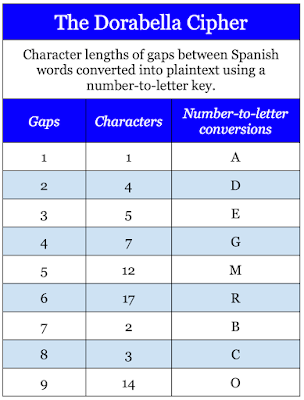
With so many Spanish terms dispersed throughout the ciphertext, it was theorized that gaps of varying lengths between them could encode further information. To assess that possibility, a tabulation of character lengths for all gaps between Spanish words was compiled.
The cipher begins in row one with the first gap of one character before peca. The second gap has four characters between peca and y. The third gap has five characters between y and ir. The fourth gap has seven characters between ir and a second y. The fifth gap has twelve characters between y in row one and cerré in row two. The sixth and largest gap has seventeen characters between cerré and se that spans the second and third rows. The seventh gap has three characters between se and sed. The eighth gap has three characters between sed and ser. The ninth and final gap consists of fourteen characters that conclude row three. There are nine gaps with a total of 65 characters with sizes ranging from one to seventeen.


The first four gap lengths are 1, 4, 5, and 7. These sums correspond to the dotted numerals in the date (1, 4, and 7), and the dotted character in row three which represents e, the fifth letter of the alphabet. When the numbers 1, 4, 5, and 7 are converted into letters of the alphabet using a basic number-to-letter key  (1 = A, 2 = B, 3 = C, etc.), they yield the plaintext A, D, E, and G. These letters pinpoint the four strings of the violin (E, A, D, and G). Elgar served as an orchestral violinist and taught that instrument at various schools. The splayed V-pattern of the dots in the date suggest the violin’s initial.
The next step in the cryptanalysis was to convert character lengths of the nine gaps in the cleartext between Spanish terms into corresponding letters of the alphabet using a number-to-letter key. This conversion relies on Elgar’s notebook key which condenses the cipher alphabet from 26 to 24 by conflating similar letters (i/j and u/v). The results of this number-to-letter conversion are summarized in the table below:


The application of a number-to-letter key to these nonsense text gaps using Elgar’s 24 character notebook cipher alphabet generates the following plaintext: A, D, E, G, M, R, B, C, and O. It is significant that four of these gap letters spell “DORA”: A, D, E, G, M, R, B, C, and O. It is conceivable that Elgar used a simple number-to-letter key to encode part of his message using the lengths of nonsense text strings separated by identifiable Spanish words. There are 169 possible anagrams obtained from these nine gap letters with correct spellings, and two results featuring “MR CODE,” a fitting title for Elgar who was fascinated by cryptograms. The remaining three letters (A, G, and B) are anagrams of gab and bag. Merriam-Webster defines gab as “talk” and “idle talk.” The first possible anagram “GAB MR CODE” is a decryption that reflects Elgar's desire to communicate in code.
Merriam-Webster furnishes numerous definitions of bag. When used as a verb, bag means “to get possession of by strategy and stealth,” “capture,” and “win.” A second possible anagram is “BAG MR CODE”, a solution that aptly describes the process of defeating Elgar’s cipher and capturing its solutions. Another definition for bag is “an assortment or collection especially of nonmaterial things” and provides the sample phrase “a bag of tricks.” A third prospective anagram is “MR CODE BAG”, a decryption that refers to Elgar’s cunning stratagems for concealing and hardening his ciphers.
A fourth possible anagram obtained from these nine plaintext letters is “DORA GEM BC.” Dora is the forename of the recipient of Elgar’s coded missive. Merriam-Webster defines a gem as “a precious or semiprecious stone cut and polished for ornament” and “a highly prized or well-beloved person.” The latter definition is heavily implied by the encoding of Dora’s name. “BC” is the acronym for “Before Christ.” A coded reference to “Before Christ” is a fitting reference to the daughter of an Anglican Rector who remained active in the church throughout her life.
A credible reading of the anagram “DORA GEM BC” is “Dora, a gem before Christ” with the repetition of the aThe conflation of Dora with gem produces the compound “Doragem,” a prospective wordplay on “Diadem.” A diadem is a jeweled headband or crown which is often adorned with gems. The New Testament describes the awarding of various crowns to those who follow Christ. These include a “crown of glory” (1 Peter 5:4), a “crown of righteousness” (2 Timothy 4:8), a “crown of rejoicing” (1 Thessalonians 2:19), a “crown of life” (James 1:12 and Revelation 2:10), and an “incorruptible crown” (1 Corinthians 9:24-27). The anagrams “GAB MR CODE,” “BAG MR CODE,” “MR CODE BAG,” and “DORA GEM BC” are collectively labeled the Spanish Gaps Anagrams Cipher.
The anagram “DORA GEM BC” (Dora, a gem before Christ) is a suitable declaration from an older married man to a younger unmarried lady is respectful and appropriate following their first extended visit. With so many overlapping interests and family connections, Elgar and Dora became fast and enduring friends. Their friendship is movingly depicted by Variation X (Dorabella), a coruscating gem in the Enigma Variations. As one of the longest movements at 73 bars, Elgar clearly longed for Dora’s attention and company.
Four languages are employed in the Dorabella cipher: English, German, Latin, and Spanish. The first letters of these four languages is an acrostic anagram of “LEGS”: Latin, English, German, Spanish. Why would Elgar encode a reference to legs in connection to Dora Penny? In her memoir, she recalls during Elgar's July 1897 visit that he performed some of his original compositions on the piano including excerpts from Lux Christi, Scenes from the Bavarian Highlands, and sketches from Caractacus. When she heard the lullaby In Hammersbach, she said, “That's lovely — I should like to dance to that.” “Elgar replied, I wish you would: I'll play it again.” She reports, “So much did he like it that I was called upon to ‘come and dance’ Hammersbach’ on several occasions at Malvern.” The “LEGS” Acrostic Anagram is a subtle reference to Dora’s proclivity to dance along to Elgar’s music.
There is a secret melody that serves as the contrapuntal cornerstone of the Enigma Variations. Dora pleaded with Elgar to share the title of that mysterious melody, but he steadfastly declined her persistent overtures. When she begged for the solution, he replied, “Oh, I shan’t tell you that, you must find it out for yourself.” “But I’ve thought and racked my brains over and over again,” she insisted. He answered, “Well, I’m surprised. I thought that you of all people would guess it.” The reason Elgar suspected Dora, the daughter of an Anglican Rector who actively sang in church, would guess the hidden melody is because it is the famous hymn A Mighty Fortress (Ein feste Burg) by the German Reformer Martin Luther. Little did Dora realize that the ending phrase from that Protestant anthem is quoted twice in Variation X by the inner voice. If only she had searched for the mysterious tune’s ending rather than its beginning, she would have soon unmasked the solution for herself, for she sang it many times in church.


Dr. Massey presents some persuasive evidence in favor of meaningless text strings in the Dorabella Cipher. His assessment may be correct regarding the non-Spanish sections of the cryptogram. That would explain why even the most advanced computer systems fail to yield any sensible results. Based on my independent analysis, however, the varying lengths of these “nonsensical” text strings segregated by Spanish words encode a message that includes the name Dora, the recipient of Elgar’s coded message. In a potent irony, Elgar deploys nonsense text strings to encode something entirely sensible. In the process, he secured a cryptographic coup that stumped the best and brightest for more than eight decades. My original research confirms that Elgar’s methods of encryption deployed in the Dorabella cipher are relatively straightforward and simple enough for a novice like Dora to unravel. To learn more about the secrets behind the Enigma Variations, read my free eBook Elgar's Enigmas ExposedPlease help support and expand my original research by becoming a sponsor on Patreon.

Monday, March 7, 2022

Who's "Hus" in Elgar's Dorabella Cipher?

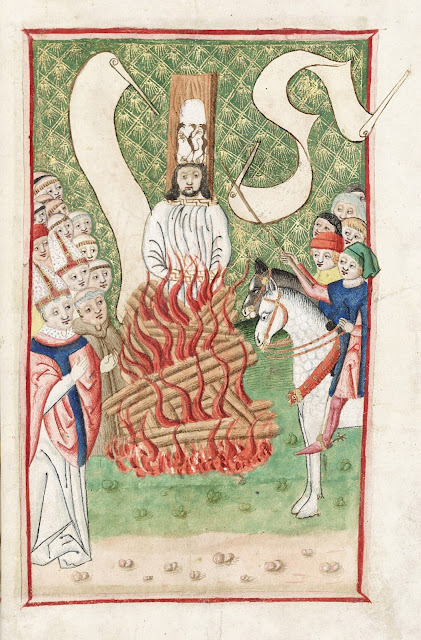
1894 engraving of the execution of Jan Hus
Today you will roast a lean goose, but a hundred years from now you will hear a swan sing, whom you will leave unroasted and no trap or net will catch him for you.
Jan Hus prophesying at his martyrdom in 1415

The English composer Edward Elgar (1857–1934) and his wife enjoyed a long weekend visit in mid-July 1897 with the family of Reverend Alfred Penny (1845–1934), the rector of St. Peter’s Collegiate Church in Wolverhampton. Caroline Alice Elgar (1848–1920) was a childhood friend of the Reverend’s wife, Mary Frances Baker, who married the widower in 1895 and became the stepmother of his only daughter, Dora Penny (1874–1964). On their return to Great Malvern, Alice penned a letter thanking the Penny family for their hospitality. Elgar added a short enciphered missive to his wife’s correspondence, addressing it to “Miss Penny” on the back. The incisive salutation is a classic Elgarian pun. “Miss” is an honorific title for an unmarried woman or girl, but it also functions as the verb “miss” to express regret or sadness over a person’s absence. Elgar was clearly missing Miss Penny when he created his cryptographic pièce de résistance. Dora was unable to decipher Elgar’s enigmatic script and filed it away for over 40 years before eventually publishing it in her 1937 biography.


Elgar’s coded message to Dora Penny is popularly known as the Dorabella Cipher. The name comes from Variation X of the Enigma Variations (1899), a movement dedicated to her that bears the title “Dorabella.” Elgar procured that playful pseudonym from a soprano role for a young unmarried woman in the opera Così fan tutte by Wolfgang Amadeus Mozart. An operatic nickname for Dora was befitting because she was an avid vocalist who sang in the Wolverhampton Choir Society and her father’s rectory choir. As she recalled in her biography, “I was so mixed up with tunes in those days; Choral music, Church music, and orchestral music – and my own solo-singing, scenes from opera, songs, ballads –, and so on.”
The Dorabella Cipher has 87 curlicue symbols arranged in three rows of varying character lengths followed by a fourth row providing the date “July 14 [18]97”. There are 29 characters in row one, 31 in row two, 27 in row three, and 8 in row four. A conspicuous dot appears over the sixth symbol in row three. Three others appear in row four with small dots to the right of “1” and “4”, and a larger dot affixed to the bend in “7”. In all, there are 87 symbols, four rows, four dots, four letters, and four numbers on the Dorabella Cipher.


Fortunately, the key for translating this confounding cast of characters into recognizable cleartext is preserved in one of Elgar’s surviving notebooks. A facsimile of his cipher key is displayed below:

Elgar’s notebook key (1924)

Elgar sketched three distinct glyphs relying on the lower case c as the primary building block. His motive for selecting that particular letter is easy to surmise because c is the initial for cipher and cryptogram. There is persuasive evidence in support of this hypothesis as Elgar wrote some of those identical symbols around the word “Cryptogram” on an index card dating from 1896.


With his three prototypes assembled from one, two, and three stacked cs, Elgar systematically arranged them into eight different triplets using various angles and orientations to generate 24 alphabetic avatars. Elgar assigned the alphabet’s 26 letters to these 24 odd characters by conflating i with j and u with v. Combining similar letters is a standard convention in cryptography. The resemblance of some of Elgar's curlicue characters to the capital cursive “E” from his initials is deliberate, embellishing the cipher with his imprimatur in contrasting guises. Relying on Elgar’s notebook key, the Dorabella Cipher converts into the following unintelligible cleartext:


Elgar used twenty symbols from his lineup of twenty-four characters, omitting those for M, N, O, and Z. The three contiguous absent letters (M, N, O) are an anagram of nom, the French term for “name.” That word appears in nom de plume which is a pseudonym or pen name. Elgar’s signature is conspicuously absent from his coded missive. Could this nom anagram sourced from his missing letters be a clue that Elgar’s name is hidden within the ciphertext? The absence of these four letters parallels the structural emphasis placed on that number by four rows, four dots, four letters, and four numbers. Elgar is clearly hinting at the importance of the number four. One possible explanation could be that the fourth letter of the alphabet is D, the initial for Dora.
Cryptographers are perplexed by the Dorabella Cipher’s seemingly incoherent cleartext. In his history of unbroken cryptograms titled Unsolved!, mathematics professor Craig P. Bauer concedes that the Dorabella Cipher appears to be a simple monoalphabetic substitution cipher (MASC) in which one letter is replaced by one symbol. Gaps between words are excised to make the code even more difficult to unravel. Like modern ciphers, ancient Greek and Classical Latin text omit spaces between words in a practice called scriptio continua. Bauer laments that when applied to the Dorabella Cipher, none of the standard techniques for solving a MASC yield any sensible or credible results. Even the most advanced computer programs fail to make any inroads. Bauer briefly describes and dismisses purported solutions by Eric Sams, Tony Gaffney, and Tim S. Roberts. He laments that the Dorabella Cipher has not yet been solved because Elgar’s system of encipherment must be “something more complicated.”
Recent cryptanalysis of the seemingly impregnable Dorabella Cipher determined that its dotted symbols encode solutions in Latin (AMDG) and German (Magd). Elgar penned the Latin abbreviation “AMDG” on some of his master scores as a sacred dedication. Used to refer to a young unmarried woman, the German word Magd means “maid” and “virgin.” This solution is consistent with the recipient of Elgar’s coded missive, Miss Dora Penny, the young unmarried daughter of Reverend Penny. The Dorabella Cipher also presents some English words as the note is addressed to “Miss Penny” and the month is shown as “July”. Remarkably, these three languages — English, Latin, and German — are an acrostic anagram of the first three letters of ELGAR. The linguistic sophistication of the Dorabella Cipher easily explains why experts failed to penetrate it since they naively assumed it was confined to English. Such a unidimensional mindset is utterly incompatible with an autodidactic polymath like Elgar.


Three of the four absent letters (M, N, O, Z) from the Dorabella Cipher are an anagram of nom, the French word for “name.” Remarkably, the dot above the sixth character in row three of the Dorabella Cipher pinpoints a familiar nickname for Elgar. Relying on Elgar’s notebook key, the raw decryption of the character below the dot in row three is the letter E. A single dot in International Morse Code is also E. Consequently, the dot and the symbol encode Elgar’s initials (EE). Immediately following the encoded E, the next two characters encode the letters D and U/V. The small dot above the ciphertext in the third row tags the text sequence “E D U” which is Elgar’s primary nickname.


Elgar’s wife coined the pet name “Edoo” using the first three letters of the German version of her husband’s forename, Eduard. Elgar assigned this pseudonym to his musical self-portrait in the Enigma Variations (1899), the martial Finale with the title “E. D. U.” Dora Penny was familiar with this pet name as she spent a substantial amount of time around the Elgar family and heard Alice call her husband “Edoo.” This fragmentary decryption confirms that the Dorabella Dots Dedication Cipher is covertly signed by its author. The solution is consistent with the feasibility of spelling nom from absent letters in the cipher and the glaring absence of Elgar’s signature from his note. The discovery of Elgar’s nickname is consistent with other cryptograms in the Enigma Variations that are similarly tagged by his name or initials.
Far from being a random assortment of letters as posited by investigators like Keith Massey, the cleartext presents a coded form of Elgar's name expertly woven into the fabric of the cleartext. Elgar made it an obvious place to look because of the anomalous dot above the sixth character in row three. This “EDU” Dot Cipher furnishes the author's signature conspicuously missing from his missive to Miss Penny. It is astonishing that his signature remained undetected since the cipher was first publicized 85 years ago. One reasonably wonders what else the so-called experts like Massey failed to detect lurking just beneath the surface of the Dorabella Cipher. After all, Elgar's encoded signature was not difficult to spot.
The Dorabella Dot Ciphers encode the abbreviation (A. M. D. G.) for the Latin motto “Ad Majorem Dei Gloriam,” the German word for maid and virgin (Magd), and Elgar’s pseudonym (EDU). The cleartext also has five discrete Spanish words: Peca, ir, cerré, se, and ser. In order of appearance, the first (peca) in row one means “spot” and is directly relatable to the conspicuous dots on the Dorabella Cipher. The second (ir) in row one means “go,” suggesting to go to the singular spot above the sixth character in row three where Elgar’s nickname is enciphered. The third (cerré) in row two means “I closed,” an apt characterization of closing up a message via a cipher. The position of cerré in the second row overlays Elgar’s pseudonym in the third row, visually confirming it is Elgar who is issuing this cryptic statement. The fourth (se) in rows two and three means “I know”, affirming that he knows the solution to his cryptogram. The fifth (nullser) in row three means “to be,” a verb that could serve a clue about the cipher’s construction or key.
My cryptanalysis of the Dorabella Cipher found it has ciphers that encode solutions in Latin, German, and Spanish. Elgar studied Latin and German, but not Spanish. The discovery of these Spanish words in the Dorabella cleartext indicates the participation of Elgar’s wife who was fluent in that Romance language. These cryptograms evaded detection because the experts naively presumed Elgar’s message was confined to English. Additional research uncovered another three-letter name immediately preceding Elgar’s pseudonym in row three where characters 63-65 spell “h-u/v-s”. Those cleartext letters may be read as HUS and HVS. That same name is also produced by characters 50-52 in the second row of ciphertext. 


Elgar provides a vital clue regarding the identity of “Hus” by immediately preceding the first occurrence in row two by characters 48-49 that encode “fr”. Those letters are the standard abbreviation for the Roman Catholic title “Father.” For example, Jerrold Northrop Moore employs this abbreviation in his book Edward Elgar: A Creative Life. Consequently, the cleartext “f r h u/v s” in the second row may be read as “Father Hus.”
Who is Father Hus? Jan Hus (c. 1372–1415) was an influential Czech theologian whose ideas sparked the Bohemian Reformation led by the Hussites, a precursor of Protestantism. Anglicized as John Hus, he was heavily indebted to the writings of John Wycliffe (c. 1320–1384), a priest and seminary professor at the University of Oxford. Wycliffe is recognized as the morning star of the English Reformation that paved the way for the establishment of the Anglican Church. He championed the supremacy of scripture, rejected extra-biblical traditions such as simony and indulgences, and called for the translation of the Bible into the vernacular so it may be read by the people. Wycliffe was the first to translate the Bible into English from the Latin Vulgate. For these beliefs that led him to question the infallibility of the papacy, Wycliffe was posthumously condemned as a heretic at the Council of Constance.

Henry Morley, Emeritus Professor of English Language and Literature at University College London in 1891, trace a continuity of thought between John Wycliffe and John Hus:
In Wycliffe, the young students who came, full of zeal, from Prague to Oxford, found a power beyond that of Milicz and Janow. They studied his philosophy, they listened reverently to his interpretations of the Scripture, and for three years he was a living presence to them. After his death he lived in his writings. The Bohemians copied them and took them home to Prague. The soil was ready for the seed: and among the Bohemians, John Wycliffe’s spirit passed into the body of John Hus.
Like Wycliffe, Hus was studiously unconventional. At the Bethlehem Chapel in Prague, he preached in the Czech language rather than Latin as required by the Roman Catholic Church. His church could accommodate three thousand people, and he delivered more than three thousand sermons during his tenure at Bethlehem Chapel. He refused to don priestly vestments because it promoted an artificial division between clergy and laity. When celebrating the Eucharist, Hus administered both bread and wine in defiance of Roman Catholic convention that arbitrarily reserved the wine exclusively for priests. He championed congregational singing and called for the translation of the Bible into the vernacular so it may be consulted directly by the people. These same beliefs were embraced a century later by the Augustian monk and professor, Martin Luther.
Hus was a trailblazer who exited life’s stage in a literal blaze of glory. He paid the supreme penalty for his convictions by being stripped of his priesthood, excommunicated, and burned at the stake on July 6, 1415. The significance of Hus to Christianity is affirmed by his inclusion in John Foxe’s Book of Martyrs. As the flames and smoke rose around his funeral pyre, he issued a prophetic wordplay on his Czech name “Hus” which means “goose” in Czech. The idiom “Your goose is cooked” probably originated from this event. Hus proclaimed to onlookers gawking at his grim execution:
Today you will roast a lean goose, but a hundred years from now you will hear a swan sing, whom you will leave unroasted and no trap or net will catch him for you.
Many interpret his avian prophecy to portend the rise of Martin Luther. A little over a century after Hus’ death, Luther launched the German Reformation when he nailed his Ninety-Five Theses on the door of Castle Church in late October 1517. While scouring the library stacks at the University of Erfurt, Luther was surprised to stumble across sermons by Hus. As Luther later recalled, “I was overwhelmed with astonishment. I could not understand for what cause they had burnt so great a man, who explained the Scriptures with so much gravity and skill.” Luther was so impressed by Hus’ scholarship that he translated some of his letters and theological writings from the original Latin into German. Luther publicly acknowledged, “We are all Hussites without realizing it.” For Luther, Hus exemplified the original Christian faith espoused by early Church fathers like Paul and Augustine. In contemporaneous paintings and prints, Luther is shown with a swan to represent the fulfillment of Hus’ final prophecy.
The conviction of Hus for heresy was partly orchestrated by Johann Zachariae of Erfurt, a friar in the same Augustinian order that welcomed Luther. Zachariae’s grave is located in front of the high altar of the Augustinian Church in Erfurt. That is the very place where Luther prostrated himself in 1506 when he was inducted into that order. In a profoundly ironic act, Luther consecrated his life to God on the grave of one of Hus’ assassins. An engraving shows Luther symbolically standing next to Hus as they administer the Eucharist. “Hus” is spelled “HVS” using the medieval Latin alphabet. The cleartext sequence “h-u/v-s” in the second and third rows of the Dorabella Cipher permits that identical spelling. Elgar was educated in Latin and would have easily recognized the alternative spelling of “Hus” as “Hvs.”


Another engraving shows a symbolic torch of truth being passed from Wycliffe to Hus and then to Luther. Like the previous example, “Hus” is spelled as “HVS”.


The name “Hus” is not the only Czech word embedded in the seemingly random Dorabella Cipher cleartext. Characters 65-68 in row three spell sedu, the Czech word for seat. This word bridges “HUS” and “EDU” in row three.


Is there some rationale for why Elgar would encode the Czech word for seat? The answer may be found in the trial of Hus at the Council of Constance. In his book Jan Hus Between Time And Eternity, professor Thomas A. Fudge describes how five years of legal proceedings against Hus culminated in a sermo generalis that condemned him as a heresiarch. During this malicious diatribe, Hus was forced to sit on an elevated seat so the assembly could gawk and glare at the condemned. Professor Fudge describes the proceedings:
On a Saturday morning, Hus was made to sit on an elevated seat in the Cathedral of Constance so everyone could see him clearly. The sermon delivered by the Bishop of Lodi took its theme from a phrase extracted out of context from Romans 6:6: “The sinful body should be destroyed.” That Pauline sentence was made to act as a proof text for arguing heretics and heresies must be suppressed. Drawing upon patristic sources, the bishop pointed out that diseased sheep must be expelled from the sheepfold to prevent the entire flock from becoming infected. Moreover, a small fire must be immediately extinguished to save the entire house from destruction. By implication, heretics are infected animals and uncontrollable fires. They must be contained and condemned. Toleration of such threats was tantamount to ecclesiastical misfeasance.
A second explanation for a coded “seat” reference within the Dorabella Cipher’s cleartext may be connected to an incident recounted by Dora about Elgar’s visit in July 1897. She describes his arrival and the events that soon unfolded in her memoir:
The train came in and, of course, not having seen one another for an age, the two friends [Alice and Mary] fell upon each other and Mr. Elgar was left for me to look after. I quickly found out that music was the last thing he wanted to talk about. I think we talked about football . . .
He came into the drawing-room before luncheon: ‘Hullo, there’s the black piano. Let’s see how its inside has stood the move.’
    Although I had not left school very long I had heard a number of good pianists, but I had never heard anything quite like this. He didn’t play like a pianist, he almost seemed to play like a whole orchestra. It sounded full without being loud and he contrived to make you hear other instruments joining in. It fascinated me . . .
    After luncheon that first day we all went to the drawing-room for coffee and he took hold of a high-backed wooden chair to bring it forward—and its back came off.
    ‘Here’s another old friend and its back still comes off. Why don’t you mend it?’
    I said it was a job which got put off to another day.
    ‘Well, this is the day. Got any tools?’
    So, after coffee, bearing with us the chair, we departed to my sitting-room and started on it.
    ‘Now clearly understand,’ he said, ‘if this is a success I mended it; if it’s a failure you did it.’
    That, I think, sealed our friendship.
In this charming anecdote, Elgar likens a chair to an old friend. More significantly, he and Dora became fast friends over a derelict chair. One of the synonyms for chair is seat. Elgar’s Czech camouflage ensured his cleartext reference to a seat remained transparently concealed.
The inclusion of some Spanish words in the Dorabella Cipher’s cleartext may have been motivated by an episode from Hus’ imprisonment. A Spanish Minorite Friar and Chaplain to King Ferdinand of Aragon, Fra Andreas Didachus de Moxena, pretended to be a lowly simple monk when he repeatedly interrogated Jan Hus during his incarceration in the dungeon of a Dominican monastery. He carried out this ruse in an attempt to dupe Hus into committing heresy in the seclusion of his cell. Hus refused to fall for such a transparent ruse.
Why would Elgar encode the name of a proto-reformer in a message to Dora Penny? There are unmistakable parallels between Dora Penny’s father and Hus who were educated in theology, ordained as ministers, and served as rectors. Raised in the Anglican tradition, Dora would have known about the life and legacy of John Hus. She was an active participant in congregational singing, a means of educating the people about God and the scriptures through song. Hus was a proponent of congregational singing. On his way to the stake to be burned alive, he sang psalms and responsories.
Would Elgar have known about Jan Hus? Living and working in a predominantly Anglican society enhanced that probability. His access to an eclectic library during his youth also likely introduced him to that Bohemian reformer. As Elgar would later recollect:
I had the good fortune to be thrown among an unsorted collection of old books. There were books of all kinds, and all distinguished by the characteristic that they were for the most part incomplete. I busied myself for days and weeks arranging them. I picked out the theological books, of which there were a great many, and put them on one side. Then I made a place for the Elizabethan dramatists, the chronicles including Barker’s and Hollinshed’s, besides a tolerable collection of old poets and translations of Voltaire and all sorts of things up to the eighteenth century. Then I began to read. I used to get up at four or five o’clock in the summer and read—every available opportunity found me reading. I read till dark. I finished reading every one of those books—including the theology. The result of that reading has been that people tell me that I know more of life up to the eighteenth century than I do of my own time, and it is probably true.
Elgar had an interest in Reformist literature. For example, in a letter he wrote, “I found a lovely old volume ‘Tracts Against Popery’ – I appeased Alice by saying I bought it to prevent other people seeing it - but it wd . make a cat laugh.” Elgar’s wife was born into a prominent Anglican family and was still practicing that faith when they married in 1889. In response to her decision to marry beneath her social status and outside of her faith, the family retaliated by writing her out of the will. Alice’s influence on the Dorabella Cipher is evident by the appearance of some Spanish words in the cleartext. Her knowledge of Anglican Church history surely included an awareness of the connection between Wycliffe and Hus. For this reason, she was undoubtedly instrumental in commending Hus as a worthy subject to encipher within the cleartext.
Like Hus, Elgar was a serious student of the Bible. His friend Billy Reed remarked that Elgar’s “knowledge of the Bible and the Apocrypha was profound.” Elgar’s personal library held many translations of the Bible and biblical commentaries. He served for over a decade as an organist at St. George's Catholic Church where congregational singing in English was common. He composed sacred choral works in the English language and set many biblical passages to music in works like Lux Christi, The Apostles, and The Kingdom. He attended both Catholic and Protestant services. One of his personal heroes was General Gordon, a high Anglican. He befriended Roman Catholics and Protestants. For example, the majority of his friends depicted in the Enigma Variations were Anglican. Like Luther, Elgar could claim to be a Hussite without ever fully realizing it. The pairing of “Hus” with “EDU” in the third row of the Dorabella Cipher favors this conclusion.
My cryptanalysis of the Dorabella Cipher found it employs at least five different languages: Czech, English, German, Latin, and Spanish. Elgar’s use of five languages is an effective strategy for hardening his cipher against decryption. The experts were so convinced that the Dorabella Cipher had to be solely in English that they never bothered to check for Czech. That prospect did not even occur to me until I stumbled on the cleartext in row two that unveils “Father Hus.” More work remains to be done as the complete message of the Dorabella Cipher has yet to be decoded. The available evidence suggests that it consists of words in multiple languages. The added complexity of a polyglot cryptogram will it far more onerous to decrypt. To learn more about Elgar’s obsession with cryptography, read my free eBook Elgar’s Enigmas ExposedPlease help support and expand my original research by becoming a sponsor on Patreon.


About Mr. Padgett

My photo
Mr. Padgett studied violin with Michael Rosenker (a student of Leopold Auer), and Rosenker’s pupil, Owen Dunsford. Mr. Padgett studied piano with Sally Magee (a student of Emanuel Bay), and Blanca Uribe (a student of Rosina Lhévinne). He attended the Stevenson School in Pebble Beach, California, and Vassar College in Poughkeepsie, New York, where he graduated Phi Beta Kappa with a degree in psychology. At Vassar he studied music theory and composition with Richard Wilson. Mr. Padgett has performed for Joseph Silverstein, Van Cliburn, Arnold Schwarzenegger, Maria Shriver, Steve Jobs, Prince Charles, Lady Camilla, Marcia Davenport, William F. Buckley, Jr., and other prominent public figures. His original compositions have been performed by the Monterey Symphony, at the Bohemian Grove, the Bohemian Club, and other private and public venues. In 2008 Mr. Padgett won the Max Bragado-Darman Fanfare Competition with his entry "Fanfare for the Eagles." It was premiered by the Monterey Symphony under Maestro Bragado in May 2008. A member of the Elgar Society, Mr. Padgett is married with five children.