Translate

Showing posts with label Caesar. Show all posts

Wednesday, December 29, 2021

Decoding Elgar’s Liszt Fragment Ciphers


Ich kraxele auf der Leiter
Und komme doch nicht Weiter.
(I scramble up the ladder
And still don’t get any further)

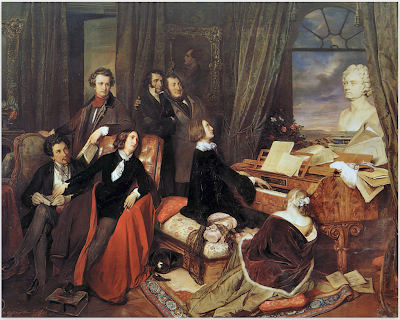
A rhyming couplet by Franz Liszt to Bettina von Arnim

The British composer Edward Elgar (1857–1934) is remembered for his regal Pomp and Circumstance Marches and significant contributions to the symphonic repertoire such as his perplexing Enigma Variations and noble Symphony No. 1 in A-flat major. He bequeathed an extraordinary and enduring legacy for orchestra, choir, and solo instruments such as the violin and cello. While the public is generally aware of Elgar’s musical genius, they remain largely unfamiliar with his other lifelong passion for cryptography. Like his music, Elgar left behind coded masterpieces that have fascinated and confounded experts and amateurs for over a century. The objective of this essay is to describe and decrypt his earliest known cryptogram, the Liszt fragment. The solution was realized almost exclusively by Wayne Packwood and is presented with the assistance of Robert Padgett whose supplementary analysis uncovered corroborating evidence for Packwood’s decryption.

Elgar's Liszt Fragment Cipher

The Liszt fragment cipher is a short sequence of curlicue-like symbols penciled in the margin of a concert program dating from April 10, 1886. Almost 136 years ago, Elgar attended a performance conducted by August Manns (1825–1907) at London’s Crystal Palace in honor of the eccentric Abbe Franz Liszt (1811–1886). A famous piano virtuoso and influential romantic composer, Liszt coined the term recital for his solo concerts and the expression Poème Symphonique (Symphonic Poem) to describe thirteen of his orchestral works. Below is a page from that evening’s program discussing Liszt’s Les Préludes Symphonic Poem No. 3 with Elgar’s enigmatic string of characters penciled in parallel with a long vertical bracket.


A closer view of that cryptic fragment shows eighteen symbols followed by a long dash.


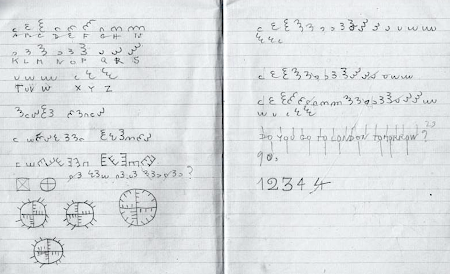
These squiggly characters and their decryptions are conveniently preserved in one of Elgar’s surviving notebooks. He devised three distinct glyphs using the lower case c as the primary building block and organized them into eight distinct groups with different angles and orientations to generate 24 cryptographic avatars. Elgar assigned the alphabet’s 26 letters to these 24 characters by conflating i/j and u/v. Pairing similar letters is an established practice in cryptography.


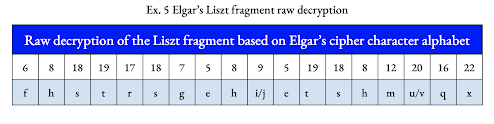
The letters represented by Elgar’s cryptic characters were translated into serial numbers to facilitate cryptanalysis.


The raw translation of the Liszt fragment yields the following unintelligible ciphertext:


The respected Elgar scholar Jerrold Northrop Moore endorses a decryption proffered by Anthony Thorley that reads, “GETS YOU TO JOY, AND HYSTERIOUS.”[1] In his book Unsolved!, mathematician Craig P. Bauer contends Thorley’s purported solution does not add up as its 26 letters far exceed the 18 characters in the Liszt fragment. Bauer concludes that all prior attempts to crack this cipher “don’t make much sense” and that it “must...be considered unsolved.”[2]

Which Encryption Key?

Assuming that the plaintext is restricted to Elgar’s native language, certain letters evince higher frequencies than others and may be correlated with characters exhibiting similar frequencies. However, a cipher with fewer symbols than letters in the alphabet blunts the effectiveness of such an investigative tool. A short ciphertext necessitates experimentation to assess prospective encryption techniques to unmask the key(s). The Liszt fragment is Elgar’s earliest known cryptogram, so it is reasonable to test elementary encipherment methods before considering more sophisticated techniques.
What basic encryption method should be evaluated first? Liszt's public reputation implicates an exquisitely specific answer to that query. His extraordinary triumphs in the concert halls of Europe were glorified by a fawning press that elevated him to the status of a military hero. Dana Gooley, a Professor of Music at Brown University, captures the cultural context of Liszt’s rise and quasi-martial status:
Tales of great conquerors of antiquity formed an integral part of the popular culture of Liszt’s contemporaries. Caesar and Alexander, in particular, were a ubiquitous presence in popular literature and educational curricula . . . Already during his virtuoso travels, Liszt had acquired a mythical public identity that drew him into the orbit of these conquerors.[3]
In keeping with his public persona, Liszt was inundated with gifts and medals from European nobility. A group of Hungarian noblemen presented him with a ceremonial sword during his visit to the city of Pest. When Liszt strode out on stage donning his glimmering medals and ceremonial sword, he looked more like a decorated general than a musician. His musical conquests invited constant comparisons to Julius Caesar (100 BC–44 BC). The composer Carl Goldmark (1830–1915) recounts a revealing incident at the Vienna Musician’s Society (Tonküstler-verein) attended by the acclaimed pianists Liszt, Anton Rubinstein (1829–1894), and the composer Johannes Brahms (1833–1897). Goldmark’s recollection is published in a 1909 issue of The Etude magazine:
At the foundation of the present Tonküstler-verein in Vienna, there was a large number of distinguished musicians assembled in the supper room of the Musikverein. Liszt, Rubinstein, Brahms were present and sat near each other at supper. Somebody let fall the word “triumvirate.” Rubenstein said, pointing to Liszt, “Caesar”; to himself, “Brutus,” and then to Brahms, “Lepidus.”[4]

A Brute Force Decryption

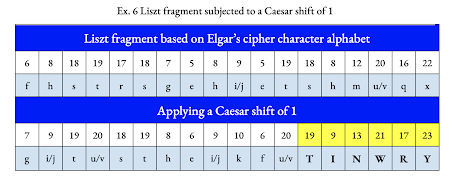
These constant comparisons of Liszt to Caesar bolster the suspicion that Elgar may have constructed his Liszt fragment using a Caesar shift cipher. This encipherment system is named after Julius Caesar who used it to encode military and governmental communiqués. The Roman historian Suetonius (c. 69–after 121) records how Caesar enciphered messages to Cicero (106 BC–43 BC) and other Roman elites by shifting plaintext letters three places further down in the alphabet.[5] The traditional Caesar shift substitutes a plaintext letter with another using a fixed number of positions away in the alphabet. For example, a Caesar shift of 1 replaces the letter A with B. The application of a Caesar shift of 1 to the Liszt fragment produces the following plaintext:


A Caesar shift of 1 transforms the last six ciphertext letters of the Liszt fragment into the recognizable English words “tin” and “wry.” The statistical odds of realizing six letters in a row that spell two recognizable words applying a Caesar shift of 1 is too unlikely for a random formation. In a musical context, the term “tin” may be used in conjunction with “ear” to denote a “deafened or insensitive ear.”[6] The word “wry” is defined in two ways. “Wry” can mean “bent, twisted, or turned usually abnormally to one side.”[7] It is also defined as “cleverly and often ironically or grimly humorous.”
Elgar used the word “wry” in his correspondence. In a letter to Troyte Griffith (1864–1942) dated February 10, 1918, Elgar lamented, “Well, I wish you were here: I have had a long and dreary time and should like a sight and a word, but these wry-necked times make it impossible to move.”[8] The partial decryption of the last six letters from the Liszt fragment using a Caesar shift of 1 presents a promising breakthrough. More significantly, it may be safely deduced that Elgar applied alternate Caesar shifts to the ciphertext letters. The application of divergent Caesar shifts within a cryptogram is classified as a Vigenère cipher, a sophisticated polyalphabetic substitution method typically reliant on a keyword or phrase.
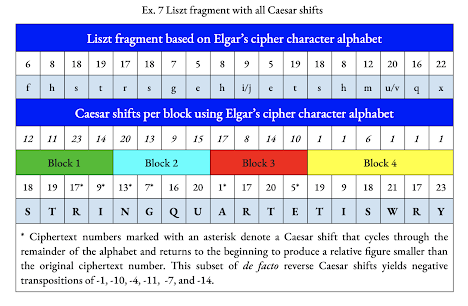
When Caesar was assassinated in the Roman Senate, he reportedly asked, “Et tu, Brute?” That Latin phrase translates as “And you, Brutus?” This question is immortalized in Act III Scene 1 of the play Julius Caesar by William Shakespeare (1564–1616). Caesar directed the query to his friend Marcus Junius Brutus (85 BC–42 BC) who joined the cabal in executing the gruesome murder. Caesar’s last words intimate the method for cracking Elgar’s Liszt fragment cipher — a brute-force decryption. Exhaustive experimentation was required to unmask the Caesar shifts for ciphertext letters, a process known as “brute-forcing” a cipher. The final decryption “STRING QUARTET IS WRY” with the corresponding Caesar shifts is shown below:


A string quartet consists of four parts: Violin 1, Violin 2, Viola, and Cello. Likewise, this cipher consists of four parts labeled Block 1 through Block 4. The first three blocks are of comparable size with each possessing four ciphertext letters. Block 4 is noticeably larger with six ciphertext letters. Similarly, the upper three voices in a string quartet (Violin 1, Violin 2, and Viola) are nearly identical in size. Like Block 4, the fourth and lowest instrument of the string quartet (Cello) is substantially larger.
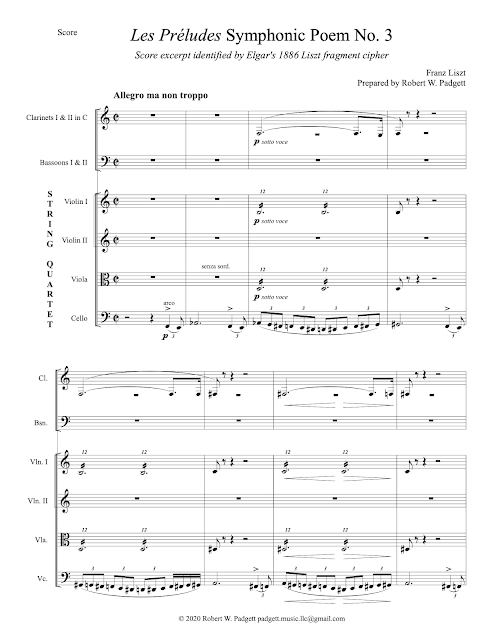
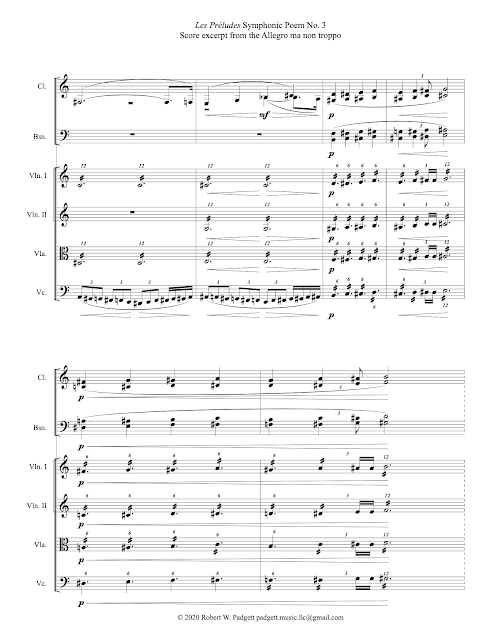
Elgar bracketed the midsection of his program where he penciled in the Liszt fragment near its top. Just above the bracket, it reads, “The ‘working out’ section commencing :—” The long dash mirrors what is observed at the end of the Liszt fragment. The short score at the uppermost part of Elgar’s bracket refers to the Allegro ma non troppo of Les Préludes No. 3. Remarkably, the opening of this section is orchestrated almost exclusively for the string quartet with only a single line played by the principal clarinet that is later joined by the second clarinet and bassoons. The string part is quietly frenetic with rapid chromatic runs in the cello line accompanied by tense sotto voce tremolos that crescendo and decrescendo in the upper strings. Consequently, the decryption “STRING QUARTET IS WRY” is contextually appropriate and an apt characterization of Liszt’s orchestration in this passage addressed by the bracketed portion of the program. The orchestration elegantly affirms the efficacy of this solution.


Diana McVeigh is a respected British musicologist and the author of Elgar: The Music Maker. She furnished program notes for a 2011 recording by the Goldner String Quartet of Elgar’s E minor Op. 83. McVeigh writes, “The mood of the String Quartet in E minor Op 83 is wry, the sharp rhythmic gestures at odds with the hollow, irresolute harmonies.”[9] Her use of the term “wry” to characterize a string quartet is hardly an isolated instance of a knowledgeable student of music employing such language to describe such an ensemble.
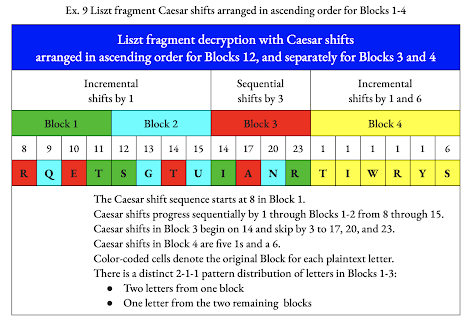
Although the Caesar shift patterns within the Liszt fragment decryption may initially appear random, this is far from the case as a detailed analysis uncovered a sophisticated underlying structure. This pattern is more easily observed when the Caesar shifts are arranged in ascending order for Blocks 1-4:


There is a clear pattern of Caesar shifts rising incrementally by 1 starting on 8 in Block 1 (8, 9, 10, 11) and continuing stepwise through 15 in Block 2 (12, 13, 14, 15). The ascending Caesar shifts in Block 3 (14, 17, 20, 23) start on 14 with each subsequent shift rising by 3 before ending on 23. The shift by 15 is bookended by 14. Caesar shifts in Block 4 are 1 and 6. The use of divergent Caesar shifts within each Block considerably complicates the key and hardens the cipher against decryption. In all, there are thirteen different types of Caesar shifts ranging from 1, 6, 8-15, 17, 20, and 23.
Elements of the decryption key are suggested by the orchestration in the inaugural four bars from the Allegro ma non troppo. The first two bars cover a span of eight quarter notes. Similarly, Blocks 1 and 2 cover eight plaintext letters encoded by incremental Caesar shifts of 1 beginning with 8. In these opening two bars, the cellos play a subject that begins on F that descends stepwise to E. Those two adjacent note letters repeated in the opening two bars suggest a Caesar shift of 1. The third bar of the Allegro ma non troppo is dominated by a chromatic series of four triplets also performed by the cellos. These rhythmic contours in the third bar are mirrored by Block 3 with four plaintext letters enciphered by sequential Caesar shifts of 3. There are six written notes in the fourth measure of this section. Likewise, there are six plaintext letters in Block 4.

A Passwords Key

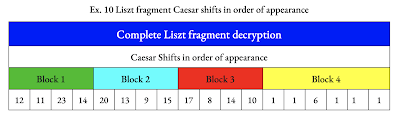
Meticulous analysis revealed that the ordering of these Caesar shifts appears to be rooted in a series of passwords that serve as keys. The 18 Caesar shifts in order of appearance are shown below:


Converting the numbers of those Caesar shifts into their corresponding letters of Elgar's cipher alphabet using a simple number-to-letter key (1 = A, 2 = B, 3 = C, etc.) generates the following plaintext:


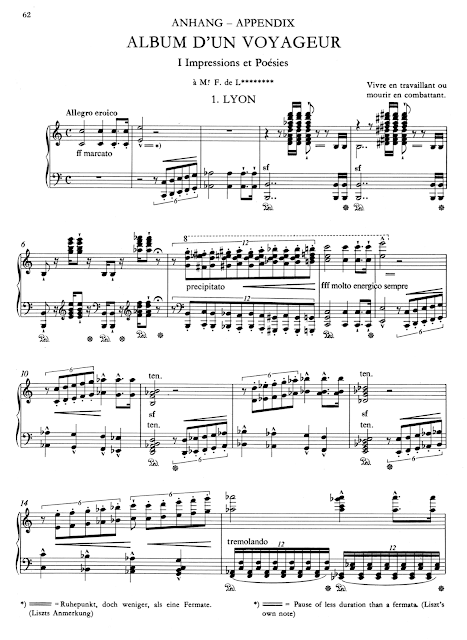
Letters two through six immediately stand out as they spell “LYOUN,” the old French word for lion. The name of the French city Lyon originates from that antiquated spelling. Liszt’s primary spoken language was French, and he enjoyed a long association with the city of Lyon. In late 1834 and early 1835, he composed a defiant piano solo called Lyon published in 1840 as part of his Album d'un voyageur (Traveler’s Album).[10] Like his later Les Préludes No. 3, Lyon is written in the key of C major. Liszt recorded the following motto on its score, “Vivre en travaillant ou mourir en combattant.” The English translation reads, “Live while working or die while fighting.” The motto was inspired by an uprising of local silk weavers protesting unbearable working conditions. Elgar was a proficient pianist and was undoubtedly familiar with Liszt’s popular piano solo Lyon.


Elgar was an ardent Wagnerian whose interest in Liszt was undoubtedly fueled by his intimate friendship with that revolutionary German composer. In 1854, Liszt sent Richard Wagner (1813–1883) some music written to commemorate the 100th birthday of the famous German poet and playwright Johann Wolfgang von Goethe (1749–1832). Wagner replied, “I compare it to the claw by which I recognise the lion; but now I call out to you, Show us the complete lion…”[11] Wagner likened the music of Liszt to a lion likely as a wordplay on Lyon. Liszt received many titles and honors. One of his most notable titles was the Cross of the Lion of Belgium conferred on July 18, 1842.[12] The association between Liszt and the lion is so prevalent that musicologist Alan Walker calls Liszt “The Lion of Weimar.”[13]
Liszt dedicated his composition Lyon to "M. F. de L." The first two letters of the plaintext description of the Caesar shifts are M and L. The ciphertext for the plaintext M is F, the remaining initial in Liszt's dedication. Consequently, all three initials from Liszt's dedication (MFL) are recorded by the original plaintext (6) and Caesar shift plaintext (12, 11) in conjunction with a phonetic spelling of Lyon. Such an uncanny combination reeks of intelligent design.
The seventh and eighth letters are I/J and P. Elgar was fond of practical jokes that he called japes. When treated as a noun, a jape is defined as “something designed to arouse amusement or laughter.” When used as a verb, jape means “to say or do something jokingly or mockingly.”[14] Elgar’s correspondence bristles with inventive phonetic or trick spellings. For example, he respelled “excuse” as “xqqq.” Other exemplars of Elgar’s creative spellings are listed below:
  1. Bizziness (business)
  2. çkor (score)
  3. cszquōrrr (score)
  4. fagotten (forgotten)
  5. FAX (facts)
  6. frazes (phrases)
  7. gorjus (gorgeous)
  8. phatten (fatten)
  9. skorh (score)
  10. SSCZOWOUGHOHR (score)
The realization that Elgar was an enthusiast for unconventional spellings permits a reading of the adjacent letters “JP” as a phonetic rendering of jape. The inclusion of the “I” permits a phonetic reading of “I JP” as “I jape.” The Liszt fragment cipher encodes a wry jape in Elgar’s native language. In commenting about another more famous cipher by Elgar that employs the same characters found in the Liszt fragment, Bauer suspects “. . . the reason the automated programs fail to break the Dorabella cipher is because much of it consists of misspelled words and words invented by Elgar . . .”[15] Consistent with Bauer’s hunch, Elgar deploys some phonetic misspellings in his Liszt fragment password key.
The ninth, tenth, and eleventh letters are “RHP.” The letter “R” is a homonym of “Our.” The letters “HP” form a phonetic spelling of “Hope.” The plaintext cluster “RHP” may be interpolated as “Our Hope.” The final seven plaintext letters are “KAAFAAA.” This plaintext series is a phonetic rendering of the German word “Kaffee” that translates as coffee. Remarkably, the last two letters in the correct German spelling “Kaffee” furnish Elgar’s initials (EE). The German poet Heinrich Heine (1797–1856) coined the term “Lisztomania” to describe how young women venerated Liszt by vying for his discarded gloves, plucking hairs from his head as keepsakes, retrieving his cigar butts and secreting them away in their corsets, and saving the dregs from his coffee cups in small vials.[16] There is an unmistakable comical connection between Liszt, coffee, and his adoring fans.
Siegfried Wagner recalled an amusing coffee prank perpetrated by Liszt at a dinner party hosted by an aristocratic matron. When served coffee, Liszt helped himself to a domino of sugar using his fingers rather than the sugar-tong. Repulsed by Liszt’s unsanitary table manners, the Madame ordered the butler to immediately empty the sugar bowl out the window and refill it. Nonplussed, Liszt quietly finished his coffee, proceeded to the same window, and tossed his cup outside. When the Madame protested, Liszt politely replied, “If Madame would throw the sugar out because my fingers had touched it, she surely would not drink again from a cup my lips had touched.”[17]
Only one French term and one English word are spelled correctly in this password key with the remaining English and German words realized phonetically. As amply testified to by his correspondence, phonetic spellings bear Elgar's cryptographic fingerprints. The password key that encodes the Caesar shifts is written as “M LYOUN I/JP RHP KAAFAAA.” Remarkably, these letters appear in this precise order within the key. The phonetic translation of this password key reads, “M(F) LYOUN, I JAPE OUR HOPE COFFEE.” There are two French elements, four English terms, and one German word. Three languages are employed in this password key:
  1. French
  2. English
  3. German
The use of multiple languages with some phonetic spellings hardens this keyword cipher against decryption. The sum of these languages is reflected by the number three assigned to Les Préludes. The choice of languages reflects the lingua franca of Liszt (French and German) and Elgar (English). In his youth, Elgar studied the German language because he dreamed of attending the Leipzig Conservatory, Germany's oldest university school of music. The notes of the recurring motive performed by the cellos in the fourth bar of the Allegro ma non troppo are G-sharp, F, and E. Those three note letters conveniently furnish the initials for those three languages: German, French, and English. The cellos perform those same pitches in the first two bars of this section with the G-sharp respelled enharmonically as A-flat.

A Ringing Endorsement

Ciphertext numbers marked with an asterisk indicate a Caesar shift that cycles through the entire alphabet and returns to the beginning to produce a relative figure smaller than the original ciphertext number. For example, a ciphertext number of 18 (S) subject to a Caesar shift of 23 adds up to 41, a sum greater than the 24 characters in Elgar’s cipher alphabet. The shift from the first letter of the alphabet is the difference of 41 less 24 which yields 17 (R). This would be the equivalent of a Caesar shift of -1, a step backward by one letter. A total of six Caesar shifts circle back to the beginning of the alphabet with two in each of the first three blocks. The consistent distribution of two de facto negative Caesar shifts in the first three blocks indicates deliberation and design.
In all, six of the eighteen plaintext letters in the Liszt fragment are encoded by negative Caesar shifts. These reverse Caesar shifts (-1, -10, -4, -11, -7, -14) apply to ciphertext letters in positions 3-6, 9 and 12. Six of eighteen letters constitute 33 percent of this cryptogram. The number 33 is the mirror image of Elgar’s initials consisting of two cursive capital Es. Such a precise percentage mathematically implies a coded version of Elgar’s initials.
Further analysis revealed that this set of negative Caesar shifts constitutes a sub-cipher within the password key. In order of appearance, the plaintext for the first four reverse Caesar shifts spells “RING.” The orchestral score of Les Préludes No. 3 includes “Becken,” the German name for cymbals. That percussion instrument produces a loud crash followed by a sustained ring that may be dampened by placing the cymbals’ edges against the performer’s chest. Liszt’s scoring in the concluding Andante maestoso does not call for dampening the cymbals, permitting them to ring out above the orchestra.
The word “RING” is also closely associated with Richard Wagner (1813–1883) and his colossal opera cycle Der Ring des Nibelungen (The Ring of the Nibelung). Referred to simply as the Ring, Wagner composed this series of four operas that require approximately 15 hours to perform. Liszt was an early and generous supporter of Wagner, a romantic composer whose music exerted a profound and lasting influence on Elgar. Elgar’s absorption and distillations of leitmotifs from Wagner’s operas are widely acknowledged in his compositions. Wagner effusively praised Liszat’s invaluable assistance following the August 1876 premiere of the Ring at Bayreuth, a unique opera house and shrine explicitly built for Wagner’s Gesamtkunstwerk (Total artwork). Wagner toasted Liszt in these words:
For everything I am and have achieved I have one man to thank, without whom not a single note of mine would be known, a dear friend who, when I was banned from Germany, with incomparable devotion and self-sacrifice drew me to the light and first recognized me. To this dear friend is due the highest honour. It is my noble friend and master, Franz Liszt![18] 
The first four plaintext letters revealed by negative Caesar shifts spell “RING” and allude to Liszt’s intimate connection to Wagner’s extraordinary opera cycle. There are four operas in the Ring, and likewise, there are four blocks in Elgar’s cipher. A consideration of the remaining two plaintext letters produced by negative Caesar shifts (A and E) with the original four letters is the anagram “A RING - E.” This may be read as “A RING” with Elgar’s initial appended at the end.
Negative Caesar Shifts (-1, -10, -4, -11, -7, -14) apply to ciphertext letters in positions 3-6, 9 and 12 of the Liszt fragment. The application of a number-to-letter key (1 = A, 2 = B, 3 = C, etc.) to those letter positions using Elgar’s cipher alphabet yields C, D, E, F, I/J, and M. The sequential application of the negative Caesar shifts (-1, -10, -4, -11, -7, -14) to those letters produces B, S, A T, B, and X. That assortment of letters is an anagram of “BXSTAB,” a phonetic rendering of “Backstab.” Two principal characters from Wagner’s Ring cycle are Brunhilde and Siegfried. Brunhilde uses a magic potion to protect every part of Siegfried’s body except for the small of his back. In Act III of Gӧtterdämmerung (Twilight of the Gods), the fourth and final opera in the Ring cycle, Siegfried is murdered when Hagen stabs him in the back with a spear. This ancillary cryptogram intersects elegantly with the encoding of “RING” by the negative Caesar shifts. Like Siegfried, Caesar was stabbed to death by rivals whom he mistakenly believed were trusted allies.

Summation

The efficiency and multilayering of the Liszt fragment ciphers present an impressive demonstration of Elgar’s cryptographic prowess. With three characters oriented at diverse angles, he efficiently generates 24 symbols that replace the English alphabet’s 26 letters by conflating the letters i/j and u/v. These curlicue symbols are the first layer of encryption. Liszt’s longstanding reputation as a musical “Caesar” fueled the suspicion that Elgar deployed a Caesar shift system to construct his enigmatic fragment. Brute-forcing the cipher revealed its eighteen characters encode the phrase “STRING QUARTET IS WRY.” The decryption draws on a combination of thirteen different Caesar shifts within four blocks, three with four letters and one with six. Thirteen different Caesar shifts form the second encryption layer.
The Liszt fragment is penciled next to the program note that discusses the Allegro ma non troppo section of Les Préludes No. 3. The orchestration of that passage is dominated by the string quartet with the cellos playing rapid chromatic runs below energetic tremolos that crescendo and decrescendo in the upper strings. The phrase “STRING QUARTET IS WRY” is an apt characterization of this passage, rendering this decryption of the Liszt fragment as contextually accurate and appropriate. 
Viewing the decryption through the lens of Elgar’s musical expertise permits a deeper appreciation of his cryptogram’s ingenious construction. Four blocks and their respective complement of letters mirror the number of instruments and their relative sizes within a string quartet. Blocks 1 through 3 share an equal complement of four letters, and Block 4 has six. A string quartet consists of two violins, one viola, and one cello. The violin and viola are nearly identical in size, but the cello is much larger. Like the 2-1-1 distribution of the instruments in a string quartet, Elgar’s Caesar shifts are distributed in a 2-1-1 pattern within Blocks 1-3 where two are drawn from one Block and two from the remaining Blocks.
The mechanism of Elgar’s cryptogram relies on a series of thirteen different Caesar shifts. Although many Caesar shifts may appear random, an in-depth analysis reveals they are distributed in a sophisticated pattern that suggests a passphrase key. When converted into their respective letters from Elgar’s cipher alphabet, they produce a series of recognizable words and phrases in French, English, and German. The passphrase key begins with “M” followed by “LYOUN,” the old French spelling of Lyon. Liszt’s well-known piano piece Lyon is dedicated to “M.F. de L.” The plaintext letter M corresponds with the ciphertext F (the second initial of the dedication), and the third initial (L) overlaps with the spelling of “LYOUN.” This first part of the cipher key consists of two parts in French, Liszt’s preferred conversational language.
The second part of the passphrase key is “I/JP.” The letter “I” is the first person pronoun that refers to Elgar. The letters “JP” are a phonetic adaption of “Jape.” Elgar orchestrated practical jokes that he called “japes.” The letters “I/JP” is a phonetic version of the phrase “I jape” that conveys Elgar’s known proclivity for pranks and mockery. The Liszt fragment encodes a wry remark about the orchestration of the Allegro ma non troppo, constituting a concealed jape.
The third part of the passphrase key is “RHP”. The letter “R” is a phonetic version of “Our.” The letters “HP” are a phonetic rendering of “Hope.” The letters “RHP” produces a phonetic rendition of the phrase “Our Hope.” The fourth and final part of the password key is “KAAFAA.” This is a phonetic spelling of Kaffee, the German word for coffee. Remarkably, the last two letters in that German term replicate Elgar’s initials. The letters “I/JP R HP KAAFAA” generate the phrase “I jape our hope coffee.” These phonetic words reflect Elgar’s affinity for unconventional spellings, a cunning tactic to thwart cryptanalysis. Liszt spoke French and German. Elgar’s native language was English, but he also learned to read, write, and speak German. These linguistic links to Liszt and Elgar bolster the efficacy of this secondary password key that furnishes a third tier of encryption.
There are six Caesar shifts in the Liszt fragment cipher that “wrap around” the alphabet and replace ciphertext with plaintext appearing earlier in the alphabet. The first four of these reverse Caesar shifts occur consecutively in the 3rd through 6th positions and spell “RING.” Liszt is closely associated with Wagner’s famous Ring Cycle. When “RING” is contemplated with the remaining plaintext letters for the remaining two negative Caesar shifts in the 9th (A) and 12th (E) positions, it permits the anagram “A RING - E.” This may be read as the phrase “A RING” followed by Elgar’s initial. This cipher within the decryption presents a fourth layer of encryption.
Ciphertext letters in positions 3-6, 9, and 12 of the Liszt fragment are subjected to effective negative Caesar shifts of -1, -10, -4, -11, -7, and -14. The application of a number-to-letter key to those letter positions using Elgar’s cipher alphabet yields C, D, E, F, I/J, and M. The application of the negative Caesar shifts (-1, -10, -4, -11, -7, -14) in sequence to those ciphertext letters produces B, S, A T, B, and X. That assortment of letters is an anagram of “BXSTAB,” a phonetic rendering of “Backstab.” In Act III of Gӧtterdämmerung, Hagen assassinates Siegfried by stabbing him in the back with a spear. This fifth layer of encryption elides elegantly with the “RING” sub-cipher associated with the negative Caesar shifts. Like Siegfried, Caesar was betrayed by poseurs feigning to be allies and bludgeoned to death.
Elgar’s Liszt fragment has resisted all attempts at a solution for 135 years. Now the reasons for its resilience are manifest. Its mechanism is coyly suggested by the construction of its characters from the lowercase “c” shifted into contrasting configurations, for that letter is the initial for Caesar. The Liszt fragment is a sophisticated multilayered, multidisciplinary, and multilingual Vigenère cipher that enciphers a narrow band of consistent and mutually supportive solutions. Both Liszt's reputation as a musical “Caesar” and his music furnish critical clues for unlocking Elgar's earliest known cryptogram. It is extraordinary how much information was efficiently encoded within these eighteen enigmatic characters. Please help support and expand my original research by becoming a sponsor on Patreon.


About the Authors

Wayne Packwood

Mr. Packwood attended Binley Park Coventry school before joining the Army. After serving in the Army for four years, he joined the Electrical Engineering firm Lee Beasley where he was employed for a decade. During his tenure at Lee Beasley, he became a qualified Electrical Engineer by completing coursework and training through the Joint Industry Board of Electrical Engineers. He next joined AT&T as a Project Manager where he was promoted to middle management and supervised a team of 19. Mr. Packwood is self-taught in the discipline of cryptography. His original research was published in the July 2020 issue of the journal Musical Opinion. A member of the Elgar Society, he presently serves as a carrier with Royal Mail.

Robert W. Padgett

Mr. Padgett graduated from Vassar College Phi Beta Kappa and Magna Cum Laude with a degree in Psychology. He has performed on the violin for Prince Charles, Lady Camilla, Steve Jobs, Arnold Schwarzenegger, Maria Shriver, Gavin Newsom, George Shultz, William F. Buckley, Jr., Van Cliburn, Joseph Silverstein, Marcia Davenport, and other public figures. His original compositions have been performed by the Monterey Symphony, at the Bohemian Grove, the Bohemian Club, and other private and public venues. In 2008, Mr. Padgett won the Max Bragado-Darman Fanfare Competition with his entry Fanfare for the Eagles. It was premiered by the Monterey Symphony under Maestro Bragado-Darman in May 2008. Mr. Padgett is a member of the Elgar Society and has presented papers at annual conferences. Married with five children, he resides in Plano, Texas, where he teaches violin, viola, piano, music theory, and composition.


FOOTNOTES

  1. Moore, Jerrold Northrop. Edward Elgar: A Creative Life (Clarendon Press, 1999), 114.

  2. Bauer, Craig P. Unsolved! (Princeton University Press, 2017), 135.

  3. Gooley, Dana. The Virtuoso Liszt (Cambridge University Press, 2004), 81-82.

  4. Goldmark, Carl. The New Music Review and Church Music Review (Vol. 7 No. 80, July 1908), 462.

  5. Kahn, David. The Codebreakers: The Comprehensive History of Secret Communication from Ancient Times to the Internet. (Scribners and Sons, 1997), 84.

  6. Merriam-Webster Dictionary

https://www.merriam-webster.com/dictionary/tin%20ear Accessed December 22, 2020.

  1. Merriam-Webster Dictionary

https://www.merriam-webster.com/dictionary/wry Accessed December 22, 2020.

  1. Elgar, Edward, and Jerrold Northrop Moore. Edward Elgar: Letters of a Lifetime (Elgar Works, 2012), 350. 

  2. Diana McVeigh for Hyperion Records https://www.hyperion-records.co.uk/dc.asp?dc=D_CDA67857

accessed January 7, 2021.

  1. Walker, Allan. Liszt: The Virtuoso Years 1811-1847 (Cornell University Press, 1987), 158.

  2. Liszt, Franz, Richard Wagner, and Francis Hueffer. Correspondence of Wagner and Liszt (United Kingdom: H. Grevel and Company, 1897), 47.

  3. Walker, Allan. Liszt: The Virtuoso Years 1811-1847 (Cornell University Press, 1987), 380.

  4. Walker, Allan. Liszt: The Final Years: 1861-1886 (Cornell University Press, 1987), 228.

  5. Merriam-Webster Dictionary

https://www.merriam-webster.com/dictionary/jape accessed December 23, 2020.

  1. Bauer, Craig P. Unsolved! (Princeton University Press, 2017), 154.

  2. Puslowski, Xavier Jon. Franz Liszt, His Circle, and His Elusive Oratorio (United Kingdom: Rowman & Littlefield Publishers, 2014), 87.

  3. Saffle, Michael, and Lachmund, Carl. Living with Liszt: From the diary of Carl Lachmund, an American pupil of Liszt, 1882-1884 (United Kingdom, Pendragon Press, 1995), 276.

  4. Millington, Barry. The Sorcerer of Bayreuth (Oxford University Press, USA, 2012), 118.

Tuesday, February 20, 2018

Elgar's Mendelssohn Fragments Clefs Cipher

Drawn by Edward Elgar in March 1866
Call unto me, and I will answer thee, and shew thee great and mighty things, which thou knowest not.

The conventional wisdom holds that the Mendelssohn fragments quoted in Variation XIII are unrelated to the Enigma Theme and by extension the whole of the Enigma Variations. This view is fueled by the realization they harken from an entirely foreign work, Felix Mendelssohn’s Calm Sea and Prosperous Voyage Op. 27. That concert overture is approximately thirteen minutes long, a duration that presents an intriguing parallel with Variation XIII’s Roman numerals. The original German title — Meeresstille und glückliche Fahrt — is drawn directly from two poems by Goethe that were extremely popular when Mendelssohn composed this programmatic piece. There is a tinge of irony in that deceptively serene title because Goethe was an early proponent of the literary movement known as Sturm und Drang which translates as “storm and drive.” With such an obvious foreign provenance, scholars reason the Mendelssohn fragments in Variation XIII must be extraneous to the covert principal Theme, the “dark saying” mentioned by Elgar in the original 1899 program note, and the secret friend memorialized in Variation XIII. The scholars could not be more mistaken.
A contrarian view is raised by Elgar’s decision to superimpose those fragments over a pulsating ostinato sourced from the Enigma Theme’s palindromic rhythm of alternating pairs of eighth and quarter notes. This ostinato figure which represents a calm sea is comprised of harmonic sixths alternating by melodic thirds. With this specific combination of harmonic and melodic intervals, Elgar cleverly encodes an inverted reference to the opus number (36) of the Enigma Variations. This orchestrated mingling of the Enigma Theme’s rhythmic structure with the Mendelssohn fragments raises the possibility of a more nuanced connection between these two outwardly unrelated themes that demands a more in-depth inquiry.


The cursory impression the Mendelssohn fragments are unconnected to the Enigma Theme is undermined by numerous factors. First and foremost is the intentional and obvious pairing of these fragments with the Enigma Theme’s rhythmic ostinato. Elgar cautioned in the original 1899 program note, “. . . I warn you that the apparent connexion between the Variations and the Theme is often of the slightest texture . . .” This admonition is not granted sufficient weight by those who casually dismiss any potential links between the Enigma Theme and the Mendelssohn fragments. That no clear associations between the two may be easily spotted does not automatically render them aesthetically or cryptographically misaligned. It is paramount to recognize these fragments are quoted as prominent features of a variation, so this context strongly suggests they must be in some way related to the Enigma Theme if not its underlying mysteries. Uncovering those interconnections requires an intimate familiarity with music cryptography, a nebulous discipline for legacy scholars too preoccupied with recycling stale ideas while actively excluding fresh research and analysis through a rigged peer-review process.
The Mendelssohn fragments are like a small thread that, when tugged, unravels to reveal a much larger tapestry of intersecting musical cryptograms and counterpoints. Far from being irrelevant, the Mendelssohn fragments conceal a rich cache of cryptograms that disclose and authenticate the covert melodic Theme and the secret friend memorialized in Variation XIII. A comprehensive survey shows they harbor no less than seventeen cryptograms. These diverse ciphers encode a highly specific set of mutually reinforcing solutions that disclose and authenticate the covert Theme of the Enigma Variations and the secret friend memorialized in Variation XIII. This distinct subset of ciphers is listed below with links to their detailed descriptions and descriptions:
  1. FAE Cipher 
  2. Mendelssohn FAE Syllables Cipher 
  3. FACE Cipher 
  4. AMF Cipher 
  5. Mendelssohn E.F.B. Cipher 
  6. Mendelssohn Keynotes Cipher 
  7. Mendelssohn Scale Degrees Cipher 
  8. Variation XIII Music Anagram Ciphers 
  9. Mendelssohn Clarinet Solo Nominal Notes Cipher 
  10. Clarinet A Major Key Signature Transposition Cipher 
  11. Mendelssohn Pi Cipher 
  12. Mendelssohn Pi-C Cipher 
  13. Mendelssohn Fragments Melodic Intervals Cipher 
  14. Dual Initials Enigma Cipher 
  15. Romanza Cipher 
  16. Dominant-Tonic-Dominant (5-1-5) Cipher 
  17. “See Abba” Mendelssohn Cipher
Elgar was an expert cryptographer, so these discoveries should come as no surprise except for those who believed there are no cryptograms to uncover. His passion for this esoteric art is a principal feature of his psychological profile. It is exciting to report that further research has unmasked an eighteenth cipher previously unseen and unappreciated lurking among the Mendelssohn fragments within the orchestral score of Variation XIII. It is constructed from the particular clefs used by the instruments that perform the Mendelssohn fragments. For this reason, it is called the Mendelssohn Fragments Clefs Cipher.
Before laying out its decryptions and their significance, it is vital to recognize that the decision to carefully probe the clefs used to perform the Mendelssohn fragments was not a haphazard fishing expedition. It was sparked by the realization the word clef originates from the French word for key. That etymological insight proved pivotal because a particular cryptogram in the Enigma Theme’s opening six measures encodes a phonetic spelling of the word locks. The application of that association to the Enigma Theme soon led to the discovery of the Enigma Theme’s Keys Cipher. That haunting movement is performed in the parallel keys of G minor and major which have the accidentals B-flat, E-flat, and F-sharp. The letters of those accidentals encode the initials for Ein feste Burg, the covert Theme by Martin Luther. Locks are opened by keys, and the clefs used by the instruments which perform the Mendelssohn fragments are on closer inspection a set of previously unrecognized keys for unlocking Elgar’s melodic safe.


In the full score, there are three clefs used by instruments that perform the Mendelssohn fragments: Treble, alto, and bass. The solo B-flat clarinet which is written in treble clef plays the A-flat and E-flat major Mendelssohn quotations. The F minor fragment is performed in octaves with the upper voice played by three trumpets, and the lower voice by three trombones. These instrumental parts appear in the full score on three adjacent staves with three distinct clefs. Like the B-flat clarinet, the F trumpets are written in treble clef. The two tenor trombones are in the alto clef, and the bass trombone is in the bass clef. A triumvirate of clefs is assigned to performing the Mendelssohn fragments, and all three appear together for the F minor fragment.


The treble, alto, and bass clefs are known as the G, C, and F clefs respectively because of the particular notes they define on the staff in relation to middle C. The treble clef is called the G clef because it indicates the second line from the bottom as the G located a fifth above middle C. The alto clef is described as the C clef since it pinpoints the centerline as middle C. The bass clef is referred to as the F clef as it identifies the second line from the top as the F positioned a fifth below middle C. The use of precisely three clefs to perform the Mendelssohn fragments presents a tantalizing parallel with the title’s three cryptic asterisks (✡ ✡ ✡). The match between the number of clefs associated with the Mendelssohn fragments and the title’s cryptic asterisks hints at a prospective cipher. Elgar was quite familiar with this technique of spelling words with different clefs. At eight years old, he drew four intersecting staves with four different clefs and one note in the center to encipher BACH. This was done in imitation of the original by the master himself.


Before venturing any further into the cryptographic convergence between the Mendelssohn fragments' three clefs and three asterisks, it is important to consider that Elgar was steeped in Roman lore in the months leading up to the genesis of the Enigma Variations Op. 36. During 1897 and 1898, his artistic energies were directed towards completing Caractacus Op. 35. This oratorio recounts the historical drama of a British chieftain who heroically resisted the Roman legions at the British Camp on the Malvern Hills. Although defeated and taken captive to Rome, Caractacus so impressed Claudius, the fourth Emperor of the Julio-Claudian dynasty, that he was pardoned. Elgar’s interest in the intersections of Roman and British history certainly extended to Julius Caesar (who mounted two invasions of Britain) and his notable passion for cryptography.
In his personal library, Elgar kept a series of four articles published by The Pall Mall Magazine in 1896 under the collective title Secrets In Cipher. John Holt Schooling prepared these informative and engaging exposés about the history of secret codes. The first installment — From Ancient Times To Late Elizabethan Days — includes a brief description of a secret code used by Julius Caesar. Schooling writes, “. . . the historian Suetonius relates that when Caesar would convey any private business he did usually write it by substituting other letters of the alphabet for those which composed his real meaning — such as D for A, E for B, and so for the rest.” Elgar studied this basic encipherment technique known more commonly today as the Caesar shift at least two years before turning his attention to completing the Enigma Variations in 1898-99.
There are varied reasons for suspecting Elgar contemplated a Caesar shift cipher when inserting the anomalous Mendelssohn fragments in Variation XIII. One obvious clue hinges on the Roman numerals in the title. Another and perhaps less apparent hint is the subtitle Romanza, a term that is based almost entirely on the word Roman. One of the most towering figures in Rome’s thousand-year history was Julius Caesar, the first Emperor to invade England in 55 BC and the subject of one of Shakespeare’s most celebrated plays written around 1599. There is yet another suggestion found in the Mendelssohn fragments which symbolize the sea, a term that phonetically duplicates the first syllable in Caesar. This link is further cemented by the Roman numerals XIII which encode the initials for Julius Caesar using a basic number-to-letter key (X = J, III = C). 
In consideration of these clues, it is entirely conceivable Elgar applied Caesar’s encipherment method to the clefs used with the Mendelssohn fragments. But how many letters should the clef letters be shifted? There are some indirect indications for how much of a shift should be applied. The first concerns the number of this movement, thirteen. The first digit of that number is one, and the second is three. The placement of the one before the three suggests moving three different letters back one space. A similarly constructed clue is found in the Mendelssohn fragments, for there are three in contrasting major keys and only one outlier in a minor mode. A major triad is transformed or “shifted” into a minor chord by lowering the third note by a half step. The presence of three major fragments and only a single minor exception hints at shifting three letters by one step. The application of a Caesar shift of minus one to the clef letters CFG yields the three letters immediately preceding them in the alphabet, or BEF. Those plaintext solution letters are the initials of Elgar’s covert Theme, Ein feste Burg. These are the solution letters to the three cryptic asterisks serving as the title for Variation XIII.
The application of alternative alphabetical shifts to the clef letters produces some extraordinary results. A Caesar shift of plus five to the clef letters “GCF” yields a decryption of “BXA”. Those letters are an anagram “of ABX” which may be read phonetically as “A BoX.” Elgar’s personal correspondence is rife with phonetic spellings, and it is for this reason that phonetic decryptions must be granted serious consideration. The plaintext “A B(o)X” is significant because Elgar embedded within the Enigma Theme’s opening six measures an ingenious Music Box Cipher that encodes the entire twenty-four letters of the covert Theme’s complete six-word title as a grand anagram. A shift of five to these three clef letters is suggested by Elgar’s initials because the fifth letter of the alphabet is E. When the letters GCF are shifted by 24 letters, the plaintext result is IEH. These three letters are an anagram of ΙΗΣ, the first three letters in the Greek spelling for the Latinized rendering of Jesus (ΙΗΣΟΥΣ). In Latin, ΙΗΣΟΥΣ is spelled as IHSOUS, the source of the IHS insignia. There are twenty-four letters in the covert Theme’s complete title, a figure that is encoded extensively throughout the Enigma Theme.
Most scholars would assert the three asterisks must stand for the initials of a secret friend, and that is undoubtedly what Elgar would have expected an unsuspecting observer to believe. This perspective is rooted in the observation that seven other movements also exhibit three letters representing the initials for some of Elgar’s friends. However, he did not uniformly acknowledge all of his friends in that way. Three are signified by either their name or nickname and still one more with four initials rather than the usual three. This shows there is no hard and fast rule requiring the three asterisks must absolutely signify a secret friend’s initials. There is mounting cryptographic evidence they actually conceal the initials for the covert Theme. This suspicion is supported by the obvious parallel between an absent Theme and the missing initials. The title of the covert Theme is secret, and so too are the initials for Variation XIII. This point of correspondence strongly intimates the initials actually stand for those of the secret Theme.


Where could the secret friend’s initials be found if they are not lurking behind the cryptic asterisks? Consider the case of Variation IX. That elegiac movement is dedicated to August Jaeger, Elgar’s only German friend portrayed in the Variations, yet it has as its title the biblical name Nimrod. Although it seems to exclude Jaeger’s initials, Elgar transparently conceals them in the Roman numerals with a simple number-to-letter cipher. The Roman numeral for one is I; the first letter of the alphabet is A. X represents ten; the tenth letter is J. With the application of an elementary number-to-letter key, the Roman numerals IX may be decoded as AJ. Those are the initials for August Jaeger. There is a commonality as the Enigma Locks Cipher also employs the same number-to-letter decryption key as this Variation IV Roman Numerals Cipher.
The discovery of the Roman Numerals IX Cipher in the ninth variation calls for contemplating the same approach with Variation XIII. The tenth letter of the alphabet is J, and the third is C. The application of a number-to-letter conversion to the Roman numerals XIII produces the initials J. C. Is there some well-known person with those initials for whom Elgar, a Roman Catholic who openly dedicated the majority of his major works to God, would compose an orchestral Romanza? Certainly, it is not Julius Caesar, although such a covert reference would serve an ancillary cryptographic purpose as shown by the Mendelssohn Fragments Clefs Cipher. The manifest choice is the Lord and Savior of Elgar’s Roman Catholic faith, Jesus Christ.
There are a host of reasons for concluding that the initials encoded by the Variation XIII Roman Numerals Cipher refer to Jesus Christ. The “deathly stillness” sonically portrayed by the Mendelssohn fragments alludes to his gruesome crucifixion. A coded connection between Jesus and his executioners is openly concealed by the subtitle for Variation XIII — Romanza — which contains a phonetic version of Romans. The dynamic marking for the very first Mendelssohn quotation (PP) shrewdly encodes the initials for the Roman governor who pronounced his death sentence: Pontius Pilate. With his Dual Initials Enigma Cipher, Elgar relies on four sets of matching initials associated with the Enigma Variations to encode all six initials of the covert Theme’s complete German title. The discovery of Pilate’s initials in the first Mendelssohn quotation constitutes a fifth set within the context of another cipher.
The discovery of the DEAD G-D” Cipher in Variation XIII reinforces the identification of the encoded initials in the Roman numerals as those for Jesus Christ. In Variation XIII there are two instances in which the word DEAD is spelled by notes played sequentially in the bass section, the lowest voice on the bottom staff of the orchestral score. The spelling of this ominous word by the lowest voice in the orchestra is symbolically apropos because death takes one low to the depths of the grave. In each case, these four-note death phrases are immediately followed by three phonetic spellings of “G-D” in the three highest voices on the top three staves of the score. The note G followed by D is a phonetic spelling for God. Three statements of “G-D” are a transparent allusion to the Roman Catholic belief in the Trinity. A central tenet of Roman Catholicism is the belief that Jesus is the Second Person of the Godhead who died and rose from the grave. This identification is strengthened by the first two melody notes of Variation XIII which are G followed by D, yet another illuminating and phonetic spelling of God. This presents a parallel with the “A B(o)X” decryption of the Mendelssohn Fragments Clef Letters because the o is absent.


The marine atmosphere of Variation XIII is theologically tied to Jesus because he likened his death and resurrection to the prophet Jonah who spent three days and nights in the belly of a whale. When the Pharisees and scribes demanded a miracle as proof of his divine authority, Jesus replied none would be granted except the Sign of Jonah. He explained:
Evil and sinful people are the ones who want to see a miracle as a sign. But no miracle will be done to prove anything to them. The only sign will be the miracle that happened to the prophet Jonah. Jonah was in the stomach of the big fish for three days and three nights. In the same way, the Son of Man will be in the grave three days and three nights.
The Mendelssohn fragments hint at the second initial encoded by the XIII Roman Numerals Cipher because they sonically portray a calm sea. This is a consummate example of Elgar’s affinity for wordplay because the word sea is the phonetic equivalent of the letter C. That letter is also the first in the English translation of the title to Mendelssohn’s overture, Calm Sea and Prosperous Voyage. It should also be mentioned that on March 21, 1816 — the birthday of Johann Sebastian Bach — Felix Mendelssohn was baptized a Lutheran. Although he was born a Jew, Mendelssohn proudly and publicly embraced Jesus as his Messiah. Elgar’s decision to quote Mendelssohn’s music in a movement covertly dedicated to Christ was surely motivated by this reality. By overtly quoting the music of a Lutheran by baptism, Elgar cleverly hinted at the identity of the composer of the covert Theme, Martin Luther. The name of Elgar’s secret friend is given in the second stanza of Ein feste Burg, establishing a cohesive bond between the secret friend and the hidden Theme. The presence of the secret friend’s initials via the Roman numerals for Variation XIII makes it far more likely that the three mysterious asterisks stand for the initials of the absent Theme. Like those three asterisks, the common title for Luther’s hymn has precisely three words for three initials.
This cryptographic excavation is far from over because there is much more to this puzzle than merely shifting three clef letters back one space to unveil the initials of the covert Theme. With its ominous minor mode, the Mendelssohn fragment in F minor most compellingly conveys the “deathly stillness” of the sea captured by Goethe in his poem Meeresstille und glückliche Fahrt. This fragment is performed in octaves by three F trumpets, two tenor trombones, and one bass trombone. The original score identifies these instruments by their Italian names with the trumpets labeled Trombe, and the trombones Tromboni. Ensconced within the first five letters of these Italian terms is the word tomb. It appears in the Italian words for trumpet (Trombe), the plural of the tenor trombones (Tromboni), and the singular case for bass trombone (Trombone).
There are precisely two es in Trombe, Tromboni, and Trombone. This is undoubtedly a coded version of the composer’s initials. Indeed, he initialed multiple cryptograms found in the Enigma Variations. The number of trumpets (3) and trombones (3) furnish the mirror image of Elgar’s initials of two capital cursive Es. This is yet another way in which Elgar covertly initialed this cipher. The first letters of the trumpets and trombones allude to the initials for Torquato Tasso whom Elgar paraphrases at the conclusion of the original full score. Tasso and the Turin Shroud are indelibly linked because Tasso was the guest of honor when the Holy Shroud arrived in Turin in 1578.


This F Minor Mendelssohn Fragment “TOMB” Cipher is another sublime example of Elgar’s propensity for wordplay. According to the Gospel accounts, Jesus spent three days and three nights in the tomb. Three thinly veiled tomb references on three adjacent staff lines used to perform the F minor Mendelssohn fragment are evocative of Christ’s brief entombment. Regarding the intervening rs which separate the Ts from the remaining letters of the word tomb, Elgar may have contemplated various Latin abbreviations from the catacomb inscriptions. In the catacombs, the letter r represents such terms as requiescit (He Rests) and refrigerio (In [a place of] Refreshment).

The appearance of three capital Ts on the three brass staves performing the F minor fragment is telling because the Greek letter Tau is an ancient Christogram for the cross. It appears in early catacomb epitaphs as signi Christi, the sign of Christ. Jesus was crucified between two criminals, resulting in a total of three crosses at his gruesome and unjust execution. In like manner, there are three T’s in the orchestral score used to identify three brass staves that perform the F minor Mendelssohn fragment.


Elgar employed six brass instruments with parts dispersed over three staves to perform the F minor Mendelssohn fragment, resulting in yet another coded reference to the opus number (36). The use of brass instruments presents a theological tie-in with the Exodus account where Moses placed a serpent of brass on a wooden pole as a token of salvation from a plague of venomous snakes. It was during a conversation with the Pharisee Nicodemus that Jesus prophesied regarding his crucifixion by citing this symbolic act by Moses. “As Moses lifted up the serpent in the wilderness,” Jesus explained, “even so must the Son of man be lifted up.” The blend of the three major Mendelssohn fragments performed by the clarinet (a symbolic wooden stick) with a single minor fragment performed by six brass instruments may be interpreted as an orchestral allusion to Moses’ Brazen Serpent described in the Book of Exodus, for this powerful symbol was fashioned from wood and brass.

The Brazen Serpent by James Tissot (circa 1896–1902)

The names of these brass instruments conceal multiple wordplay ciphers. The Tomb Cipher is one superb example, and there are at least two others. The letters of the Italian word for the city where the Turin Shroud is guarded — Torino — are hidden within the first and last three letters of the Italian word for trombones (Tromboni). The first three letters of the Italian terms for the brass instruments tasked with performing the F minor Mendelssohn fragment (Trombe, Tromboni, and Trombone) is an anagram for Tor, a term which means a high craggy hill. Jesus was crucified on a rocky outcropping known as Golgotha, a term derived from the Aramaic Gagultâ which means “place of the skull.”
The initials unveiled by the Roman Numerals XIII Cipher encode those for Elgar’s real secret friend, Jesus Christ. However, this does not preclude their stealth use for multiple ancillary cryptograms. A coded reference to Julius Caesar using the same set of initials for Jesus Christ is actually quite elegant because Jesus was born under the reign of Caesar Augustus (the adopted son of Julius Caesar), and died under Tiberius Julius Caesar. There is cryptographic evidence that Elgar used the same set of initials to refer to multiple individuals in Variation II. The initials H. D. S-P. refer to two individuals. They publicly represent Elgar’s friend, Hew David Stewart Powell. However, the dash between the S and P is conspicuously absent from Powell's college records. That anomalous dash serves to link the S and P together as a second set of initials which stand for the first official photographer of the Turin Shroud, Secondo Pia. Confirmation of this decryption is provided by the Roman Numerals for that movement (II) which literally translates into Italian as Secondo. The translation of these Roman numerals into their Italian counterpart is strongly suggested by the toccata-like subject employed by Elgar for this variation because the term toccata is of Italian derivation. The last name, Pia, is ingeniously hinted at by the toccata-like runs Elgar uses throughout that movement to portray Powell’s warm-up routine on his favored instrument, the Piano. Like the name of the city where the Turin Shroud is stored and periodically displayed, the word toccata begins with the letter t which resembles a small cross.
Elgar’s secret homage to Pia was undoubtedly motivated by his historic photograph of the sacred burial cloth of Jesus Christ taken in May 1898, five months before serious work commenced on the Enigma Variations. Pia’s photograph was unprecedented because it proved for the first time that the image of a crucified man on the Shroud was a photographic negative, a preternatural feature that predates the invention of this technology by millennia. The coded connections in the Enigma Variations between Jesus Christ and Secondo Pia are credible and robust because they are reinforced by other cryptograms, most notably the Romanza Cipher which encodes a direct reference to the Turin Shroud.


In a numerically fitting gesture, Elgar employs the initials for the second Variation to refer to two individuals. In a similar vein, he achieves the same with the initials encoded by the Roman Numerals XIII Cipher.

Left: Photographic negative of the Turin Shroud
Right: Secondo Pia posing with his camera

The metallic drone of the timpani on a C during the performance of the A-flat major fragments, and again on G with the E-flat fragment, represents the sound of a distant steamer crossing the open sea. The dearth of wind would risk death on the high seas for a sailing vessel, but not for one powered by steam. This absence of cloth sails may be viewed as an allusion to another renowned cloth, the Turin Shroud. In a conversation between Elgar and Troyte Griffith at Marl Bank, it suggested that the Enigma Theme could be portrayed in a ballet as a veiled dancer.” Elgar’s remark is cut from a different cloth in light of the cipher discoveries implicating the Turin Shroud.
Among the instruments Elgar chose to perform the Mendelssohn fragments, only two are transposing ones: A solo B-flat clarinet and three F trumpets. Notice that the integers needed to form the number thirteen make yet another appearance. The written pitch in the clarinet part for the A-flat major and E-flat major fragments is B-flat major and F major respectively. The F trumpets perform the F minor fragment in C minor, and the relative major of C minor is E-flat. Therefore, the major key signatures of the written pitches for the transposing instruments which perform the Mendelssohn fragments encode the initials E. F. B. The letters B and F are directly linked to these two transposing instruments, namely the B-flat clarinet and F trumpets. The initials for Ein feste Burg are present in the Italian term for the F Trumpets which perform the upper octave of the F minor Mendelssohn fragment: F Trombe. On the last page of the appended Finale completed in July 1899, Elgar wrote his signature next to the musical term Fine and the location Birchwood lodge. The close proximity of the first letters of these terms (Edward, Fine, and Birchwood) forms a thinly veiled acrostic anagram of the covert Theme’s initials.


The discovery of the Enigma Locks Cipher led to the discovery of the Enigma Keys Cipher because locks are opened with keys. This, in turn, prompted a careful analysis of the clef letters associated with the Mendelssohn fragments in Variation XIII because the French word clef means key. It has been shown how the clef letters for the instruments which perform the Mendelssohn fragments in Variation XIII may be decrypted using a Caesar shift of minus one to divulge the initials (E. F. B.) for the covert Theme, Ein feste Burg. Applying a Caesar shift of 5 to those clef letters produces the plaintext “ABX” which may be read phonetically as “A B(o)X.” The shift of five letters is suggested by Elgar’s initials because E is the fifth letter of the alphabet, and his initials are embedded in the Mendelssohn fragments in multiple ways. A decryption that reads phonetically as “A BoX” is significant because there is a Music Box Cipher ensconced in the Enigma Theme which encodes all twenty-four letters of the covert Theme’s six-word German title. The application of a Caesar shift of twenty-four to those three clef letters produces “IHE”. These three letters are an anagram of ΙΗΣ, the first three letters in the Greek spelling for the Latinized rendering of Jesus (ΙΗΣΟΥΣ). The initials for the Savior of Elgar’s Roman Catholic faith are transparently encoded by the Roman numerals of Variation XIII using a number-to-letter key. There are numerous ciphers that confirm and authenticate Jesus Christ as the secret friend memorialized in Variation XIII.
Elgar’s flair for wordplay is exhibited by his orchestration of the F minor Mendelssohn fragment performed by the trumpets and trombones. The Italian names for the trumpets (Trombe) and trombones (Tromboni) contain multiple instances of the word tomb. With that grave term buried within these Italian terms, the dispersal of these instrumental names over three adjacent staves in the full score serves as a coded reference to Christ’s three-day interment. This interpretation is bolstered by the discovery of the DEAD G-D Cipher in Variation XIII, and various cryptograms in the Enigma Variations referring to the Turin Shroud and its first official photographer. The first and last three letters of the Italian word for trombones (Tromboni) are an anagram for Torino, the Italian name translated as Turin. It is hardly coincidental that the three capital Ts appearing as the first letter in the instrumental names Trombe, Tromboni, and Trombone, resemble three Tau crosses, for this was the number and type of crosses at Christ’s crucifixion where he was executed between two common criminals. At the top of the page on the earliest known sketch of Variation XIII, Elgar wrote three Xs in blue pencil that resemble three crosses. The identification of these three Xs as transparent Christograms is bolstered by the recognition that in his personal correspondence, Elgar would sometimes write Xtian in place of the word Christian.

Earliest known sketch of Variation XIII

The decision to quote music by Felix Mendelssohn in the Enigma Variations decisively refutes the misguided assumption that Elgar’s Roman Catholicism would bar him from citing the works of any Protestant composers. Although born to Jewish parents, Mendelssohn was baptized a Lutheran on the anniversary of another prominent Lutheran’s birth, Johann Sebastian Bach. The FAE Cipher formed by the key letters of the Mendelssohn fragments hints at another Jew who was baptized a Lutheran, the famed violin virtuoso Joseph Joachim. It is incredibly revealing that through these seemingly extraneous Mendelssohn fragments, Elgar refers to two great Jewish musicians who converted to Lutheranism, Mendelssohn and his protégé Joachim. That one of them bears the name of Jesus' earthly father (Joseph) is not accidental, but instead another clue regarding the secret friend’s identity. Elgar invited the speculation that Variation XIII was dedicated to Lady Mary Lygon whose first name is the same as Jesus’ mother who is known by pious Roman Catholics as Lady Mary. To learn more about one of Elgar's greatest symphonic achievements, read my free eBook Elgar’s Enigmas ExposedPlease help support and expand my original research by becoming a sponsor on Patreon.


About Mr. Padgett

My photo
Mr. Padgett studied violin with Michael Rosenker (a student of Leopold Auer), and Rosenker’s pupil, Owen Dunsford. Mr. Padgett studied piano with Sally Magee (a student of Emanuel Bay), and Blanca Uribe (a student of Rosina Lhévinne). He attended the Stevenson School in Pebble Beach, California, and Vassar College in Poughkeepsie, New York, where he graduated Phi Beta Kappa with a degree in psychology. At Vassar he studied music theory and composition with Richard Wilson. Mr. Padgett has performed for Joseph Silverstein, Van Cliburn, Arnold Schwarzenegger, Maria Shriver, Steve Jobs, Prince Charles, Lady Camilla, Marcia Davenport, William F. Buckley, Jr., and other prominent public figures. His original compositions have been performed by the Monterey Symphony, at the Bohemian Grove, the Bohemian Club, and other private and public venues. In 2008 Mr. Padgett won the Max Bragado-Darman Fanfare Competition with his entry "Fanfare for the Eagles." It was premiered by the Monterey Symphony under Maestro Bragado in May 2008. A member of the Elgar Society, Mr. Padgett is married with five children.