Translate

Showing posts with label FAE. Show all posts

Friday, September 20, 2024

The “FAE-EFB” Cipher in Variation XIII (✡ ✡ ✡)

Joseph Joachim (circa 1890)
Absence of evidence is not evidence of absence.

The English composer Edward Elgar excelled at cryptography, the science of coding and decoding secret messages. His obsession with ciphers merits an entire chapter in Craig P. Bauer’s book Unsolved! Bauer devotes much of the third chapter to Elgar’s meticulous decryption of a purportedly insoluble Nihilist cipher released by John Holt Schooling in the April 1896 issue of The Pall Mall Magazine. A Nihilist cipher is built on a Polybius square key. Elgar was so gratified by his decryption of Schooling’s impenetrable code that he mentions it in his first biography released by Robert J. Buckley in 1905. Elgar painted his solution in black paint on a wooden box, an appropriate medium as another name for the Polybius square is a box cipher.
Elgar’s meticulous decryption of Schooling’s cryptogram is summarized on a set of nine index cards. On the sixth card, Elgar likens the process to “working (in the dark).” Note his use of the word dark as a synonym for cipher.


Elgar’s parenthetical remark is revealing as he employs that same language in the original 1899 program note to characterize the Enigma Theme. It is an oft-cited passage that warrants revisiting as he lays the groundwork for his tripartite riddle:
The Enigma I will not explain–its ‘dark saying’ must be left unguessed, and I warn you that the connexion between the Variations and the Theme is often of the slightest texture; further, through and over the whole set another and larger theme ‘goes’, but is not played . . . So the principal Theme never appears, even as in some later dramas–e.g., Maeterlinck’s ‘L’Intruse’ and ‘Les sept Princesses’–the chief character is never on the stage.
Elgar wields the words dark and secret interchangeably in a letter to August Jaeger penned on February 5, 1900. He wrote, “Well—I can’t help it but I hate continually saying ‘Keep it dark’—‘a dead secret’—& so forth.” One definition of dark is “secret.” A saying is a series of words that form a coherent phrase or adage. Based on these definitions, Elgar’s odd expression—“dark saying”—may be interpolated as coded language for a cipher. In a roundabout way, Elgar hints that the Enigma Theme conceals a secret message.
Mainstream scholars insist there are no valid solutions to the Enigma Variation because Elgar allegedly concocted the notion of an absent principal Theme as an afterthought, practical joke, or marketing ploy. The editors of the Elgar Complete Edition preemptively deny the likelihood of any stealthy counterpoints or cryptograms. Relying on Elgar’s recollection of playing new material at the piano to gauge his wife’s reaction, they tout the standard lore that he must have extemporized the idiosyncratic Enigma Theme, mirabile dictu, without any forethought or planning:
There seems to have been no specific ‘enigma’ in mind at the outset: Elgar’s first playing of the music was hardly more than a running over the keys to aid relaxation. It was Alice Elgar’s interruption, apparently, that called him to attention and helped to identify the phrases which were to become the ‘Enigma’ theme. This suggests it is unlikely that the theme should conceal some counterpoint or cipher needed to solve the ‘Enigma’.
Such a blanket renunciation conveniently relieves musicologists of any duty to probe for counterpoints and ciphers. Prominent offenders include such luminaries as Robert Anderson, Jerrold Northrop Moore, and Julian Rushton. The unavoidable irony is that proponents of such denialism extol the validity of their position based on a dearth of evidence for which they never executed a diligent or impartial search. Such a ridiculous state of affairs is a textbook case of confirmation bias pawned off as “scholarship.” Carl Sagan warns against that perilous persuasion with the antimetabole, “Absence of evidence is not evidence of absence.”
Embraced by those who take Elgar at his published word, the more sensible view accepts the challenge of a famous melody lurking behind the Variations’ contrapuntal and modal facade. In his sanctioned 1905 biograph, Elgar plainly states, “The theme is a counterpoint on some well-known melody which is never heard . . .” Most scholars insist the answer can never be known because Elgar allegedly took his secret to the grave. This supposition precludes from consideration the prospect that he encoded the solution within the Enigma Variations for posterity to discover. Indeed, such a rigid judgment glosses over or blatantly ignores Elgar’s obsession with cryptography. That incontestable facet of his psychological profile enhances the possibility that solutions are skillfully encoded by the Enigma Variations’ orchestral score.
A compulsion for cryptography is a reigning facet of Elgar’s personality. Trawling the Enigma Variations for over a decade netted over one hundred cryptograms in diverse formats that encode a set of mutually consistent and complementary solutions. Although that figure may seem extraordinary, it is entirely consistent with Elgar’s fascination for ciphers. Solutions encoded by these cryptograms answer the riddles posed by the Enigma Variations. What is the secret melody to which the Enigma Theme is a counterpoint and serves as the melodic foundation for the ensuing movements? Answer: Ein feste Burg (A Mighty Fortress) by the German reformer Martin Luther. What is Elgar’s “dark saying” concealed within the Enigma Theme? Answer: A musical Polybius cipher situated in the opening six bars. Who is the secret friend and inspiration behind Variation XIII? Answer: Jesus Christ, the Lord and Savior of Elgar’s Roman Catholic faith.

Some “EFB” Ciphers
A distinct subset of ciphers sprinkled throughout the Enigma Variations encode the initials of Ein feste Burg. Some noteworthy examples are the Enigma Theme Keys Cipher, Nimrod Timpani Tuning Cipher, Variation XII through XIV Letters Cluster Cipher, Mendelssohn Fragments Scale Degrees Cipher, and the Original and Extended Ending Ciphers. The Enigma Theme is written in the parallel modes of G minor and G major. The accidentals for those two key signatures (B♭, E♭, and F♯) are an anagram of “EFB.” The keys of the Enigma Theme unlock the initials of the covert Theme. It is also significant that the first three letters of the Theme’s title (Enigma) are an anagram of the Ein, the first word from the covert Theme’s title.


Variation IX (Nimrod) begins in measure 308 at Rehearsal 33. Elgar specifies the tuning of the timpani for this elegiac movement as E♭, B♭, and F. Those three note letters are an anagram of “EFB”, the initials of Ein feste Burg. The first three letters in the timpani’s tuning directions (“in E♭ . . .”) is a thinly disguised anagram of Ein, the first word in the covert Theme’s title. This mirrors the same pattern observed with the first three letters of the Theme’s title “Enigma” which form an anagram of “Ein”. The E♭in the timpani’s tuning supplies Elgar’s initial and the three pitches are separated by two perfect fifths. Two intervals of a perfect fifth suggest a coded form of Elgar’s initials (EE) as E is the fifth letter of the alphabet. Consistent with that pattern, the Rehearsal number (33) is also the mirror image of two capital cursive Es.


Variation XIII (✡ ✡ ✡) has a cryptic title of three black hexagrammic asterisks enclosed by parentheses. The absent initials signified by those starry asterisks are conveniently supplied as an acrostic anagram by the titles of the adjoining movements, XII (B. G. N.) and XIV (E. D. U. & Finale). Elgar frames the mystery posed by the cryptic title with the correct solution as an acrostic anagram using the titles of the neighboring movements.


There are four incipits in Variation XIII sourced from a subordinate theme of Felix Mendelssohn’s concert overture Meeresstille und glückliche Fahrt (Calm Sea and Prosperous Voyage). Two quotations are performed in A♭ major, one paraphrase in F minor, and another quotation in E♭ major. These Mendelssohn fragments encode the initials for Ein feste Burg using the number of statements in a given key to designate the scale degree of that particular mode. Two Mendelssohn fragments in A♭ major specify the second scale degree of that key which is B♭. One Mendelssohn fragment in F minor identifies its first degree of F. A single Mendelssohn quotation in E♭ major designates its first scale degree of E♭. The notes selected by this encipherment system—B♭, F, and E♭—are an anagram of “EFB”. These are the same three notes chosen by Elgar to define the timpani’s tuning in Variation IX.


There is an “EFB” acrostic anagram on the final page of the manuscript score with the original ending of Variation XIV. On that closing page, Elgar penned Fine, an Italian paraphrase from Torquato Tasso’s La Gerusalemma Liberata (Jerusalem Delivered) beginning with the word Bramo, and his autograph. The first letters of these three entries (Fine, Bramo, Edward) generate the acrostic anagram “EFB”, the initials of the covert Theme.


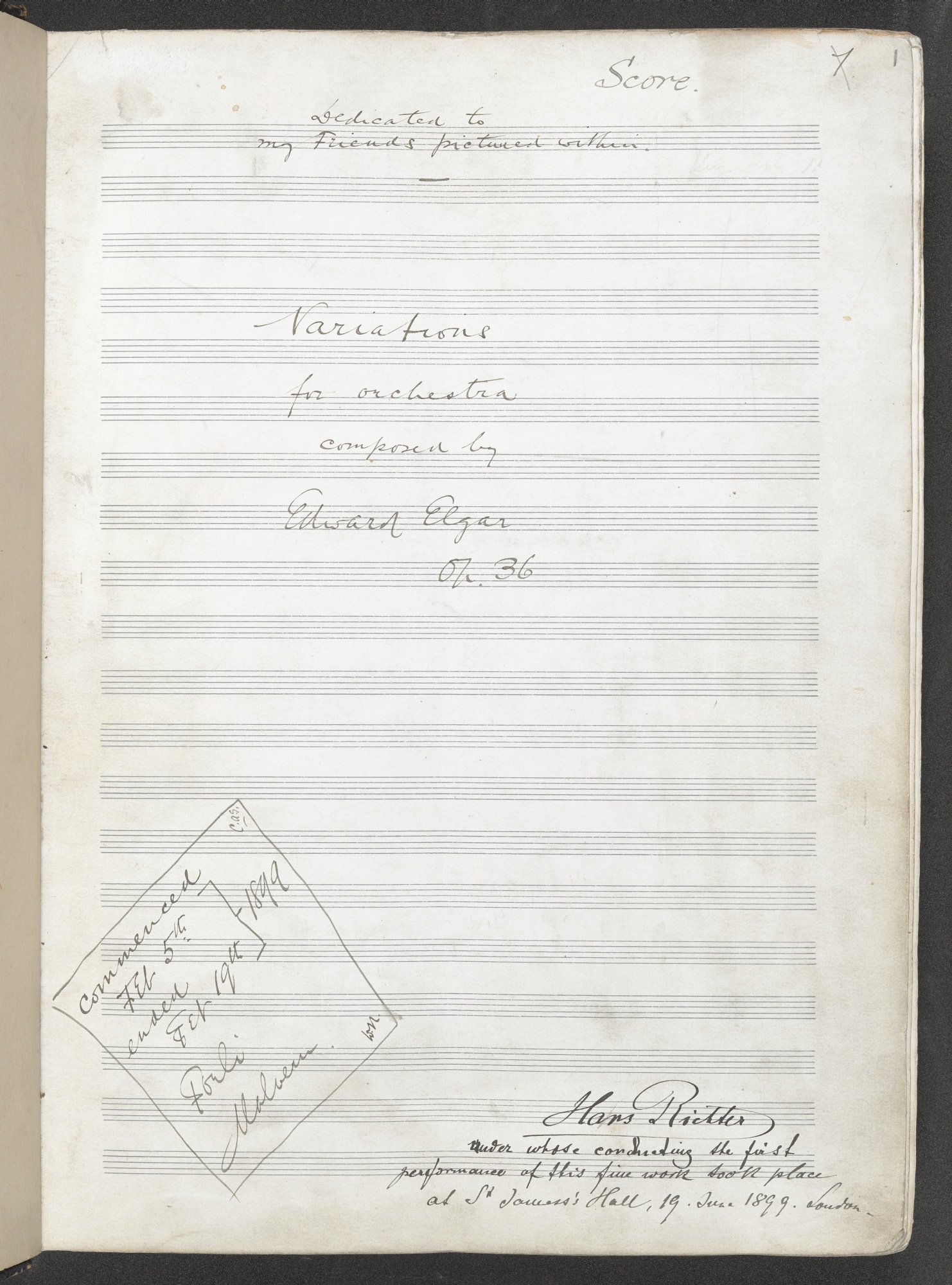
The anomalous date on that page—“FEb 18 1898”—furnishes yet another anagram of “EFB” coinciding with the anniversary of Luther’s death in 1546. As documented on the cover of the autograph score, Elgar completed the Enigma Variations on February 19, 1899. The erroneous date on the last page is one year and one day earlier than the actual completion date, a whopping discrepancy of 366 days. Luther is interred in front of the pulpit of Schlosskirche (Castle Church) in the city of Wittenberg. A coded reference to Luther’s death points to his resting place where “EIN FESTE BURG IST UNSER GOTT” is emblazoned around the church tower. Luther’s resting place supplies the title of the covert Theme.

The tower of Schlosskirche (Castle Church)

Like the original ending, Elgar inserted another acrostic anagram of “EFB” on a 96-bar addendum to the Finale composed in June and July 1899. His signature on the final page of this addition is accompanied by the word Fine and the location (Birchwood Lodge) where he completed the manuscript. The first letters of these three entries form an acrostic of “EFB”, the initials of Ein feste Burg. The L in “Lodge” even divulges the initial of its composer (Luther). That same initial is reinforced by the quotation at the upper right of the page from stanza XIV of the poem Elegiac Verse by Longfellow.


Three musical friends depicted in the Enigma Variations attended constituent colleges of Oxford University. The dedicatee of Variation II is the pianist Hew David Steuart-Powell who graduated from Exeter College. The dedicatee portrayed in Variation XII is the cellist Basil George Nevinson, another graduate of that same institution. The friend sketched in Variation V is the pianist Richard Penrose Arnold, a student of Balliol College. All three were active in the Oxford University Musical Society (OUMS) founded in 1872. Another Oxford graduate portrayed in Variation VII of the Enigma Variations is Troyte Griffith who attended Oriel College. Unlike his three Oxford peers, Troyte was unmusical and not actively engaged in the Oxford University Musical Society. The musical trio of Oxford students—Steuart-Powell, Arnold, and Nevison—were friends of Elgar’s wife and entered his social sphere following their marriage in May 1889.
Exeter College was founded in 1314 and adopted the Latin motto “Floreat Exon” (Let Exeter Flourish). Balliol College was founded in 1263 but does not advertise a collegiate motto. It is possible to obtain the initials “EFB” as an acrostic from the first letters of Exeter, its Latin motto “Floreat Exon”, and Balliol.
Exeter
Floreat Exon
Balliol
It is equally feasible to generate the acrostic anagram “EFB” using Exeter’s motto and the name Balliol.
Floreat Exon
Balliol
Elgar ingeniously encodes the initials of Ein feste Burg as an acrostic anagram using the college names and motto associated with three Oxford friends portrayed in Variations II, V, and XII.
This overview showed how Elgar encodes the initials “EFB” through a variety of different cryptograms. Most rely on the use of anagrams and acrostics to encode information. These ciphers represent a set of variations on the covert Theme’s initials. The “EFB” decryption is consistent with the majority of the titles from the Enigma Variations which are comprised of different sets of initials. This pattern of anagrams is consistent with the name “Craeg Lae” coined in March 1899 by Elgar for his new residence. The unusual moniker is an anagram of his forename spelled backward (Craeg Lea) mingled with the initials of Carice, Edward, and Alice (Craeg Lea).

Joachim’s Motto “EFB” Cipher
Another “EFB” cipher was recently discovered In Variation XIII (✡ ✡ ✡) of the Enigma Variations. Before presenting this discovery, it is necessary to revisit two related cryptograms. In Variation XIII, Edward Elgar openly cites a four-note melodic fragment from the concert overture Calm Sea and Prosperous Voyage by Felix Mendelssohn. As shown earlier, the key letters of those Mendelssohn fragments encipher an anagram of “FAE”, the initials of Joseph Joachim’s romantic motto “Frei aber einsam” (Free but lonely). Elgar scholars should have easily spotted this simple musical cryptogram but were too preoccupied with denying the existence of ciphers in the Variations to mount even a cursory search. The “FAE” Cipher furnishes valuable clues about the covert Theme’s title and its composer. The discovery of the “FAE” Cipher embedded within the Mendelssohn fragments verifies that they harbor cryptograms.
There is a slightly more sophisticated cipher in the Mendelssohn fragments that encodes the initials of Ein feste Burg. This cryptogram relies on the number of times an incipit is stated in a given key to encode the scale degree of that particular mode. Two quotations in A♭ major pinpoint its second scale degree of B♭. One paraphrase in F minor points to its first scale degree of F. A third quotation in E♭ major identifies its first scale of E♭. These three note letters (B, F, E) are an anagram of “EFB”, the initials of Ein feste Burg. This set of initials supplies the absent letters in the cryptic title of three hexagrammic asterisks.
The latest “EFB” cipher found in Variation XIII bridges the “FAE” and Mendelssohn fragments “EFB” ciphers. Elgar devised a straightforward method to identify specific scale degrees from the three different keys of the Mendelssohn fragments to encode the covert Theme’s initials (EFB). What makes his formula even more extraordinary is that it also works with Joachim’s motto. The first scale degree of F minor is F, the same as the first letter in Frei. The second scale degree of A♭ major is B♭ which corresponds to the second letter in aber. The first scale degree of E♭ major is E, the same as the first letter of einsam. Applying the specific scale degrees associated with each key letter (one for F and E, and two for A) to letters from each corresponding word in “Frei aber einsam” highlights F, b, and e. These three letters are an anagram of “EFB”, the initials of Ein feste Burg. The methodology used to encode “EFB” in the Mendelssohn fragments also transfers seamlessly to Joachim’s German motto. This synchronous treatment of the FAE and Scale Degrees ciphers located in the Mendelssohn fragments yields identical decryptions that validate both cryptograms and illustrate Elgar’s mastery of cryptography.
To learn more about the secrets of the Enigma Variations, read my free eBook Elgar’s Enigmas Exposed. Please help support and expand my original research by becoming a sponsor on Patreon.

Sunday, July 31, 2022

The Mendelssohn's Initals "EFB" Cipher

Felix Mendelssohn by Hadi Karimi
To sum up in a word what was most striking in his character, he was an Evangelical Christian in the fullest sense; he knew and loved the Bible as few did in his time; and from this intimate acquaintance came the assured belief, the steadfast piety, without which it would have been impossible to create works of so deep and strong a spiritual character as he wrought.
. . . Elgar, wishing to write his own libretto for the oratorio, The Apostles, began to collect material. As is well known, his knowledge of the Bible and the Apocrypha was profound. He certainly consulted his friends also, both in his own Roman Catholic church and in the Anglican, for instance Canon Gorton, who helped him a great deal in his researches.

The late romantic composer Edward Elgar (1857–1934) achieved international acclaim with the premiere of his Enigma Variations in June 1899 under the baton of the Wagnerian protégé Hans Richter (1843–1916). The work was revolutionary because its original theme was devised as a counterpoint to a famous melody that remains unheard and mysteriously absent. Elgar labeled the Theme “Enigma” before publication and the inaugural performance to convey his contrapuntal riddle, effectively ruling out the groundless speculation that this puzzling title was merely an afterthought or marketing ploy. In the 1899 program note, Elgar calls the Theme “Enigma.” He continues this practice in a later program note for an October 1911 performance at Turin where he refers to the opening movement as simply “Enigma.” Elgar never veered away from this consistent account of his melodic conundrum throughout his life and impressive career as one of England’s iconic composers.
Conventional scholarship asserts the hidden melody is unfathomable because Elgar took his secret to the grave. As Michael Kennedy opines, “People have ingeniously been trying to guess the tune ever since, a harmless but pointless recreation since the secret, if there was one, died with him.” Did Elgar leave behind no written trace of the secret tune’s identity, forever entombing the solution with his burial? Or is it time to lay that misconception to rest?
Elgar incinerated notebooks that held sketches of the Enigma Variations shortly after the passing of his wife, Alice Elgar (1848–1920). If there was no secret melody, as Kennedy coyly suggests, then what was Elgar concealing from posterity by burning his notebooks? The destruction of those primary sources erased the opportunity to scrutinize intimate details about the genesis and development of his magnum opus. However, there remains another promising avenue of inquiry, one glossed over or entirely overlooked by musicologists. It hinges on Elgar’s obsession with cryptography, the art of encoding and decoding secret messages. Musicologists typically have little to no training in this arcane discipline, lacking the expertise and tools to identify and decrypt ciphers. Given Elgar’s expertise in this specialized field, it remains entirely plausible that he enciphered the answers to the Enigma Variations within the score.

The Dorabella Cipher from Powell's biography

It is generally acknowledged that Elgar excelled in cryptography. His mastery of ciphers merits an entire chapter in Craig P. Bauer’s book Unsolved! The editor of the journal Cryptologia and a mathematics professor, Bauer devotes the bulk of his attention to Elgar’s meticulous decryption of an allegedly insoluble Nihilist cipher published by John Holt Schooling in an 1896 edition of The Pall Mall Magazine. Elgar was so pleased with his solution that he bragged about it in his first biography published with his full cooperation in 1905 by Robert J. Buckley (1847–1938). Cracking Schooling’s challenge cipher is the feat of an expert.
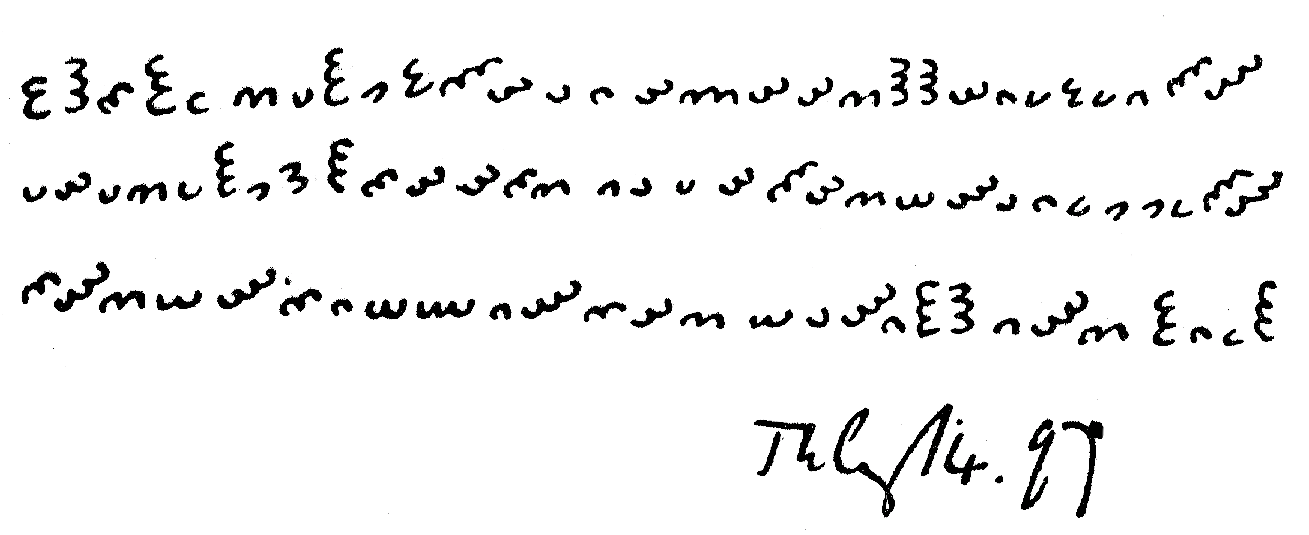
An outstanding specimen of Elgar’s mastery is his seemingly impervious Dorabella Cipher. In July 1897, he mailed an encrypted missive to a family friend named Dora Penny (1874–1964). Two years later, she would be immortalized as the dedicatee of Variation X with the Mozartian nickname Dorabella. Dora could not decipher Elgar’s coded message and filed it away for four decades before publishing it in her 1937 memoir. The ciphertext consists of curlicue symbols that take the place of letters. In one of his surviving notebooks, Elgar wrote a key for converting those cryptic symbols into plaintext. When that key is applied to the Dorabella Cipher, it produces what appears to be random cleartext. Appearances can be deceiving, particularly in the case of a cipher.


Bauer reviews some purported solutions to the Dorabella Cipher and rejects them as untenable. This dismissal fueled a renewed push to penetrate one of Elgar’s most popular ciphers. Recent cryptanalysis found the Dorabella Cipher cleartext openly conceals eleven Spanish words. Although Elgar did not study Spanish, his wife was fluent in that Romance language. Consequently, these Spanish terms imply her participation. The first is “peca” which means freckle or spot. The second is “ir” which is the verb “to go.” Pairing these two Spanish terms from the first line of cleartext suggests going to the spot. What could Elgar possibly mean by encoding this within the cleartext?


The relevance of this breakthrough is there are four conspicuous spots on the Dorabella Cipher that some mistaken for ink blotches. There is only one spot in the body of the ciphertext over the sixth character in the third line. That spot pinpoints the cleartext sequence “EDU”. “Edoo” is Alice’s pet name for Elgar sourced from the German spelling of Eduard. That Teutonic pseudonym is the title of his musical self-portrait (E. D. U.) in the Enigma Variations. Shockingly, the vaunted experts failed to spot Elgar’s stealth pseudonym lurking within the cleartext of the Dorabella transcription.


The Dorabella Cipher’s ingenious system of dots encodes the Jesuit motto “AMDG”. This Latin dedication is inscribed on sacred works such as The Dream of Gerontius. The acronym stands for “Ad majórem Dei glóriam” (For the Greater Glory of God). This covert expression of Elgar’s faith resonates with Dora Penny who was the daughter of an Anglican Rector and served in her father’s church choir. It is surprising how nobody previously managed to connect the dots and decrypt their Latin dedication, one written by Elgar on some of his Christian compositions.


The same dotted symbols encode an anagram of the German word for “Maid” (Magd). That label is wholly appropriate for Dora Penny who was still a young maiden in 1897. These multilingual decryptions in Spanish, Latin, and German escaped the notice of investigators who naively assumed Elgar would limit his cipher to English. The use of multiple languages is a sophisticated technique to harden a cipher against decryption. The Dorabella Cipher reflects Elgar’s flair for original codes that baffle professionals like Craig Bauer and Keith Massey.


In The Code Breakers, historian David Kahn theorizes that the solution to the Enigma Variations may be concealed within the Dorabella Cipher. On page 800 he writes:
Even music has a touch of cryptography. About 1898, composer Sir Edward Elgar, best known for his Pomp and Circumstance march, wrote Variations on an Original Theme, in which he musically depicted in each variation a member of his circle of friends, his wife, and, to end the piece, himself. Elgar labeled the basic theme in G minor, on which the individual portraits were the variations, “Enigma,” and said that it was itself a variation on another piece of music—which he never disclosed. “The Enigma I shall not explain—its ‘dark saying’ must be left unguessed,” he wrote, adding, “. . . the principal theme never appears.” Many persons have tried to guess what the Enigma theme might be : a phrase from Parsifal, one from Pagliacci, or the theme of Auld Lang Syne. None has won acceptance. But it is possible that a clue to the Enigma lies hidden in a cryptogram that Elar sent to one of the “variationees” in 1897—Miss Dora Penny, the Dorabella of Variation X. As a girl in her twenties she spent much time with Elgar, and when she asked him about the Enigma, protesting that she simply could not figure it out, she was told by the composer, “I thought you, of all people, would guess it.” He would say no more. The cryptogram consists of 87 characters consisting of one, two, or three curves in various positions and looking as a whole rather like a flock of sheep. Nobody has solved it, and so nobody knows whether it will shed any light on the Enigma. But if it does, it may help resolve one of the oddest mysteries in the musical domain.

The multilingual solutions to various ancillary ciphers in the Dorabella Cipher bolster the prospect that Elgar would deploy multilingual cryptograms within the Enigma Variations. This impression is supported by the published score that employs four languages: English, German, Italian, and Latin. The number four is carefully emphasized in Variation XIII, a pelagic Romanza with an austere title of three hexagrammic asterisks. Elgar sprinkled some gargantuan clues about the secret melody in that movement. On four occasions, he cites a four-note melodic incipit from the concert overture Calm Sea and Prosperous Voyage by Felix Mendelssohn (1809–1847). The original German title of that overture is four words: Meerestille und glückliche Fahrt. These four Mendelssohn fragments are exhibited below with facsimiles from an autograph score of the title page and page 14 showing the source of the melodic quotation in the cello staff:


Why would Elgar cite four thematic fragments, each consisting of four-notes, from an unrelated overture with a four-word German title? The stress on the number four is unmistakable. This line of inquiry fueled the deduction that Elgar quotes Mendelssohn in a symphonic work to imply by imitation that Mendelssohn quotes the covert Theme in one of his own symphonies. There are four fragments, each with four sounding notes, that impose a pronounced emphasis on the number four. Is there a famous tune quoted by Mendelssohn that may be convincingly linked to that number? Mendelssohn quotes the famous hymn Ein feste Burg (A Mighty Fortress) by Martin Luther (1483–1546) in the fourth movement of his Reformation Symphony followed by a set of variations.

Respected scholars such as Julian Rushton hastily ruled out Luther’s epic hymn as a credible candidate due to Elgar’s fervent Roman Catholicism in 1898-99. They cannot reconcile Elgar’s faith with a Protestant Reformer who was denounced as a heretic and excommunicated by Pope Leo X (1475–1521). What those highly credentialed academics fail to appreciate is that Mendelssohn was baptized into the Lutheran Church as a child, remained a committed Protestant in adulthood, composed the Reformation Symphony, and produced a large body of sacred works such as the oratorio Elijah and numerous settings of the Psalms. By citing the music of a Lutheran psalmist in Variation XIII, Elgar shines the equivalent of a klieg light on the composer of the covert Theme and its literary fountainhead. Mendelssohn’s Jewish heritage and Christian faith adds further clues about Elgar’s secret friend whose name “Jesus” and title “Christ” appear in the lyrics of Ein feste Burg.

The Mendelssohn fragments are like a small thread that, when tugged, unravels a vast tapestry of intersecting musical cryptograms and counterpoints. Far from being extraneous to the Enigma Variations, the Mendelssohn fragments conceal a rich cache of cryptograms that disclose and authenticate the covert melodic Theme and the secret friend memorialized in Variation XIII. A comprehensive survey shows they harbor more than a dozen ciphers that encode a highly specific set of mutually reinforcing solutions that disclose and authenticate Ein feste Burg as the melodic cornerstone to the Enigma Variations, and Jesus as the secret friend commemorated in Variation XIII.


Mendelssohn's Initials “EFB” Cipher

It is exciting to report the discovery of yet another cipher associated with the Mendelssohn fragments. This cryptogram is derived from the initials of Mendelssohn’s name. Mendelssohn’s full name is Jacob Ludwig Felix Mendelssohn Bartholdy. However, he signed his name as “Felix Mendelssohn Bartholdy” as evidenced by a letter from July 1840 and an autograph manuscript from 1842.


The name Bartholdy can be traced to his maternal uncle who served as the Prussian consul-general in Rome. During his service in the Italian capital, the uncle converted to Christianity and built a house called Casa Bartholdi. As a sign of his newfound faith, he adopted the Christian name Bartholdy. When Mendelsohn’s father, Abraham, decided to raise his children in the Protestant tradition, his brother-in-law persuaded him to adopt the name Bartholdy.

A subtle emphasis is imposed on the number three by the Mendelssohn fragments. Each fragment has three discrete notes. The incipits are framed in three contrasting keys: A-flat major, F minor, and E-flat major. Three quotations descend stepwise by a major third. The remaining F minor incipit descends stepwise by a minor third. The Mendelssohn fragments stress the significance of the number three, the very same number of initials (FMB) in Mendelssohn’s signature. This pattern is reinforced by the ambiguous title of Variation XIII consisting of three asterisks. The asterisks signify three absent initials, a feature shared by the absent Principal Theme.

The initials for Felix Mendelssohn Bartholdy are “FMB”. Two of those letters (F and B) match the initials of the title Ein feste Burg. In the Dorabella Cipher, Elgar reorients the capital cursive E glyph to replicate the letter M. Applying this same technique to the M from Mendelssohn’s initials permits it to be rotated 90 degrees upright akin to a dial on a safe to resemble an E. This elastic procedure transforms the initials “FMB” to “FEB”, the abbreviation for February. When viewed as an anagram, “FEB” may be reshuffled as “EFB”, the initials of the secret melody. Kahn's suspicion that the Dorabella Cipher may hold the key to unmasking the covert melody to the Enigma Variations proved to be prescient. 


Elgar wrote “FEb” twice within an angular square on the lower left-hand cover of the autograph score. He recorded that the orchestration began on “FEb 5th” and concluded on “FEb 19th”. Next to these dates is a large bracket with the year 1899. The bracket resembles a capital L facing leftward with its mirror image atop separated by a small dividing line. The letter L is the initial for Luther. 


    Elgar penned an anomalous completion date on the last page of the original Finale as “FEb 18 1898”. It predates the actual date by one year and one day. The erroneous date turns out to be another cipher as it marks the anniversary of Martin Luther’s death 353 years earlier in 1546. The end of the score presents a coded reference to the end of Martin Luther. This parallels the incorrect year (1595) attached to the Tasso paraphrase from the Jerusalem Delivered, an epic Christian poem published in 1581. The Italian poet Torquato Tasso died in 1595 at Sant'Onofrio, the official church of the papal Order of the Holy Sepulchre. The Holy Sepulcher is revered as the tomb of Jesus Christ, the anonymous friend memorialized in Variation XIII. Two incorrect dates on the original Finale's final page allude to the deaths of two eminent artists.


Decoding Mendelssohn’s initials “FMB” as “FEB” produces an organic link to the cover and final sheet of the Master Score to the Enigma Variations. On these first and last pages, Elgar penned “FEb” a total of three times. “FEb” is an anagram of “EFB”, the initials of Ein feste Burg. These abbreviations of February are a thinly disguised anagram of the initials for Ein feste Burg. Remarkably, the solution to Elgar's melodic riddle is hiding in plain sight on the front and back of the score. It is noteworthy that the top three lines of text on the original Finale's last page encode an acrostic anagram of “EFB” — Fine, Bramo, and Edward.

The Mendelssohn fragments encode the initials for the secret melody in a variety of ways. An elegant example is the Mendelssohn Fragments Scale Degrees Cipher. The key to this cipher is to count the number of times a fragment is stated in a given key and use that sum to select the corresponding scale degree in that particular mode. There are two quotations in A-flat major. The second scale degree of that key is B-flat. There is one incipit in F minor and another quotation in E-flat major. The first scale degrees of those two keys are F and E-flat respectively. The note letters “BFE” divulged by this cipher are the reverse of “EFB”. This backward decryption is significant because Elgar mapped Ein feste Burg in retrograde above the Enigma Theme. The reverse decryption “BFE” hints at Elgar’s sophisticated backward counterpoint.


Joachim’s Motto “FAE” Cipher

There is a second three-word German phrase encoded by the Mendelssohn fragments. They are performed in three contrasting keys: A-flat major, F minor, and E-flat major. Those key letters are an anagram of “FAE”, the acronym of the German romantic motto “Frei aber einsam” (Free but lonely) formulated around 1853 by the violin virtuoso Joseph Joachim (1831–1907). He may have coined this maxim in opposition to the declaration, “Der Einsame ist unfrei” (The solitary individual is unfree) by Richard Wagner (1813–1883). The FAE motif forms the basis of the F-A-E Sonata, a work composed collaboratively for Joachim in 1853 by Robert Schumann (1810–1856), Albert Dietrich (1829–1908), and Johannes Brahms (1833–1897). Joachim was a renowned violinist, composer, conductor, instructor, and champion of German romanticism. He was mentored by Mendelssohn who conducted his historic London debut before the Royal Philharmonic Society in May 1844. Joachim embodied Elgar’s childhood dream of attending the Leipzig Conservatory and becoming a famous violinist. Elgar’s admiration for Joachim permeates the Enigma Variations with overt and covert allusions to his storied life.

The encoding of Joachim’s motto by the Mendelssohn fragments is contextually appropriate because Mendelssohn and Joachim were colleagues and friends. Like the covert Theme’s title, the FAE cryptogram consists of three German words. Remarkably, the FAE cryptogram presents another coded connection to the absent Theme. The initials “FAE” may be interpolated as “FAM” when the E is turned 90 degrees downward like a safe dial to reproduce an M. The significance of this decryption is that “FAM” is an anagram of “AMF”, the acronym for A Mighty Fortress.


Conclusion

This foregoing cryptanalysis showed how the Mendelssohn fragments are associated with its composer's initials (FMB) and encipher Joachim's motto as an anagram (FAE). Two sets of three initials suggest a coded version of Elgar's initials as the 3 glyph is the mirror image of a capital cursive E. There are discernable patterns in converting “FMB” and “FAE” into two companion sets of initials for the hidden melody’s title. First, they encode three-letter acronyms of the covert Theme’s title in German (EFB) and English (AMF). Second, they share two of three initials with those corresponding acronyms. Mendelssohn’s initials (FMB) supply the second and third letters of “EFB”. Joachim’s motto (FAE) contains the first and third letters of “AMF”. Third, the absent letters needed to round out both decryptions are obtained by rotating like a safe dial the matching E and M glyphs 90 degrees in opposite directions. This transposition device revolves around the letter E that Elgar’s wife used in her diary to represent her husband. The E glyph is the key to unlocking these two initials ciphers and evince Elgar’s cryptographic fingerprints. The outcome of both decryptions yields complementary and mutually consistent anagrams of the covert Theme’s initials. This reliance on initials is consistent with ten of fifteen titles from the Enigma Variations that are comprised of initials.

An alternative way to construct the related acronyms “EFB” and “AMF” from Mendelssohn's initials (FMB) and Joachim's motto (FAE) is to exchange corresponding glyphs (M and E). Trading the second initial from “FMB” with the first from “FAE” produces “FEB” and “FAM” respectively. These reciprocal glyphs spell me, a pronoun that intimates how Elgar identified with Mendelssohn and Joachim. “ME” also conveys a cloaked version of his initials (EE) due to the resemblance between M and E in cursive. The Mendelssohn fragments in Variation XIII are a nexus of cryptograms that authenticate Luther’s Ein feste Burg as the covert Theme to the Enigma Variations. To learn more regarding the secrets of the Enigma Variations, read my free eBook Elgar’s Enigmas ExposedPlease help support and expand my original research by becoming a sponsor on Patreon.

About Mr. Padgett

My photo
Mr. Padgett studied violin with Michael Rosenker (a student of Leopold Auer), and Rosenker’s pupil, Owen Dunsford. Mr. Padgett studied piano with Sally Magee (a student of Emanuel Bay), and Blanca Uribe (a student of Rosina Lhévinne). He attended the Stevenson School in Pebble Beach, California, and Vassar College in Poughkeepsie, New York, where he graduated Phi Beta Kappa with a degree in psychology. At Vassar he studied music theory and composition with Richard Wilson. Mr. Padgett has performed for Joseph Silverstein, Van Cliburn, Arnold Schwarzenegger, Maria Shriver, Steve Jobs, Prince Charles, Lady Camilla, Marcia Davenport, William F. Buckley, Jr., and other prominent public figures. His original compositions have been performed by the Monterey Symphony, at the Bohemian Grove, the Bohemian Club, and other private and public venues. In 2008 Mr. Padgett won the Max Bragado-Darman Fanfare Competition with his entry "Fanfare for the Eagles." It was premiered by the Monterey Symphony under Maestro Bragado in May 2008. A member of the Elgar Society, Mr. Padgett is married with five children.