 |
| Old Wye River Bridge |
Most of my ‘sketches’,—that is to say the reduction of the original thoughts to writing, have been made in the open air. I finished the Wye round about Mordiford & completed many pencil memoranda of compositions on the old bridge, of which I have vivid & affectionate memories.
Edward Elgar in a letter to G. H. Jacks
The British composer Edward Elgar played the Enigma Theme for the first time at the piano for his wife Alice on October 21, 1898. After hearing that melancholic melody, she inquired in an approving tone, “What is that?” He replied, “Nothing — but something might be made of it.” This private premiere of the Enigma Theme is commemorated by Elgarians every October 21 as Enigma Day. 125 years ago today marks that pivotal event heralding the dawn of the Enigma Variations. In honor of that anniversary, my 215th article will present some previously unrecognized ciphers in that extraordinary symphonic masterpiece. In a coded parallel, the number 215 is an anagram of 125.
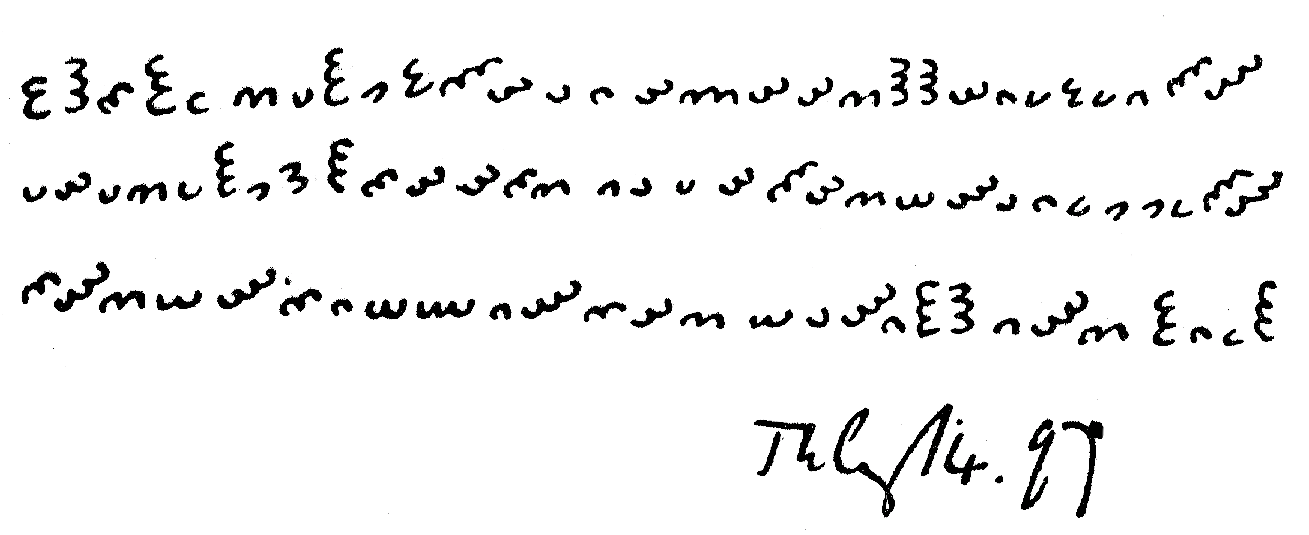
Elgar was fascinated by phonetic spellings, wordplays, and anagrams. One notable example is the title “Craeg Lea” which he imparted to his Malvern home where his family resided between 1899 and 1904. That atypical moniker is an anagram obtained from the reverse spelling of “Elgar” (Craeg Lea) mingled with the initials from the first names of his daughter Carice, himself, and his wife Alice (Craeg Lea). Elgar challenged Dora Penny to decipher the meaning of his home’s bemusing name. She caught on quickly as recounted in her memoir:
Edward called the place Craeg Lea and challenged me to guess how he had found the name. By some stroke of luck, I realized that the key lay in the unusual spelling of “Craeg” and immediately saw that the thing had been built up anagrammatically from (A)lice, (C)arice, (E)dward ELGAR. I think he was a little annoyed that this mystification had fallen flat.
Elgar’s enthusiasm for word games permeated his obsession with cryptography, the discipline of coding and decoding secret messages. His expertise in that esoteric art is extensively documented by Craig P. Bauer in his book Unsolved! The bulk of its third chapter is devoted to Elgar’s brilliant decryption of an allegedly insoluble Nihilist cipher by John Holt Schooling featured in an April 1896 issue of The Pall Mall Magazine. A Nihilist cipher is a derivative of the Polybius square, a system for fractionating plaintext that was invented by the ancient Greeks. Elgar was so delighted with his solution that he bragged about it in his first biography published in 1905 by Robert J. Buckley. Elgar painted the solution in black paint on a wooden box, an appropriate medium as another name for the Polybius square is a box cipher. The historical record is unambiguous. Elgar was an accomplished expert in the field of cryptography.
Elgar’s methodical decryption of Schooling’s conundrum is summarized on a set of nine index cards. On the sixth card, Elgar relates the task of cracking the cipher to “. . . working (in the dark).” His use of the word “dark” as a synonym for a cipher is relevant to this investigation as this same adjective turns up later in the 1899 program note for the premiere of the Enigma Variations. It is an oft-cited passage worth revisiting because Elgar lays the groundwork for his tripartite riddle:
The Enigma I will not explain – its ‘dark saying’ must be left unguessed, and I warn you that the connexion between the Variations and the Theme is often of the slightest texture; further, through and over the whole set another and larger theme ‘goes’, but is not played . . . So the principal Theme never appears, even as in some later dramas – e.g., Maeterlinck’s ‘L’Intruse’ and ‘Les sept Princesses’ – the chief character is never on the stage.
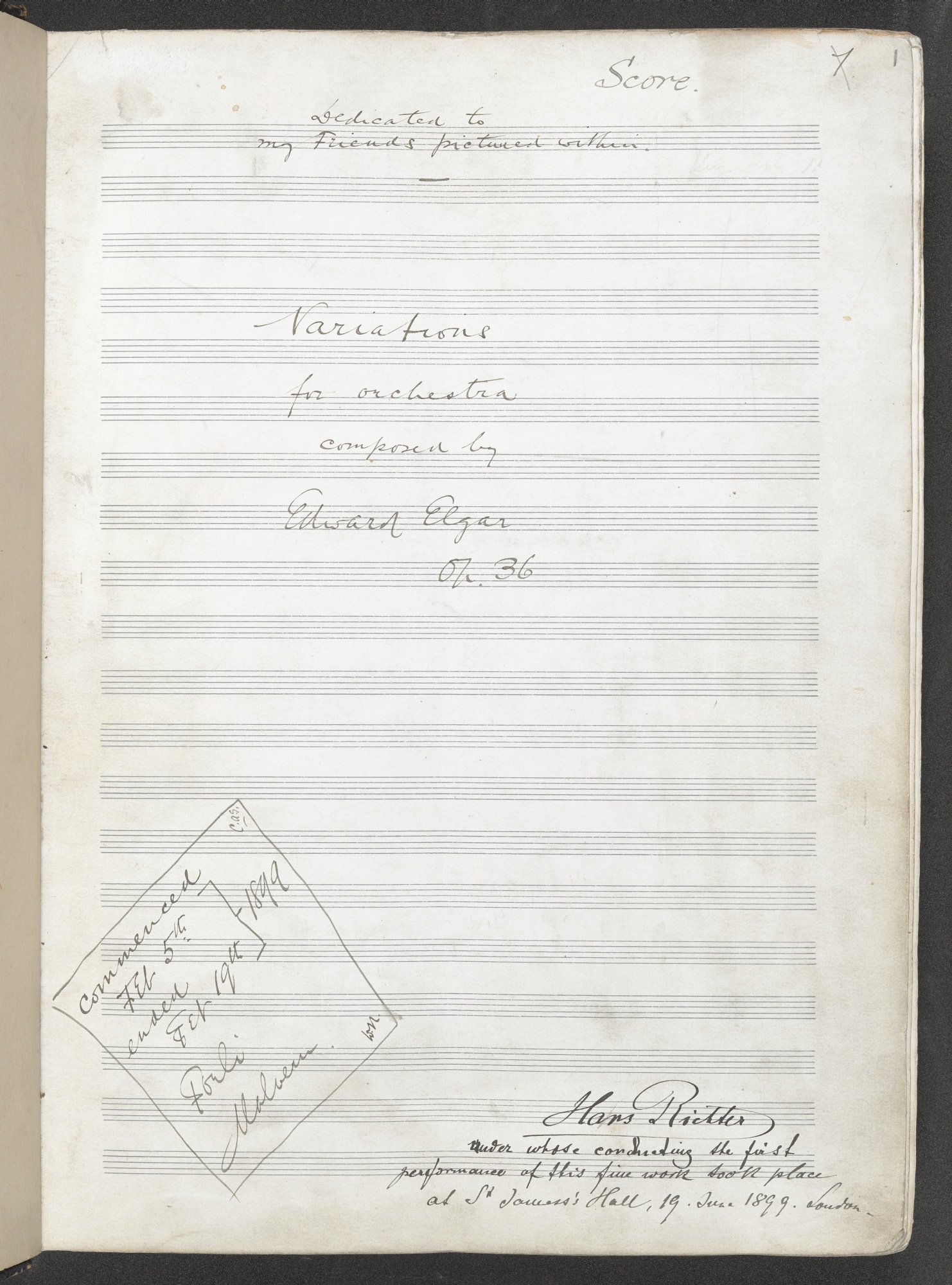
Elgar composed the Enigma Variations in 1898-99. That extraordinary work elevated him from provincial obscurity to international acclaim, transforming his career from an itinerant music teacher to a celebrated composer. The original title appears on the autograph score as “Variations for orchestra composed by Edward Elgar Op. 36”. With the unconventional theme dubbed “Enigma”, the work is popularly referred to as the Enigma Variations. In the 1899 program note and other primary sources, Elgar explains the Theme is called “Enigma” because it is a counterpoint to a famous melody that is not heard but can play “through and over” the Variations. This secret tune is the cornerstone underlying the whole work, a subject that has provoked interminable debates and disagreements about the correct solution.
Some contend there is no answer to Elgar’s Enigma by insinuating he concocted the notion of an absent principal Theme as an afterthought, practical joke, or marketing gimmick. The editors of the Elgar Complete Edition of the Enigma Variations blithely deny the likelihood there could be any covert counterpoints or cryptograms. Relying on Elgar’s recollection of playing new material at the piano to gauge his wife’s reaction, the editors tout the standard lore that he extemporized the idiosyncratic Enigma Theme, mirabile dictu, without any forethought or planning:
There seems to have been no specific ‘enigma’ in mind at the outset: Elgar’s first playing of the music was hardly more than a running over the keys to aid relaxation. It was Alice Elgar’s interruption, apparently, that called him to attention and helped to identify the phrases which were to become the ‘Enigma’ theme. This suggests it is unlikely that the theme should conceal some counterpoint or cipher needed to solve the ‘Enigma’.
Such a blanket abnegation conveniently relieves scholars of any obligation to probe for ciphers or counterpoints. Proponents of such an obtuse nihilism extol the validity of their position based on a dearth of evidence for which they never executed a diligent or impartial search. This tautological cul-de-sac is a textbook case of confirmation bias pawned off as ersatz scholarship. In the fourth chapter of The Cambridge Companion to Elgar, Christopher Kent meticulously documents how Elgar sketched and accumulated musical ideas in the countryside long before ever trying them out on the piano. Those familiar with Elgar’s compositional methods should know better than to proffer the lore that he miraculously improvised the Enigma Theme without advanced planning and preparation.
A more sensible view (embraced by those who take Elgar at his published word) accepts the challenge that there must be a famous melody concealed behind the Variations’ contrapuntal and modal facade. Regardless of the side taken in this debate, legacy scholars insist the answer can never be known with absolute certainty because Elgar allegedly took his secret to the grave in February 1934. The intellectual nomenklatura presumes he never wrote down the solution for posterity to discover. Such a staid opinion glosses over or flagrantly ignores Elgar’s documented expertise in cryptography. That incontestable facet of his psychological profile raises the possibility that the solution is scrupulously enciphered within Enigma Variations’ orchestral score.
A decade of trawling that sublime symphonic masterpiece has netted over one hundred cryptograms in diverse formats that encode a set of mutually consistent and complementary solutions. Although that figure may seem extraordinary, it is entirely consistent with Elgar’s lifelong fascination with ciphers. More significantly, the solutions give definitive answers to the core questions posed by the Enigma Variations. What is the absent melody to which the Enigma Theme is a counterpoint and serves as the melodic foundation for the ensuing movements? Answer: Ein feste Burg (A Mighty Fortress) by Martin Luther. What is the “dark saying” nestled within the Enigma Theme? Answer: A musical Polybius box cipher embedded in its inaugural six bars cordoned off by a strangely positioned double barline. Who is the secret friend and inspiration behind Variation XIII? Answer: Jesus Christ, the Lord and Savior of Elgar’s Roman Catholic faith. The cryptographic evidence supporting these discoveries is diverse yet mutually consistent, multivalent, and decisive.
Some Bridge Passages Enigma Ciphers
Such an extensive trove of ciphers affirms that the Enigma Variations is Elgar’s musical homage to cryptography. Scores of ciphers within the score justify an ongoing search for additional cryptograms. Prior research uncovered a matrix of ciphers shrouded within its three bridge passages. A section in classical music that links one movement to another without interruption is called a bridge passage. The first bridge passage couples the Enigma Theme to Variation I (C. A. E.). Some cryptograms hidden in that first bridge passage are the Opus Dei Cipher, the Psalm 46 Ciphers, Tau Cross Ciphers, and interrelated word ciphers embedded within its performance directions. There is a cluster of cryptograms in the second bridge passage linking Variation V (R. P. A) to Variation VI (Ysobel). Fourteen cryptograms are concealed within the third bridge passage connecting Variation XIII (W.N.) to Variation IX (Nimrod). Other ciphers are formed collectively by these three bridge passages. Could there be more bridge ciphers yet to be discovered?
Elgar’s Bridge Passages Acrostic Ciphers
Six of the movements from the Enigma Variations are connected by three bridge passages. The sums three and six may be merged as “36” to reproduce its opus number. When reversed as “63”, it yields the tempo marking used for the Enigma Theme, Variation I (C. A. E.), and Variation V (R. P. A.). These three movements are associated with the first and second bridge passages. A short score reduction of these three bridge passages is exhibited below:

The Enigma Theme is joined to Variation I (C. A. E.) by the first bridge passage in bars 18-19. Variation V (R. P. A.) is connected to Variation VI (Ysobel) by the second bridge passage in bars 184-187. Variation VIII (W. N.) is linked to Variation IX (Nimrod) by the third bridge passage in bars 305-307. A total of nine bars make up these three bridge passages with two in the first, four in the second, and three in the third. The bar lengths of these three bridge passages are two, four, and three. The first two numerals may be merged to form 24, the sum of the letters in the title Ein feste Burg ist unser Gott. Six words in that German title mirror the six movements conjoined by bridges. The third bridge passage consists of three bars, a total that corresponds to the common three-word title Ein feste Burg.
Six movements joined in pairs by three bridge passages encompass a distinct subset of variations. The titles of these bridge movements are listed below in order of appearance:
Enigma
C. A. E.
R. P. A.
Ysobel
W. N.
Nimrod
There is a conspicuous symmetry with the titles of these six bridge movements. Three are six-letter words (Enigma, Ysobel, and Nimrod) which are traceable to the Bible. Nimrod is described in Genesis 10:9 as “. . . a mighty hunter before the LORD.” Elgar dedicated Variation IX (Nimrod) to his German friend August Jaeger whose last name means “hunter” in German. The nickname “Nimrod” is a scriptural wordplay on “hunter.” A standard abbreviation of Genesis is “Ge.” This is affirmed by The Treasury Bible published in London in 1833. Remarkably, the first two melody notes of Nimrod — G descending a major 3rd to E-flat — are a coded abbreviation of Genesis. Nimrod is the tenth movement and the ninth variation, supplying the chapter and verse to complete the cipher “Ge. 10:9”. Genesis 10:9 conveniently provides the first two words of the covert Theme's title: A Mighty Fortress.

Ysobel is a derivative of Elisheba, the wife of the high priest Aaron mentioned in Exodus 6:23. Enigma is defined as a “dark saying,” a phrase that appears in Psalm 49:4, Psalm 78:2, and Proverbs 1:6. Elgar employs the phrase “dark saying” in his original 1899 program note to describe the Enigma Theme. The recurrence of the phrase “dark saying” in the Psalms appears to be a clue about the origin of the covert Theme. The covert Theme’s title is drawn from the first line of Psalm 46, a chapter known as “Luther’s Psalm.” The remaining three titles are composed of initials: C. A. E., R. P. A., and W. N. These two sets of three titles suggest the mirror image of Elgar's initials (33). Roman Catholic tradition holds that Jesus was crucified at age 33.

Like the two sets of three titles that intimate a coded form of Elgar’s initials, there are precisely two capital Es in the titles of the opening two movements: Enigma and C. A. E. These two Es are the first and last letters of those two titles. The Theme and Variation I are joined together by the first bridge passage.
Before venturing any further, it is crucial to recognize that Elgar used phonetic spellings in his personal correspondence. Some examples of his atypical spellings are listed below:
- Bizziness (business)
- çkor (score)
- cszquōrrr (score)
- fagotten (forgotten)
- FAX (facts)
- frazes (phrases)
- gorjus (gorgeous)
- phatten (fatten)
- skorh (score)
- SSCZOWOUGHOHR (score)
- Xmas (Christmas)
- Xqqqq (Excuse)
- Xti (Christi)
The three bridge titles consisting of six-letter names produce the acrostic “EYN”: Enigma, Ysobel, and Nimrod. “EYN” is the phonetic equivalent of Ein with y substituting for i, a spelling convention observed in words like my and cry. This phonetic acrostic encodes the first word in the covert Theme’s title Ein feste Burg.
The three remaining titles composed of initials yield the acrostic “CRW”: C. A. E., R. P. A., and W. N. “CRW” is a phonetic rendering of crow. The Cambridge Dictionary defines the verb crow as “cry” and provides the sample sentence, “When a cock (an adult male chicken) crows, it makes a very long and loud sharp cry.” The Authorized King James Version of Matthew 26:34 recounts Jesus prophesying to Peter, “Verily I say unto thee, That this night, before the cock crow, thou shalt deny me thrice.” The disciple Peter vehemently Jesus three times on the night of his arrest before the rooster announced the arrival of dawn and the fulfillment of Christ’s dire prophecy. The word crow is intimately linked to the betrayal and crucifixion of Jesus, Elgar’s secret friend memorialized in Variation XIII (✡ ✡ ✡). The identification of Christ as the dedicatee of that movement readily explains why it was performed during Elgar’s memorial service at Worcestershire Cathedral in March 1934.
A bridge is a place to cross, a word intimately associated with the crucifixion of Jesus and the Roman Catholic ritual of making the sign of the cross. Like the three bridge passages, there were three crosses at the crucifixion of Christ. Similarly, there are three Mendelssohn quotations in Variation XIII that sonically portray a sea crossing. The first bridge passage in bars 18-19 begins in G major and modulates to G minor. The second bridge passage in bars 185-188 begins in C minor and resolves to C major at the start of Variation VI (Ysobel). The key letters of the first and second bridge passages are G and C, respectively. The letters of these modes provide the initials for Gesù Cristo, the Italian translation of Jesus Christ. The encoding of Christ’s initials in Italian by the modes of the first and second bridge passages is consistent with Elgar’s reliance on Italian nomenclature for the instrumentation and performance directions in the autograph and published scores.
The third bridge passage in bars 305-307 modulates from G major to E-flat major at the arrival of Variation XI (Nimrod). When treated as an anagram, the key letters G and E may be reshuffled as “EG”, a phonetic spelling of egg. The Easter egg is a traditional Christian symbol of Christ’s resurrection. It is noteworthy that Elgar hid his Easter egg cipher in the third bridge passage, a number that equals the three days and nights that Jesus spent in the tomb. The term egg is also encoded extensively by notes in the E-flat ostinato accompanying the third Mendelssohn quotation in Variation XIII.
 |
| E-flat ostinato “EGG” cipher accompanying the third Mendelssohn quotation |
The number three is emphasized by the location and length of the third bridge passage with its three bars. These two references to the number three may be combined to produce “33”, the alleged age when Jesus was crucified.
There are fifteen lowercase letters in the three six-word bridge titles: nigma, sobel, and imrod. When treated as an anagram, the letters igmasobelimrod generate 178,572 possible combinations with accurate spellings. The overwhelming majority of these anagrams are utterly nonsensical with the notable exception “lamb is mooring ed”. “Ed” is a short form of Edward, Elgar’s first name. In John 1:29, Jesus is called the “Lamb of God” (Agnus Dei) by John the Baptist. A core tenet of Christianity is that Jesus was sacrificed at Calvary as the Passover Lamb to redeem the world from sin and death. The Cambridge Dictionary defines mooring as “a place to tie a boat.” This definition relates to Elgar’s depiction of a ship crossing a calm sea in Variation XIII, a movement dedicated in secret to Christ who fulfilled the prophetic Sign of Jonah. Merriam-Webster furnishes another definition of mooring as “an established practice or stabilizing influence.” Jesus is the ultimate mooring to whom Christians fasten their faith. Based on this analysis, the anagram “Lamb is mooring Ed” may be interpreted as Jesus securing Elgar in his faith. This interpretation is supported by Elgar’s sizable output of sacred cantatas and oratorios. Elgar was born, educated, married, and buried as a Roman Catholic. He dedicated his major sacred works to God by invoking the Jesuit motto “Ad Majorem Dei Gloriam” (For the Greater Glory of God).
Another defensible anagram obtained from the lowercase letters igmasobelimrod is “mooring lamb dies.” In this context, “mooring” refers to “an established practice or stabilizing influence.” As previously shown, “Lamb” is a title for Jesus. The term “dies” denotes the death of that lamb. The anagram “mooring lamb dies” effectively conveys a central article of faith from Elgar’s Roman Catholicism that acknowledges the sacrificial death of Jesus. The anagram “mooring lamb dies” is mutually consistent with the “Dead God” Cipher in Variation XIII where note sequences in bars 497-500 and 529-532 encode the phrase “DEAD G-D”. Roman Catholicism teaches that Jesus is the incarnation of God and a member of the Trinity who died and rose bodily from the grave.

Elgar completed many of his sketches on the Old Wye River Bridge during pastoral excursions in search of solitude and bucolic stimulation. He clearly associated his musical creations with bridge crossings. Another type of crossing is an acrostic “in which sets of letters (such as the initial or final letters of the lines) taken in order form a word or phrase.” When arranged in order of appearance, the first letters of the six bridge titles generate the acrostic “E CRY WN”.
Enigma
C. A. E.
R. P. A.
Ysobel
W. N.
Nimrod
The verb “CRY” indicates that Elgar’s ordering of these bridge movements is not random. The verb cry is a synonym for crow, a term encoded as a phonetic acrostic by the three titles consisting of initials. The “E” may be safely interpreted as Elgar because he signed and sealed his correspondence with that letter. “CRY” is an intransitive verb defined by Merriam-Webster in four ways. The first is “to call loudly, shout.” The second is “to shed tears often noisily, weep, sob.” The third is “to utter a characteristic sound or call.” The fourth is “to require or suggest strongly a remedy or disposition.” “WN” is a phonetic spelling of when. This analysis shows that the acrostic “E CRY WN” may be decoded as the command, “Elgar, cry ‘When!?’” This decryption vents his frustration with waiting to be recognized by London's musical establishment for his prodigious musical endowment.
Elgar may have encoded the word “cry” because it turns up in one of his favorite poems, Ode penned by Arthur O’Shaughnessy in 1873. Elgar set the entirety of that poem in The Music Makers for contralto or mezzo-soprano, chorus, and orchestra. It was composed sporadically between 1903 and 1912 before premiering at the Birmingham Festival in October 1912. The Musical Times published a preview of The Music Makers by Ernest Newman in September 1912 that deftly encapsulates the thrust of O’Shaughnessy’s Ode:
The ‘motif’ of O’Shaughnessy’s poem is the idea that the poets—the music makers and dreamers—are really the creators and inspirers of men and their deeds, and the true makers of history and of human societies. Their dreams and their visions are the foreshadowings of what the rest of mankind are predestined to work out in endless conflict: to-day is a realisation of a dream of the generations past; to-morrow will bring into being the dream of to-day.
The Music Makers is a retrospective piece that cites themes from the Enigma Variations, Sea Pictures, The Dream of Gerontius, Symphony No. 1, Symphony No. 2, Violin Concerto, Rule, Britannia!, and La Marseillaise. The inclusion of the Marseillaise is interesting because the German poet Heinrich Heine famously extolled Ein feste Burg as “the Marseillaise of the Reformation.” In The Music Makers, Elgar invokes incipits from the Enigma Theme and Variation IX (Nimrod). It is possible that Elgar cites melodic extracts from the Enigma Theme, Nimrod, and the Marseilaise to hint at Heine’s equation of that French paean to Ein feste Burg, the covert Theme of the Enigma Variations. According to Elgar, the Enigma Theme is quoted more than once because “it expressed when written (in 1898) my sense of the loneliness of the artist as described in the first six lines of the Ode, and, to me, it still embodies that sense.” The familiar phrase “movers and shakers” appears in line 7 of Stanza I of O’Shaughnessy’s Ode. The ninth and final stanza employing the word “cry” is cited below:
Great hail! we cry to the comers
From the dazzling unknown shore;
Bring us hither your sun and your summers;
And renew our world as of yore;
You shall teach us your song's new numbers,
And things that we dreamed not before:
Yea, in spite of a dreamer who slumbers,
And a singer who sings no more.
There are nine stanzas in O’Shaughnessy’s Ode, and coincidentally there are nine bars in Elgar’s three bridge passages. O’Shaughnessy’s Ode invokes sea imagery in its opening and closing stanzas. Line 3 of Stanza I states, “Wandering by lone-sea breakers . . .” Line 2 of Stanza IX reads, “From the dazzling unknown shore . . .” Elgar depicts a calm sea in Variation IX (Nimrod) by citing a four-note incipit from Felix Mendelssohn’s concert overture Calm Sea and Prosperous Voyage. This sonic portrayal of the sea resonates with marine references in O’Shaughnessy’s Ode tied to the lonely artist who conjures new music and new worlds.
“WN” is also a phonetic rendering of Wen, a term defined by Merriam-Webster as “an abnormal growth or a cyst protruding from a surface . . .” During the 1820s, William Cobbett coined the derogatory nickname “The Great Wen” for the city of London. That epithet remained in common usage during Elgar’s lifetime. For example, it appears twice in an 1892 issue of The National Review published (ironically) in London. Cobbett was a staunch advocate for Catholic emancipation and England’s working class, two constituencies associated with Elgar’s upbringing as a Roman Catholic and denizen of the working class. Relying on that peculiar nickname, the acrostic “E CRY WN” may also be decoded as “Elgar, cry ‘London!’” Shortly after his marriage in 1889, Elgar moved to London to launch his career as a professional composer. After encountering many obstacles and setbacks, he retreated back to the provinces to resume the daily drudgery of teaching. Fortunately, Elgar did not abandon his dream and continued to expand his portfolio of new works. A decade later in June 1899, he returned to London in triumph for the premiere of the Enigma Variations under Hans Richter. The overlapping decryptions “Elgar, cry ‘When!?’” and “Elgar, cry ‘London!’” aptly communicate this polarity of his vexation and ascendency.

In addition to the acrostic “E CRY WN,” the remaining initials (AEPAN) from the titles of I, V, and VIII form the anagram “PAEAN”. Merriam-Webster defines paean as “a joyous song or hymn of praise, tribute, thanksgiving, or triumph.” That is a fitting description of Luther’s Ein feste Burg, a hymn sung as a spiritual and patriotic paean. As previously mentioned, Heine praised Ein feste Burg as “the Marseillaise of the Reformation,” a national paean of France. In the April 1913 issue of The Lutheran Quarterly, C. J. Kiefer writes that Thomas Carlyle considered Ein feste Burg “the world’s greatest hymn, and says there is something in it like the sound of an Alpine avalanche or the first murmur of an earthquake.” Kiefer adds that Ein feste Burg “. . . has become the national hymn of Germany.”

Elgar’s interest in Ein feste Burg is consistent with his devotion to the German School and reverence for such Lutheran composers as Johann Sebastian Bach, Felix Mendelssohn, Robert Schumann, and Richard Wagner. After the outbreak of the Great War, Elgar could never disclose the hidden melody of the Enigma Variations without the risk of being ostracized from English Society. Anti-German sentiments ran so hot that Jaeger’s widow was forced to change her surname to Hunter. Even the Royal Family deemphasized its German heritage by reinventing itself as the House of Windsor. Ernest Newman supplied an essay about The Spirit of England for the May 1916 issue of The Musical Times that amplified the anti-German hysteria pervading English society during that troubled era. Below is an excerpt from Newman’s screed:
We gladly leave the writing of Hymns of Hate to the race that has shown us in too many other respects also how near its instincts are to those of the barbarian. An older and better civilisation looks to its leading artists for something different from the German froth and foam, bellowing and swagger. We are not “too proud to fight,” but we are too proud to abase our emotions about the war to the level of our bestial foe; to do that would be disloyalty to the memory of our holy dead.
The association between Ein feste Burg and German nationalism readily explains why Elgar refused to talk about the Enigma Variations’ absent Theme during and after the cataclysm of World War I.
The acrostic “E CRY WN” and associated anagram “PAEAN” may be merged into the larger anagram “A WRY PENANCE”.

Merriam-Webster defines penance as “a sacramental rite that is practiced in Roman, Eastern, and some Anglican churches and that consists of private confession, absolution, and a penance directed by the confessor.” Merriam-Webster defines wry as something “ironically humorous.” Elgar was fond of practical jokes that he referred to as japes. His earliest recorded tune is Humoresque written in 1867 in a sketchbook along with the word “Jape.” Merriam-Webster defines jape as “something designed to arouse amusement or laughter.” Elgar's reliance on the battle hymn of the Reformation as the covert Theme of the Variations is ironically humorous in light of his Roman Catholicism.
The use of the word wry in the bridge passages titles anagram is important because it also appears in Elgar’s Liszt Fragment Cipher. In April 1886, Elgar attended a concert at London’s Crystal Palace in honor of Franz Liszt. Elgar penciled eighteen curlicue-like symbols in the margin of his program known today as the Liszt Fragment Cipher. This cryptogram employs the same characters observed in the more famous Dorabella Cipher. The Liszt Fragment Cipher defied decryption for over a century before finally being cracked. Its solution is the phrase, “STRING QUARTET IS WRY.” Elgar used the word “wry” in his correspondence. In a letter to Troyte Griffith dated February 10, 1918, Elgar lamented, “Well, I wish you were here: I have had a long and dreary time and should like a sight and a word, but these wry-necked times make it impossible to move.” Those “wry-necked times” also made it inconceivable for Elgar to divulge the hidden melody of the Enigma Variations.
Summation
Three bridge passages in the Enigma Variations forge a nexus of cryptograms that encode a set of mutually consistent and complementary solutions. The first bridge passage in bars 18-19 contains the Opus Dei Cipher, the Psalm 46 Ciphers, Tau Cross Ciphers, and various word ciphers embedded within its performance directions. The second bridge passage in bars 184-187 also conceals another sequence of cryptograms. The third bridge passage in bars 305-307 harbors at least fourteen cryptograms. Other ciphers are enciphered collectively by these three bridge passages.
A reassessment of the six titles associated with the three bridge passages identified some remarkable symmetries. The numbers three and six may be combined to reproduce the opus number 36. When reversed, they give the tempo marking for the Enigma Theme, I (C. A. E.), and V (R. P. A.). Three titles consist of six-letter terms found in the Bible: Enigma, Nimrod, and Ysobel. The other three titles are made of initials: C. A. E., R. P. A., and W. N. The six-letter bridge titles form the acrostic “EYN”, a phonetic rendering of Ein which is the first word in the covert Theme’s German title. The remaining three titles consisting of initials generate the acrostic “CRW”, a phonetic realization of crow, a synonym of cry. The verb crow is associated with the crucifixion of Jesus. On the eve of his arrest, Jesus issued a stark prophecy in Matthew 26:34 that “before the cock crow” Peter would deny him thrice.
A bridge offers a place to cross, a word indelibly linked to the crucifixion of Jesus. There were three crosses at his brutal execution as Jesus was crucified between two criminals. Similarly, there are three bridge passages in the Enigma Variations. The letters of the modes used for the first and second bridge passages are G and C, the initials in order for Jesus Christ in Italian (Gesù Cristo). This cipher is consistent with the Italian nomenclature and performance directions dispersed throughout the autographed and published scores. The letters of the modes associated with the third bridge passage are G and E, an anagram of “EG” which is a phonetic rendering of egg. The Easter Egg is a traditional Christian symbol of Christ’s resurrection. Consisting of three bars, the third bridge passage parallels the same tally of days and nights that Jesus spent in the tomb before miraculously rising from the dead. The word egg is spelled out by adjacent note letters throughout the E-flat ostinato accompanying the third Mendelssohn quotation in Variation XIII. The third bridge passage consists of three bars. Its location and length encode two threes that may be merged to form “33”, the traditional age ascribed to Jesus at his death.
Fifteen lowercase letters from the titles of Enigma, Ysobel, and Nimrod yield the anagrams “lamb is mooring ed”. Jesus is the Lamb of God. Mooring may be defined as “an established practice or stabilizing influence.” “Ed” is a short form of Edward, the composer’s first name. Jesus is the conclusive mooring to whom believers fasten and secure their faith. Elgar was born, educated, married, and buried as a Roman Catholic. He dedicated his major sacred works to God by invoking the Jesuit motto “Ad Majorem Dei Gloriam” (For the Greater Glory of God). A second combination obtained from the lowercase letters igmasobelimrod is “mooring lamb dies.” This anagram expresses a key belief in Roman Catholicism about the sacrificial death of the Lamb of God. The “DEAD G-D” Cipher in Variation XIII reiterates this solution.
When the six bridge movements are listed in order of appearance, they generate the acrostic “E CRY WN”. The initial “E” represents Elgar. “CRY” is a synonym of the verb crow, an acrostic formed by the three bridge movements comprised of initials. The word cry occurs in the ninth stanza of O’Shaughnessy’s Ode, a poem Elgar set to music between 1903 and 1912. “WN” is a phonetic realization of when. The acrostic “E CRY WN” may be decoded as the directive, “Elgar, cry ‘When!?’” This solution conveys Elgar's exasperation with waiting to be accepted and acknowledged by London's musical establishment. “WN” is also a phonetic rendering of Wen, a nickname for London. Consequently, “E CRY WN” may also be read as “Elgar, cry ‘London!’” Following his 1889 marriage in London, Elgar struggled to launch his composing career in that city but was forced to beat a retreat back to Malvern to resume his duties as an instructor of violin, viola, and piano. A decade later, Elgar returned triumphantly to London for the premiere of the Enigma Variations.
After setting aside the initials used to generate the acrostic “E CRY WN”, the remaining initials (AEPAN) from I, V, and VIII may be reshuffled to form the anagram “PAEAN”. A paean is “a joyous song or hymn of praise, tribute, thanksgiving, or triumph.” Throughout its history, Ein feste Burg has been sung as a spiritual, patriotic, and military paean. In praising Ein feste Burg as “the Marseillaise of the Reformation,” Heine places that hymn on the same level as the national anthem of France. It is conceivable that Elgar quotes the Enigma Theme, Nimrod, and the Marseilaise to hint at Heine’s comparison of that French paean to Ein feste Burg, the hidden melody of the Enigma Variations. After the outbreak of World War I, Ein feste Burg could never be acknowledged by Elgar as the covert Theme to the Enigma Variations because that hymn was a nationalistic paean of Germany.
The acrostic “E CRY WN” and the anagram “PAEAN” may be consolidated to generate the larger anagram “A WRY PENANCE”. Wry is a synonym for “humorously ironic.” From the very outset, Elgar associated the serious work of composing with humor. On his earliest surviving sketch called Humoresque written in 1867, Elgar appended the word “Jape.” A jape is a practical joke. Elgar employs the word wry in correspondence and his Liszt Fragment Cipher. Penance is a sacramental rite carried out by Roman Catholic and Protestant denominations. There is a profound dichotomy between Elgar’s Roman Catholicism and his reliance on a Protestant anthem as the secret tune of the Enigma Variations. To learn more about the secrets of the Enigma Variations, read my free eBook Elgar’s Enigmas Exposed. Please help support and expand my original research by becoming a sponsor on Patreon.




%20Autograph%20Score%20-%20Cover%20Page.png)
%20Autograph%20Score%20-%20page%2014%20Cello%20Solo%20cited%20in%20Variation%20XIII.png)

,%20London%201842.jpg)

%20Original%20Ending.png)


