Translate

Showing posts with label Longfellow. Show all posts

Friday, June 12, 2026

Elgar’s Enigma Theme with “Ein feste Burg”

Möbius Strip with music tape for a 15-note music box

Amidst the worldly comings and goings, observe how endings become beginnings.

A veritable phalanx of ciphers authenticates Ein feste Burg (A Mighty Fortress) by Martin Luther as the covert principal Theme of Edward Elgar’s Enigma Variations. Precisely how that martial melody plays “through and over” the Enigma Theme has been the subject of intense and prolonged deliberation. It was initially suspected that a precise horizontal fit between both themes would be sufficient to substantiate this discovery, yet the absence of a credible counterpoint raised legitimate doubts about that melodic mapping. An alternative approach mapped Ein feste Burg over the Enigma Theme by applying free rhythm and varying its phrase order, producing a more credible vertical contrapuntal match. Even so, that mapping was greeted by some with skepticism. These and other questions fueled an ongoing reassessment, one that has now yielded a definitive mapping of Ein feste Burg above the Enigma Theme by applying a rarely used contrapuntal device: retrograde motion. Before presenting this contrapuntal solution, let us consider two crucial breakthroughs that precipitated that epiphany.

The first key insight concerns just how far Elgar’s counterpoint actually extends. The conventional wisdom, as expressed by Dr. Clive McClelland, holds the counterpoint goes no further than the first six measures of the Enigma Theme, Section A of its ABA’ ternary structure. The problem with that presumption is that it contradicts Elgar’s published position regarding the Enigma Theme’s actual length. In the late 1920s, he provided descriptive notes for a set of Aeolian Company pianola rolls issued in 1929. Regarding Variation I, he advised, “There is no break between the theme and this movement.” That disclosure is critical because it confirms that the Enigma Theme does not terminate until Variation I begins. As the first iteration of the Enigma Theme begins in bar 20, this must mean that the analytical scope of any contrapuntal mapping must cover bars 1–19.


Based on his published statement, Elgar did not consider the bridge in measures 18 and 19 to be part of Variation I (something deceptively implied by the layout of the published score), but rather an elaboration of the Enigma Theme’s ending. A conspicuous tie between the notes of measures 17 and 18 validates this observation, linking the Enigma Theme and bridge in a manner not seen with Variation I. The bridge serves to unwind the Picardy cadence and return the harmony to the minor mode. Relying on Elgar’s published position, any credible melodic mapping of the covert principal Theme must not only account for the Enigma Theme’s ternary ABA’ structure in measures 1 through 17, but also the two-bar bridge (section C) in measures 18 and 19 that precede the launch of Variation I. In recognition of this fact, all proposed melodic solutions that neglect any part of Enigma Theme’s ABA’C structure may be safely ruled invalid. This preclusion applies to the usual suspects as well as a proliferation of attempted “solutions” featured in Wikipedia’s article on the Enigma Variations.


My Friends Pictured Within by Elgar: Variation I. (C. A. E.)

The second breakthrough was the recognition that at various points throughout the Enigma Variations, Elgar places a coded emphasis on the ending phrase of Ein feste Burg. For instance, at Cue 68 in the Finale, that ending phrase is stated as a counterpoint to the opening of the Enigma Theme. The first four notes of that ending phrase appear at the beginning of the countermelody in the bass staff, and the remaining six emerge two bars later. This bifurcation of the ending phrase into four and six-note fragments alludes to “46,” the chapter from the Psalms that inspired Martin Luther to compose his most famous hymn. The four-note fragment also corresponds to the four-note melodic quotations in Variation XIII from Felix Mendelssohn’s concert overture Calm Sea and Prosperous Voyage (Meeresstille und glückliche Fahrt).


The pairing of the covert Theme’s ending phrase with the Enigma Theme’s beginning prompted a meticulous reassessment of the latter. On closer inspection, it was found that the first six notes of the Enigma Theme’s bass line state the last six notes of the covert Theme’s concluding phrase in reverse order.


This notable correspondence raises the very real prospect that Elgar composed his counterpoint with the unstated principal Theme in retrograde. This would mean that rather than mapping out the missing melody forwards as everyone would naturally expect, Elgar adopted the opposite tactic by crafting his counterpoint with the absent theme played backward. The Enigma Theme’s ABA’C structure subtly hints at this prospect because when read phonetically, “ABAC” sounds like aback. That term was originally used to describe the moment when a ship’s sails are blown backward into the mast. In present usage, it refers to being taken by surprise. Both definitions — “backward” and “by surprise” — exquisitely express Elgar’s mapping of the covert principal Theme in retrograde over the Enigma Theme, and are entirely consistent with his well-documented fondness for wordplay.

The structure of the Enigma Theme hints at the strategy Elgar deployed to foil straightforward attempts at decoding his counterpoint. According to Kent Kennan, Professor Emeritus of Music at the University of Texas at Austin, retrograde motion is rarely encountered in fugal writing. That Elgar was openly contemplating various contrapuntal techniques is reflected by the fact that on an early sketch of the Enigma Theme, he wrote the phrase “for fuga” above the first bar. Fuga means fugue in Italian and Latin. Considering the relative scarcity of retrograde counterpoint, mapping the covert principal Theme in this manner would be an extraordinarily effective ploy to foil detection. The combination of retrograde motion and free rhythm presents a robust, multilayered strategy for concealing the principal Theme from straightforward detection.

At the conclusion of the extended Finale, Elgar cites a passage by Henry Wadsworth Longfellow from his Elegiac Verse: “Great is the art of beginning, but greater the art is of ending.” That literary fragment affirms the supremacy of the ending over the beginning — a principle reasserted by the coded recognition that the ending phrase of Ein feste Burg marks the beginning rather than the end of Elgar's counterpoint with the Enigma Theme via retrograde motion. The key to unraveling Elgar’s enigma is to begin at the end and work backward to the beginning.

After determining the scope of Elgar’s counterpoint and the potential of mapping the hidden melody from end to beginning, a new mapping of Ein feste Burg in retrograde over all nineteen measures of the Enigma Theme was completed. Starting at the end of the bridge (Bar 19), Ein feste Burg is played backward to the beginning with the reverse phrase order of BFEDCBA. It is intriguing that the opening three phrases spell “BFE,” a mirror of “EFB,” the acronym of Ein feste Burg. The ending phrase (B) appears at both the opening and final cadence of the Enigma Theme, while the opening phrase (A) is deftly inserted over the bridge. This mapping mirrors the minor and major modes employed by Elgar to obfuscate the key of the hidden Theme. An audiovisual demonstration of this contrapuntal mapping supports the efficacy of this solution.


The version of Ein feste Burg used in Elgar’s retrograde counterpoint is drawn from multiple sources. A side-by-side comparison of Luther’s original composition with iterations by Bach and Mendelssohn reveals that Elgar incorporated elements of all three to assemble his hidden source melody.


When combined with retrograde counterpoint, this “tribrid” theme was undoubtedly devised to complicate detection and decryption while paying homage to three paragons of the German School. The phrase-by-phrase sourcing is as follows:

  1. Phrase A (measures 17–19): sourced from Mendelssohn’s more austere version, characterized by rising and falling thirds — an attribute endemic to the A phrase of the Enigma Theme itself.
  2. Phrase B (measures 14–16): bears the melodic imprimatur of Luther’s original hymn.
  3. Phrase C (measures 12–14): matches both Bach’s and Mendelssohn’s versions, which are virtually indistinguishable from one another.
  4. Phrase D (measures 10–11): reflects Luther’s original as well as Mendelssohn's faithful replica.
  5. Phrase E (measures 9–10): based on Mendelssohn’s more florid adaptation.
  6. Phrase F (measures 6–8): corresponds with Bach’s rendering.
  7. Phrase B (measures 1–5): corresponds with Bach’s rendering.

A systematic compilation of shared melody and harmony notes between Ein feste Burg and the Enigma Theme was conducted. Notes shared between both melodies are represented by diamond-shaped noteheads and classified as melodic conjunctions. Notes shared between the melody of Ein feste Burg and non-melodic harmony notes in the Enigma Theme's short score are represented by triangular noteheads and classified as harmonic conjunctions. Both melodic and harmonic conjunctions must sound simultaneously to qualify as a match.


The retrograde mapping documents 31 shared melody notes between Ein feste Burg and the Enigma Theme. Melodic conjunctions are present in bars 1-3, 5, 7-10, 12-16, 18, and 19, for a total of 15 out of 19 measures or nearly 80% of the movement. There are seven note types with frequencies ranging from 2 to 8, the tonic G and dominant D being the most prevalent.

There are 45 harmonic conjunctions between Ein feste Burg and the short score of the Enigma Theme for an average of 2.4 per measure. Ten shared note types have frequencies ranging from 1 to 13, the dominant D being the most common. The combined total of melodic and harmonic conjunctions is 76, covering 40 out of a total of 50 melody notes from Ein feste Burg. Remarkably, the total number of melody notes in the Enigma Theme across all 19 bars is 88 — precisely the number of keys on a standard piano keyboard. Furthermore, 80% of the melody notes from the covert Theme are embedded sequentially into the melody and harmony of the Enigma Theme.


Conclusion

The preponderance of the evidence outlined in the above Figures and Tables demonstrates that the Enigma Theme is a clear and convincing counterpoint to Ein feste Burg in retrograde. The contrapuntal mapping documented in Figure 6 reveals a relationship of remarkable depth and consistency. Thirty-one melodic conjunctions confirm that the melody of Ein feste Burg in reverse aligns directly with the uppermost voice of the Enigma Theme across 15 of its 19 measures. Forty-five harmonic conjunctions establish that the covert theme is embedded still more pervasively in the inner voices and bass, with harmonic support present across every measure of the movement without exception. That harmonic conjunctions outnumber melodic conjunctions is entirely consistent with a deliberate strategy to obfuscate the principal Theme beneath the harmonic texture of the score, where it would resist detection by the casual listener and analyst alike. Together, these 76 melodic and harmonic conjunctions account for 40 of the 50 melody notes of Ein feste Burg in retrograde — a sequential coverage rate of 80% that far exceeds what random coincidence or the casual application of free rhythm could plausibly produce.

Every bar containing a melodic conjunction is simultaneously reinforced by harmonic support, reflecting a compositional discipline consistent with deliberate design. The hidden source melody itself is a unique "tribrid" construction, assembled from complete phrases drawn from three distinct versions of Ein feste Burg — those of Luther, Bach, and Mendelssohn — fused into a single composite whole. Such a strategy is redolent of Ecclesiastes 4:12, “A cord of three strands is not quickly broken.” That Elgar wove together three strands from the German School into a single covert theme, then concealed it in retrograde within the very movement that introduces one of his most celebrated orchestral works, suggests the musical architecture carries profound personal and spiritual significance. In his original 1899 program note, Elgar advised that the solution to the Enigma Theme “must be left unguessed.” That carefully chosen phrase implies that the answer cannot be uncovered by random speculation or intuition alone, but only through systematic decryption. Like a fortress, a cipher secures and conceals. Of all the cryptograms embedded in the Enigma Variations, none is more audacious than the one hiding as a retrograde counterpoint at the threshold of the work itself.

To learn more about the secrets of the Enigma Variations, read my free eBook Elgar’s Enigmas Exposed. Please help support and expand my original research by becoming a sponsor on Patreon.

Tuesday, July 25, 2023

Elgar’s Oxford University “EFB” Enigma Cipher

Oxford University
“. . . H. D. J-P. — he (Var:II) is not a JP but a respectable member of a University Club & therefore worthy of respect not only in St Jame’s St. & Regent’s Park but also in Kensington & Earl Court.”
Edward Elgar in a letter dated March 24, 1904

The late romantic composer Edward Elgar (1857–1934) excelled in coding and decoding secret messages, a discipline formally known as cryptography. In the April 2021 issue of The Elgar Society Journal, chief editor Keven Mitchell acknowledges that for Elgar, “Wordplay, anagrams, spoonerisms, ciphers, and puzzles were fun and remained a lifelong fascination.” His obsession with ciphers merits an entire chapter in Craig P. Bauer’s treatise Unsolved! Most of the third chapter is devoted to Elgar’s brilliant decryption of an allegedly insoluble Nihilist cipher concocted by John Holt Schooling that was featured in an April 1896 issue of The Pall Mall Magazine. A Nihilist cipher is a derivative of the Polybius square. Elgar was so gratified by his solution to Schooling’s reputedly impenetrable code that he specifically mentions it in his first biography released in 1905 by Robert J. Buckley.


Elgar painted the solution to Schooling’s cipher in black paint on a wooden box, an appropriate medium as another name for the Polybius square is a box cipher. His methodical decryption is summarized on a set of nine index cards. On the sixth card, he relates the task of cracking the cipher to “. . . working (in the dark).” His parenthetical expression using the word “dark” as a synonym for a cipher is significant because he deploys that same adjective in the original 1899 program note to characterize the Enigma Theme. It is an oft-cited passage worth revisiting as it lays the groundwork for Elgar’s tripartite riddle:
The Enigma I will not explain – its ‘dark saying’ must be left unguessed, and I warn you that the connexion between the Variations and the Theme is often of the slightest texture; further, through and over the whole set another and larger theme ‘goes’, but is not played . . . So the principal Theme never appears, even as in some later dramas – e.g., Maeterlinck’s ‘L’Intruse’ and ‘Les sept Princesses’ – the chief character is never on the stage.
Elgar employs the words “dark” and “secret'' interchangeably in a letter to August Jaeger penned on February 5, 1900. He writes, “Well — I can’t help it but I hate continually saying ‘Keep it dark’ — ‘a dead secret’ — & so forth.” One of the meanings of dark is secret, and a saying is a series of words that form a phrase or adage. Based on these definitions, Elgar’s cryptic expression — “dark saying” — is a coded way of admitting there is an enciphered message in the Enigma Theme.
Mainstream scholars speculate that the Enigma Variations have no answer because Elgar allegedly concocted the notion of an absent principal Theme as an afterthought, practical joke, or marketing gimmick. The editors of the Elgar Complete Edition casually deny the likelihood of any covert counterpoints or cryptograms. Relying on Elgar’s recollection of playing new material at the piano to gauge his wife’s reaction, they tout the standard lore that he must have extemporized the idiosyncratic Enigma Theme, mirabile dictu, without any forethought or planning:
There seems to have been no specific ‘enigma’ in mind at the outset: Elgar’s first playing of the music was hardly more than a running over the keys to aid relaxation. It was Alice Elgar’s interruption, apparently, that called him to attention and helped to identify the phrases which were to become the ‘Enigma’ theme. This suggests it is unlikely that the theme should conceal some counterpoint or cipher needed to solve the ‘Enigma’.
Such a blanket renunciation conveniently relieves scholars of the obligation to probe for ciphers. The huge irony is proponents of that myopic denialism extol the validity of their position based on a dearth of evidence for which they never executed a diligent or impartial search. Such a ridiculous state of affairs is a textbook case of confirmation bias pawned off as scholarship.
A more sensible view (embraced by those who take Elgar at his published word) accepts the challenge that there is a famous melody lurking behind the Variations’ contrapuntal and modal facade. In his 1905 biograph, Elgar plainly states, “The theme is a counterpoint on some well-known melody which is never heard . . .” Most scholars insist the answer can never be known because Elgar allegedly took his secret to the grave. This rigid absolutism presumes he never wrote down the solution for posterity to discover. Such an intransigent opinion glosses over or blatantly ignores Elgar’s documented obsession with cryptography. That incontestable facet of his psychological profile raises the prospect that the solution is skillfully encoded within the orchestral score of the Enigma Variations.
A decade of trawling the Enigma Variations has netted over one hundred cryptograms in diverse formats that encode a set of mutually consistent and complementary solutions. Although that sum may seem extraordinary, it is entirely consistent with Elgar’s obsession with ciphers. More significantly, the solutions give definitive answers to the riddles posed by the Enigma Variations. What is the secret melody to which the Enigma Theme is a counterpoint and serves as the melodic unifier for the ensuing movements? Answer: Ein feste Burg (A Mighty Fortress) by Martin Luther. What is Elgar’s “dark saying” hidden within the Enigma Theme? Answer: A musical Polybius box cipher located in the opening six bars. Who is the secret friend and inspiration behind Variation XIII? Answer: Jesus Christ, the Savior of Elgar’s Roman Catholic faith.

Some “EFB” Ciphers
A distinct subset of ciphers sprinkled throughout the Enigma Variations encode the initials of Ein feste Burg. Some remarkable examples are the Enigma Theme Keys Cipher, Nimrod Timpani Tuning Cipher, Variation XII through XIV Letters Cluster Cipher, Mendelssohn Fragments Scale Degrees Cipher, and the Original and Extended Ending Ciphers. The Enigma Theme is written in the parallel modes of G minor and G major. The accidentals for those two key signatures (B-flat, E-flat, and F-sharp) are an anagram of “EFB.” The Enigma Theme’s keys unlock the initials of the covert Theme. The first three letters of “Enigma” are an anagram of the Ein, the first word from the covert Theme’s title.


Variation IX (Nimrod) begins at Rehearsal 33 in measure 308. The tuning of the timpani for this movement is specified as E-flat, B-flat, and F. Those three note letters are an anagram of “EFB.” The first three letters in the timpani’s tuning directions (“in E . . .”) is a thinly disguised anagram of Ein, the first word in the title Ein feste Burg. This is the same pattern observed with the first three letters of the Theme’s title — Enigma.


Variation XIII has a cryptic title consisting of three hexagrammic asterisks enclosed by parentheses which present as (✡ ✡ ✡). The absent initials signified by the starry asterisks are enciphered as an acrostic anagram by the titles of the adjoining movements: XII (B. G. N.) and XIV (E. D. U. & Finale). Elgar frames the riddle posed by the cryptic title with the correct solution as an acrostic anagram using the titles of the adjacent movements.


There are four melodic incipits in Variation XIII consisting of four notes from a subordinate theme of Felix Mendelssohn’s concert overture Meeresstille und glückliche Fahrt (Calm Sea and Prosperous Voyage). Two are performed in A-flat major, one in F minor, and another in E-flat major. These Mendelssohn fragments encode the initials “EFB” for Ein feste Burg using the number of statements in a given key to pinpoint the scale degree of that particular mode. Two Mendelssohn fragments in A-flat major identify the second scale degree of that key which is B-flat. There is one Mendelssohn fragment in F minor and another in E-flat major. The first scale degrees of those two keys are F and E-flat, respectively.


On the final page of the manuscript score with the original ending of Variation XIV, Elgar penned Fine, a paraphrase drawn from Torquato Tasso’s La Gerusalemma Liberata (Jerusalem Delivered) beginning with the word Bramo, and his autograph. The first letters of these three entries form the acrostic anagram “EFB”, the initials of the covert Theme. The anomalous date on that page — “FEb 18 1898” — furnishes yet another anagram of “EFB” that accompanies the anniversary of Luther’s death on February 18, 1546. The tempo marking for the Enigma Theme is 63 quarter beats per minute, a number that corresponds to Luther’s age of death. Luther is interred in front of the pulpit of Schlosskirche (Castle Church) in the city of Wittenberg.


Following the June 1899 premiere of the Enigma Variations, Elgar appended 96 bars to Variation XIV, his musical self-portrait. His signature on the final page of this addition is accompanied by the word Fine and the location (Birchwood Lodge) where he completed the manuscript. The first letters of these three entries form an acrostic of the initials for Ein feste Burg. The L in “Lodge” even divulges the initial of its composer (Luther). That same initial is reinforced by the quotation at the upper right of the page from stanza XIV of the poem Elegiac Verse by Longfellow.


This overview illustrates how Elgar encodes the initials “EFB” using a variety of different cryptograms. Most rely on the use of anagrams and acrostics to encode information. These ciphers represent a set of variations on the covert Theme’s initials. The “EFB” decryption is consistent with the majority of the titles from the Enigma Variations which are comprised of different sets of initials.

The Oxford “EFB” Cipher
Three musical friends depicted in the Enigma Variations attended constituent colleges of Oxford University. The dedicatee of Variation II is the pianist Hew David Steuart-Powell who graduated from Exeter College. The dedicatee portrayed in Variation XII is the cellist Basil George Nevinson, another graduate of that same institution. The friend sketched in Variation V is the pianist Richard Penrose Arnold, a student of Balliol College. All three were active in the Oxford University Musical Society (OUMS) founded in 1872. Another Oxford graduate portrayed in the Enigma Variations is Troyte Griffith of Variation VII who attended Oriel College. Unlike his three Oxford peers, Troyte was unmusical and not actively engaged with the Oxford University Musical Society. The musical trio of Oxford students — Steuart-Powell, Arnold, and Nevison — were friends of Elgar’s wife and entered his social sphere following their marriage in May 1889.
Exeter College was founded in 1314 and adopted the Latin motto “Floreat Exon” (Let Exeter Flourish). Balliol College was founded in 1263 but does not advertise a collegiate motto. Remarkably, it is possible to obtain the initials “EFB” as an acrostic from the first letters of Exeter, its Latin motto “Floreat Exon”, and Balliol.
Exeter
Floreat Exon
Balliol
It is equally feasible to generate the acrostic anagram “EFB” using Exeter’s motto and the name Brasenose.
Floreat Exon
Balliol
Elgar ingeniously encodes the initials of Ein feste Burg as an acrostic anagram using the college names and motto associated with friends portrayed in Variations II, V, and XII.
Variations II and XII depict graduates of Exeter. Variation V portrays a student of Balliol. Applying an elementary number-to-letter key (1 = A, 2 = B, 3 = C, etc.) to the Roman numerals II, V, and XII yields in ascending order the plaintext B, E, and L, respectively. These letters are a phonetic spelling of bell, a reading supported by Elgar’s personal correspondence which is adorned with phonetic spellings. Could this coded allusion ring a bell regarding the identity of the secret melody? Emblazoned around the belfry of Castle Church in Wittenberg is the inscription, “EIN FESTE BURG IST UNSER GOTT”. A popular English title for the covert Theme is suggested by the name “Castle Church” as a castle is “A Mighty Fortress.” Whenever the bell peals at Schlosskirche, it draws attention to the title of Luther’s most famous hymn encircling the bell tower.

Bell Tower of Castle Church (Schlosskirche) 

The first two letters — B and E — correspond to the initials for Balliol and Exeter. They also furnish two out of the three initials from Ein feste Burg. The remaining L is the initial appearing on the earliest surviving short score sketch of Variation XIII. L is the initial for Luther, the composer of Ein feste Burg.
The “bell” decryption encoded by the Roman numerals associated with the three Oxford graduates portrayed in the Enigma Variations presents multiple connections to the covert Theme and secret friend. The loudest bell at Oxford University is a large single bell called “Great Tom” mounted in Tom Tower. Remarkably, the word “Tower” occurs in at least half a dozen English translations of Ein feste Burg ist unser Gott. These titles are listed below:
  1. A tower of strength is our God’s name
  2. A tower of strength our God doth stand
  3. A strong tower is the Lord our God
  4. A tower of strength is God our Lord
  5. A tower of strength our God is still
  6. A Tower of safety is our God
These titles are cataloged in the 1892 edition of A Dictionary of Hymnology compiled by John Julian:


A musical Polybius cipher embedded in the Mendelssohn fragments of Variation XIII encodes the three-word title “A Strong Tower.” It is significant that “Tower” appears in that English rendering of Ein feste Burg. The decryption bell cleverly hints at the word tower, a term in at least six English titles for the absent principal Theme. The key to the Mendelssohn Polybius Box Cipher is displayed below:


The bell Great Tom came from Osney Abbey, an Augustinian monastery dissolved in 1539 and converted into an Anglican cathedral. This shift from a Roman Catholic to Protestant institution mirrors the experience of Martin Luther who joined an Augustinian monastery and was eventually excommunicated by the Roman Catholic Church at the Diet of Worms in 1521. The initials for Tom Tower (TT) where Big Tom is housed parallel those for Torquato Tasso, an Italian poet paraphrased by Elgar at the end of the original Finale. Tom Tower stands over the gate to Christ Church College. The secret friend memorialized in Variation XIII is Jesus Christ. Christ Church College was founded by King Henry VIII in 1546, the year that Martin Luther died. This intersects with the erroneous completion date penned at the end of the original Finale (“FEb 18, 1898”) as it marks the 352nd anniversary of Luther’s death.
In the absence of a collegiate motto, Balliol College must accede to the motto of Oxford University: Dominus illuminatio mea. That Latin motto is an incipit from Psalm 27 that opens in the first verse with, “The Lord is my light.” It is elegant that Oxford’s motto pinpoints the biblical inspiration for the covert Theme — Psalm — as well as the secret friend memorialized in Variation XIII — “The Lord.” Oxford’s motto “The Lord is my light” resonates with a cipher on the earliest surviving short score of Variation XIII that encodes a classical Latin spelling of light as “LVX.”


Elgar’s first sacred oratorio is The Light of Life (Lux Christi) Op. 29, a setting of Jesus restoring sight to a man born blind as described in the Gospel of John. Elgar’s Latin original title Lux Christi means “Light of Christ.” The oratorio premiered in Worcester at the 1896 Three Choirs Festival, three years before the completion of the Enigma Variations. The solo parts were extensively revised in 1899.
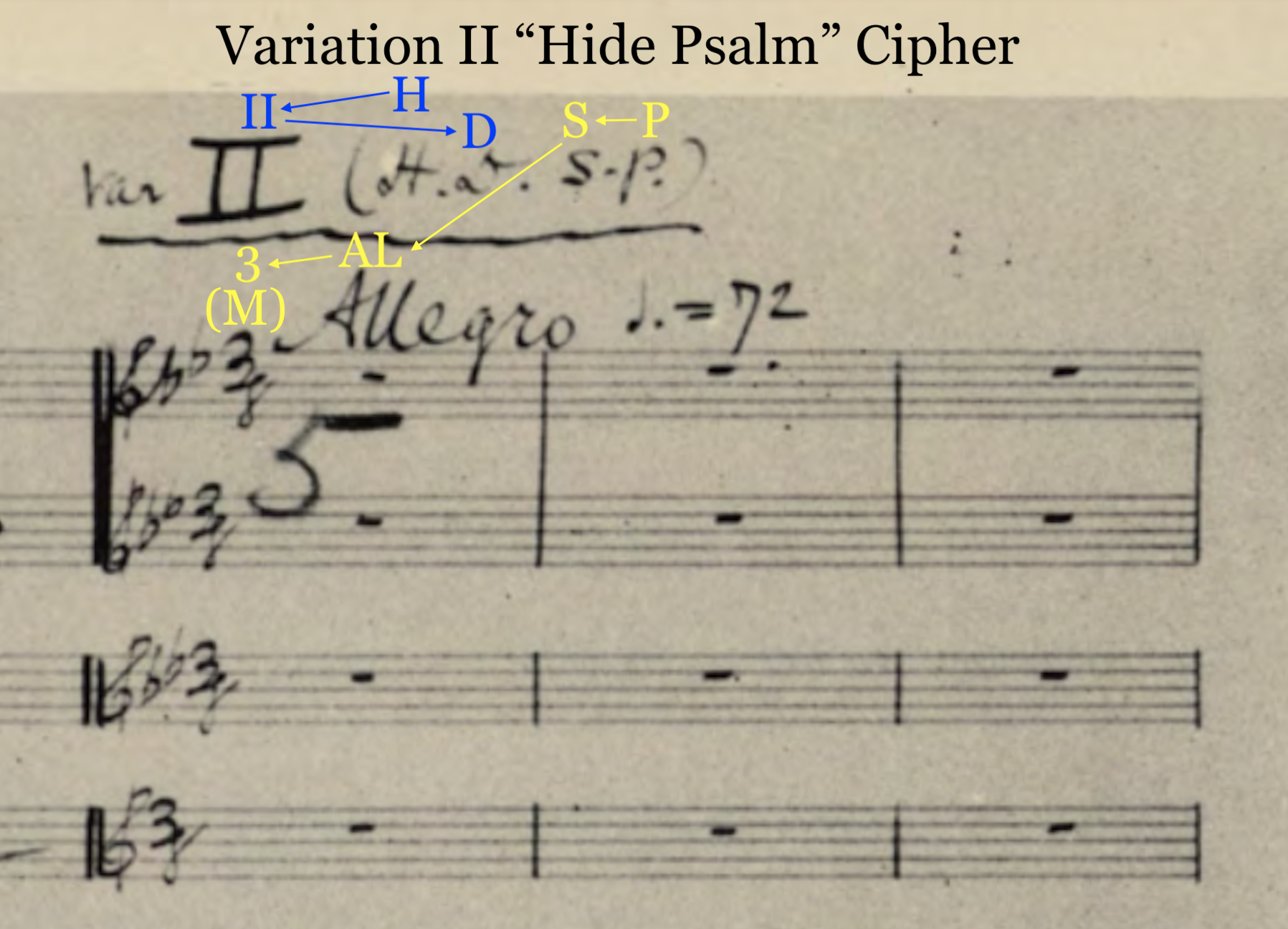
There are numerous coded references to Psalm and the number “46” in Variation II. The title area of the manuscript score encodes the acrostic anagrams “Hide Psalm” and “I hid Psalm.” The precise chapter is divulged by the number of periods (4) and letters (6) in the published title as well as by that movement’s 46-second duration.


Performance terms in the first bar of that movement also generate an acrostic anagram of Psalm. This cipher relies on the first letters of p[iano], stacc., Allegro, and the 3 from the time signature that may be rotated to resemble a cursive M. This flexible treatment of the 3 glyph is shown in the Dorabella Cipher where Elgar reorients that character to resemble an E, 3, and M. Chapter 46 is encoded by the total of all of the characters in the performance terms deployed in bar 41. That same sum is also produced by adding the bar number (41) to the Rehearsal number (5). Such redundancies serve as confirmation of the authenticity of these mutually supportive ciphers.


Performance directions in the second variation encipher seven abbreviations of Psalm (Ps) as acrostic anagrams. These ciphers use the same encoding technique observed with the Mendelssohn quotations in Variation XIII. These coded abbreviations appear in the staves of the first violin (bar 41), second violins (bar 43), cellos and contrabasses (bar 58), timpani (bar 83), flute (bar 93), and clarinet (bar 95). In bar 87, the first violins and violas play three notes in octaves — F, B, and E — which anagrammatize the initials of Ein feste Burg. The number 46 accompanies these coded abbreviations of Psalm in bars 41, 43, 93, and 95. The added sixth chord on the fourth scale degree of G minor in bar 94 encodes the numerals 4 and 6. The chord progression in bars 94 and 95 also encodes the numbers 4 and 6. Two E-flats in the accompaniment of bars 94-95 suggest a coded version of Elgar’s initials (EE).
Like the second variation, Variation XII encodes the word Psalm. The performance directions assigned to the cello solo at the beginning of that movement form an acrostic anagram of “E’s Psalm”. Recognizing that “E” represents Elgar’s initials, this anagram may be translated as “Elgar’s Psalm”. This cipher appears in bar 465. The first two numerals are 46, the chapter from the Psalms that inspired Ein feste Burg. The remaining 5 corresponds to the fifth letter of the alphabet, the initial for Elgar. 


The reluctance of legacy scholars to acknowledge or study Elgar's pioneering use of cryptography in his works is both a genuine enigma and a blessing in disguise. The more they delay devoting precious time and resources to this burgeoning field of study, the more opportunities for discovery remain the exclusive domain of independent researchers like myself. To learn more about the secrets of the Enigma Variations, read my free eBook Elgar’s Enigmas Exposed. Please help support and expand my original research by becoming a sponsor on Patreon.


Thursday, April 21, 2022

Answers to Elgar’s Enigmas in Longfellow’s “Hyperion”

Verily, no art is so damnably abused, as this glorious, holy Musica, who, in her delicate being, is so easily desecrated. Have you real talent,—real feeling for art? Then study music,—do something worthy of the art,—and dedicate your whole soul to the beloved saint.

    The English composer Edward Elgar (1857–1934) revered the works of the American author Henry Wadsworth Longfellow (1807–1882). Longfellow’s early poems and books glorify the Deutsche Romantik of Jean Paul (1763–1825), Goethe (1749–1832), and Hoffman (1776–1822). In his essay “Elgar and Longfellow” published in the April 2021 issue of The Elgar Society Journal, Arthur Reynolds explains how Elgar’s admiration for Longfellow was nurtured from early childhood by his mother. Ann Elgar inculcated her brood with Longfellow’s artistic weltanschauung through regular readings of his poetry and prose. Their esteem for that literary ambassador of Christianity was shared by such luminaries as Queen Victoria, Charles Dickens, and John Ruskin. Two years after Longfellow’s death, a memorial bust was erected in the Poet’s Corner of Westminster Abbey next to no less than Geoffrey Chaucer (c. 1340–1400). By this act, Longfellow was symbolically canonized as one of history’s eminent artisans of the English language.
    Longfellow’s stories and poems furnished Elgar with ample material for compositions produced between 1892 and 1903. The earliest is Spanish Serenade Op. 23, a piece for chorus and orchestra written in 1892 that employs a libretto from Act I of The Spanish Student. This was followed in 1893 by The Black Knight Op. 25, an oratorio that draws on Longfellow’s translation of Uhland’s “Der schwarze Ritter” from the novel Hyperion. Rondel Op. 16 No. 3 was composed in 1894, a song for voice and piano based on Longfellow’s translation of a French lyric poem by Jean Froissart (c. 1337–c. 1405). The Saga of King Olaf premiered in 1896, a cantata that sourced its text from Longfellow’s epic poem by the same title. Elgar completed his sacred oratorio The Apostles in 1903, a work partially inspired by Longfellow’s The Divine Tragedy (1871). That epic Christian poem forms a trilogy with The Golden Legend (1851) and The New England Tragedies (1868). These fusions of Elgar’s music with Longfellow’s text affirm Michael Pope’s conclusion that “...Longfellow possessed the imponderable spiritual qualities required to fire Elgar’s imagination.” Consequently, a familiarity with Longfellow’s works is a necessary prerequisite for more fully comprehending Elgar’s output.
    Elgar was not planning to compose a coruscating set of symphonic variations in October 1898. He had a far more ambitious project in mind — a symphony in honor of the late General Charles George Gordon (1833–1885) who died heroically thirteen years prior at the Siege of Khartoum. Elgar proposed a symphony about that fallen general for the Worcester Three Choirs Festival in September 1899. William H. Reed (1876–1942) recalls that during this period, Elgar was “. . . obsessed with the idea of writing a symphony, and just as Beethoven’s Eroica had a hero for its inspiration, so Elgar had a strong picture of Gordon in his mind, and meant to use the nobility of Gordon’s character as the central mood.” Such a project marked an escalation in Elgar’s artistic ambitions as he had never composed a symphony up to that point in his career. However, those plans proved premature as a decade would pass before he finally released his Symphony No. 1 in A-flat major in 1908.
    Elgar composed the Enigma Variations between 1898 and 1899. That extraordinary work catapulted him from provincial obscurity to international acclaim, transforming him from an itinerant music teacher to a celebrated composer. The original title on the autograph score is “Variations for orchestra composed by Edward Elgar Op. 36”. With the unconventional theme dubbed “Enigma”, the work is routinely referred to as the Enigma Variations. In the 1899 program note and other primary sources, Elgar explains the Theme is called “Enigma” because it is a counterpoint to a famous melody that is not heard but can play “through and over” the set of Variations. The secret tune is the cornerstone underlying the whole work, a subject that has provoked a dogged debate about the correct solution.
    The conventional wisdom posits there is no answer by speculating that Elgar concocted the notion of an absent principal Theme as an afterthought, practical joke, or marketing gimmick. The editors of the Elgar Complete Edition of the Enigma Variations blithely deny the likelihood there could be any covert counterpoints or even cryptograms. Relying on Elgar’s recollection of playing new material at the piano to gauge his wife’s reaction, the editors tout the standard lore that he extemporized the idiosyncratic Enigma Theme, mirabile dictu, without any forethought or planning:
There seems to have been no specific ‘enigma’ in mind at the outset: Elgar’s first playing of the music was hardly more than a running over the keys to aid relaxation. It was Alice Elgar’s interruption, apparently, that called him to attention and helped to identify the phrases which were to become the ‘Enigma’ theme. This suggests it is unlikely that the theme should conceal some counterpoint or cipher needed to solve the ‘Enigma’.
    Such a blanket abnegation conveniently relieves them of any obligation to probe for ciphers or cryptograms. Proponents of such a crude denialism extol the validity of their position based on a dearth of evidence for which they never executed a diligent or impartial search. This ridiculous state of affairs is a textbook case of confirmation bias pawned off as scholarship.
    The more sensible view (embraced by those who take Elgar at his published word) accepts the challenge that there is a famous melody lurking behind the Variations’ contrapuntal and modal facade. Regardless of what side is taken in this intractable debate, mainstream scholars insist the answer can never be known with certainty because Elgar allegedly took his secret to the grave in February 1934. The intellectual establishment presumes he never wrote down the solution for posterity to discover. Such a staid opinion glosses over or blatantly ignores Elgar’s documented obsession with cryptography. That incontestable facet of his psyche raises the prospect that the solution is meticulously encoded within Enigma Variations’ orchestral score.
    A decade of trawling that sublime masterpiece of British symphonism has netted over one hundred cryptograms in diverse formats that encode a set of mutually consistent and complementary solutions. Although that figure may seem extraordinary, it is entirely consistent with Elgar’s lifelong fascination with ciphers. More significantly, the solutions give definitive answers to the core questions posed by the Enigma Variations. What is the secret melody to which the Enigma Theme is a counterpoint and serves as the melodic foundation for the ensuing movements? Answer: Ein feste Burg (A Mighty Fortress) by Martin Luther. What is the “dark saying” ensconced within the Enigma Theme? Answer: A musical Polybius box cipher embedded in its inaugural six bars cordoned off by a strangely positioned double barline. Who is the secret friend and inspiration behind Variation XIII? Answer: Jesus Christ, the Savior of Elgar’s Roman Catholic faith. The cryptographic evidence supporting these discoveries is diverse yet mutually consistent, multivalent, and decisive. Such a vast trove of cryptograms reveals that the Enigma Variations is Elgar’s musical homage to cryptography.
    Elgar’s career as a composer was assured when the Wagnerian protégé Hans Richter (1843–1916) consented to conduct the London premiere of the Enigma Variations in June 1899. Following that triumph, Elgar was urged by Richter and August Jaeger (the dedicatee of Variation IV Nimrod) to expand the last movement. Elgar initially balked at this request. In a letter dated June 30, 1899, he wrote to Jaeger, “You won’t frighten me into writing a logically developed movement where I don’t want one by quoting other people! Selah!” Jaeger was privy to the secret melody and would have perceived Elgar’s allusion to the covert Theme because “Selah” appears at the end of verses 3, 7, and 11 of Psalm 46. Fortunately, Elgar soon relented and sketched a 96 bar extension to the Finale between June 30 and July 20. Maestro Leonard Slatkin does a masterful job comparing the original ending with the revised version. Elgar capped off his new ending with a quotation from the poem Elegiac Verse from Longfellow’s 1882 book In the Harbor: “Great is the art of beginning, but greater the art is of ending.” Longfellow was clearly on Elgar’s mind when he put the finishing touches to the Enigma Variations in July 1899.


    Richter’s endorsement of the Enigma Variations presented new opportunities for Elgar to compose more serious and large-scale works. As a token of his gratitude, Elgar presented Richter with a copy of Longfellow’s 1839 novel Hyperion: A Romance. In an October 1899 letter accompanying the book, Elgar explained, “I send you the little book about which we conversed & from which I, as a child, received my first idea of the great German nations.” Richter’s limited command of English prevented him from appreciating the invaluable contents of Elgar’s gift. Little did the Maestro realize that ensconced within the pages of that novel are the answers to Elgar’s enigmas. Hyperion furnishes the title of the covert principal Theme, the name of its composer, and the identity of Elgar’s anonymous friend depicted in Variation XIII. Remarkably, Elgar encoded the initials of Ein feste Burg as an acrostic anagram on the last page of the extended Finale.
    Hyperion is far from a “little book” as it consists of four parts with a total of 36 chapters. In a striking coincidence (if one may call it that), the opus number of the Enigma Variations is also 36. Where should one search for answers to Elgar’s enigmas in the pages of Hyperion? The citation from Longfellow’s Elegiac Verse at the conclusion of the Finale answers that question by magnifying the ending over the beginning. Applying this insight to Hyperion takes us to the ending in Chapter IX The Last Pang from Book IV. In those concluding pages, the protagonist Paul Flemming attends a service at the nearby cathedral:
He was still sitting at breakfast in his chamber, the next morning, when the great bell of the cathedral opposite began to ring, and reminded him that it was Sunday. Ere long the organ answered from within, and from its golden lips breathed forth a psalm. The congregation began to assemble, and Flemming went up with them to the house of the Lord. In the body of the church he found the pews all filled or locked; they seemed to belong to families. He went up into the gallery, and looked over the psalm-book of a peasant, while the congregation sang the sublime old hymn of Martin Luther, 
    “Our God, he is a tower of strength,
        A trusty shield and weapon.”
    The psalm emanating from the organ is Luther’s “sublime old hymn” Ein feste Burg (A Mighty Fortress). One may be forgiven for not recognizing this title due to Longfellow’s idiosyncratic translation of the opening lines from Psalm 46. In place of the more familiar phrase, “A mighty fortress is our God,” Longfellow offers the more poetic version, “Our God, he is a tower of strength.” The singular form psalm appears three times in Hyperion, and its plural form five times. As intimated by the quotation from Elegiac Verse, the key to untangling Elgar’s contrapuntal Gordian knot is to consult the ending of Hyperion where the reader encounters the name “Martin Luther” and the title of his most famous hymn. It is significant that no other song or composer is mentioned in this final chapter.
    Coded clues in the Enigma Variations allude to Longfellow and his novel Hyperion. The most direct is the quotation from Elegiac Verse at the end of the expanded Finale. An even more revealing hint is the Italian subtitle for Variation XIII — Romanza. The English translation of that subtitle is the third word in the title Hyperion: A Romance. On the earliest short score sketch, Elgar identified Variation XIII with a solitary capital “L.”


    It is remarkable that Longfellow’s earliest published works were identified in precisely the same manner. In the same year that Hyperion was published, The Knickerbocker Magazine featured Longfellow’s poem The Reaper and the Flowers under the title A Psalm of Death. It was accompanied by A Second Psalm of Life later renamed The Light of Stars. In lieu of Longfellow’s name, these poems were attributed to “L.” The original titles of these early poems make repeated use of the term Psalm.
    Prior research determined that proximate title letters from the Enigma Variations produce anagrams that unveil the identity of the covert melody and anonymous friend. This same encipherment technique also generates coded references to Hyperion. Paul Flemming is the protagonist who embarks on a tour of Germany and Switzerland as a salve for the loss of a dead friend. It is feasible to spell out “Paul Flemming” using adjacent title letters of the Enigma Variations. Proximate title letters from Variations V and VI spell "PAVl", a Latinized rendering of Paul due to the equivalence of the letters U and V. Elgar studied Latin at three Roman Catholic schools between the age of 5 and 15, and attended Latin Mass throughout his life.


    Adjacent title letters in Variations XII, XIII, and XIV permit a spelling of "FlEmING", a phonetic realization of Flemming. It is conspicuous that Flemming intersects with Romanza, the Italian word for "Romance" which appears in the title Hyperion: A Romance.


    The viability of this reading is enhanced by Elgar's use of phonetic spellings in his personal correspondence. Some notable examples are listed below:
  1. Bizziness (business)
  2. çkor (score)
  3. cszquōrrr (score)
  4. fagotten (forgotten)
  5. FAX (facts)
  6. frazes (phrases)
  7. gorjus (gorgeous)
  8. phatten (fatten)
  9. skorh (score)
  10. SSCZOWOUGHOHR (score)
  11. Xmas (Christmas)
  12. Xqqqq (Excuse)
  13. Xti (Christi)
    It is also feasible to spell “Hyperion” as an anagram using single letters from the titles of Variations I through VIII. The uniform yet seemingly random dispersion of these letters among the opening eight variations could suggest Flemming’s wanderings through Europe.


    The death of an unnamed friend spurs Longfellow’s doppelgӓnger Flemming to wander Germany and Switzerland in Hyperion. Death is also explored in Longfellow's early poems The Reaper and the Flowers and The Light of Stars. Elgar depicts death in Variation XIII by citing a melodic incipit from Felix Mendelssohn’s concert overture Calm Sea and Prosperous Voyage to represent a calm sea. The overture was inspired by Goethe’s poem Meeresstille und glückliche Fahrt that equates a calm sea to death with the grim declaration, “Todestille fürchterlich!” (Terrifying deathly stillness!). Elgar’s portrayal of death may be reasonably interpreted as representing the death of his anonymous friend. Like the covert Theme and its composer, the identity of this deceased friend is alluded to in the last chapter of Hyperion. For instance, Flemming observes “large crucifixes” at the entrances of towns and villages as he travels by carriage from Munich through Augsburg and Ulm towards Stuttgart.
    The Enigma Variations are dedicated to Elgar’s friends whom he identifies by their initials, name, or pseudonym. The only exception is Variation XIII where he substitutes three hexagrammic stars in place of the mysterious friend’s initials. The distinctive shape of these stars on the Master Score is faithfully retained in the published edition.


    These asterisks are the Star of David formed by merging two equilateral triangles. Elgar’s use of this particular star furnishes a glaring clue about the identity of his secret friend because one of the messianic titles for Christ is the Son of David (see Matthew 21:9). The word “stars” appears 34 times in Hyperion, often within a Christian context. The following excerpt from Book II Chapter X The Parting presents an apt illustration, “Beneath them, in the shadow of the hills, lay the valley, like a fathomless, black gulf; and above were the cloistered stars, that, nun-like, walk the holy aisles of heaven.” Another passage in Book III Chapter I Summer-Time reinforces the association between stars and Christianity:
“There take thy stand, my spirit;—spread
The world of shadows at thy feet;
And mark how calmly overhead,
The stars, like saints in glory, meet.
While, hid in solitude sublime,
Methinks I muse on Nature's tomb,
And hear the passing foot of Time
Step through the silent gloom.”
    In these two excerpts from Hyperion, Longfellow likens stars to nuns and saints, those redeemed by the atonement of Christ at Calvary. There are numerous biblical associations between Jesus and stars. The Star of Bethlehem was a prophetic sign that led the wise men from the East to the birthplace of Christ where they worshiped him and gave him gifts. In Revelation 1:16, Jesus is described as holding seven stars in his right hand. In Revelation 22:16, Jesus calls himself “the bright morning star.” The enigmatic asterisks in the title for Variation XIII are infused with theological references to Christ.
    The lyrics of Luther’s most renowned hymn settle the debate about the identity of Elgar’s secret friend memorialized in Variation XIII. In the second stanza of Ein feste Burg, Luther’s holy hero is announced in the original German lyrics as, “Er heißt Jesus Christ.” The English translation is, “He is called Jesus Christ.” When Elgar gave Richter that book, he literally gave away the answers to his enigmas.


    Martin Luther is mentioned six times in Hyperion. The first is in the form of a question where Flemming asks what would be the fame of Germany “. . . without her Martin Luther, her Goethe, and her Schiller?” The second is where Flemming confidently asserts, “I think the name Martin Luther, the monk of Wittenberg, alone sufficient to redeem all monkhood from the reproach of laziness.” The third describes Flemming passing, “. . . a ruined house where Martin Luther lay concealed after the diet of Worms . . .” Luther famously appeared at the 1521 Diet of Worms where he was charged with heresy for posting his Nine-five Theses. In the fourth reference to Luther, Fleming ponders “. . . the days, when, from that old pulpit, some bold reformer thundered down the first tidings of a new doctrine, and the roof echoed with the grand old hymn of Martin Luther.” The fifth time is by Brother Bernadus who describes Luther, Melancthon, and Calvin as “great men.” The sixth and final mention is in the concluding chapter where Flemming listens to the congregation sing Luther’s “sublime old hymn” Ein feste Burg. The theme of the sermon that followed was the Reformation.
    Hyperion is not the only work in which Longfellow extols the virtues of Martin Luther and his greatest hymn. In his 1845 anthology The Poets and Poetry of Europe, Longfellow devotes a section to Martin Luther and Thomas Carlyle’s 1831 translation of the hymn Ein feste Burg. In Christus: A Mystery, Longfellow penned a Second Interlude about Martin Luther hiding out at Wartburg Castle. Longfellow mingles his poetry with each stanza of Ein feste Burg in a glowing tribute to the great German Reformer. Luther’s hideout is also mentioned in Hyperion.


    The name of Elgar’s anonymous friend “Jesus” appears four times in Hyperion. The first is as “Jesus of Nazareth” in Chapter II The Christ of Andernach. As Flemming walks the narrow streets, he encounters a grisly spectacle:
Suddenly, on turning the corner of an ancient, gloomy church, his attention was arrested by a little chapel in an angle of the wall. It was only a small thatched roof, like a bird's nest; under which stood a rude wooden image of the Saviour on the Cross. A real crown of thorns was upon his head, which was bowed downward, as if in the death agony; and drops of blood were falling down his cheeks, and from his hands and feet and side. The face was haggard and ghastly beyond all expression; and wore a look of unutterable bodily anguish. The rude sculptor had given it this, but his art could go no farther. The sublimity of death in a dying Saviour, the expiring God-likeness of Jesus of Nazareth was not there. The artist had caught no heavenly inspiration from his theme. All was coarse, harsh, and revolting to a sensitive mind; and Flemming turned away with a shudder, as he saw this fearful image gazing at him, with its fixed and half-shut eyes.
    Elgar captures a “heavenly inspiration” from his divine “theme” in Variation XIII. That movement is riddled with cryptograms that authenticate Jesus as the secret friend. The Roman numerals are a simple number-to-letter cipher (X = 10, III = 3) that transparently encode the initials for Jesus Christ (10 = J, 3 = C). The opening two melody notes are G descending to D, a phonetic rendering of God. Its marine atmosphere alludes to the Sign of Jonah invoked by Jesus when challenged by the authorities to confirm his heavenly mandate (see Matthew 12:38-42).
    The second time the secret friend’s name appears in Hyperion is as “Jesus of Jerusalem” in Chapter III Homunculus from Book I. Merriam-Webster defines a homunculus as “a little man” or “manikin.” An ancient ruin admonishes Flemming about the dangers of dreams, illusions, and the “solemn deceivings of thy vast desires” with the following recollection:
“In ancient times there dwelt within these halls a follower of Jesus of Jerusalem,—an Archbishop in the church of Christ. He gave himself up to dreams; to the illusions of fancy; to the vast desires of the human soul. He sought after the impossible. He sought after the Elixir of Life,--the Philosopher's Stone. The wealth, that should have fed the poor, was melted in his crucibles. Within these walls the Eagle of the clouds sucked the blood of the Red Lion, and received the spiritual Love of the Green Dragon, but alas! was childless. In solitude and utter silence did the disciple of the Hermetic Philosophy toil from day to day, from night to night. From the place where thou standest, he gazed at evening upon hills, and vales, and waters spread beneath him; and saw how the setting sun had changed them all to gold, by an alchymy more cunning than his own. He saw the world beneath his feet; and said in his heart, that he alone was wise. Alas! he read more willingly in the book of Paracelsus, than in the book of Nature; and, believing that `where reason hath experience, faith hath no mind,' would fain have made unto himself a child, not as Nature teaches us, but as the Philosopher taught,—a poor homunculus, in a glass bottle. And he died poor and childless!”
    The third time is to the “beautiful Lord Jesus” in Chapter VIII Footprints of Angels from Book IV. This is soon followed by the fourth and final mention as simply Jesus. In this chapter, Flemming attends the funeral of an infant who died shortly after birth:
    It was Sunday morning; and the church bells were all ringing together. From all the neighbouring villages, came the solemn, joyful sounds, floating through the sunny air, mellow and faint and low,—all mingling into one harmonious chime, like the sound of some distant organ in heaven. Anon they ceased; and the woods, and the clouds, and the whole village, and the very air itself seemed to pray, so silent was it everywhere.
    Two venerable old men,—high priests and patriarchs were they in the land,—went up the pulpit stairs, as Moses and Aaron went up Mount Hor, in the sight of all the congregation,—for the pulpit stairs were in front, and very high.
    Paul Flemming will never forget the sermon he heard that day,—no, not even if he should live to be as old as he who preached it. The text was, "I know that my Redeemer liveth." It was meant to console the pious, poor widow, who sat right below him at the foot of the pulpit stairs, all in black, and her heart breaking. He said nothing of the terrors of death, nor of the gloom of the narrow house, but, looking beyond these things, as mere circumstances to which the imagination mainly gives importance, he told his hearers of the innocence of childhood upon earth, and the holiness of childhood in heaven, and how the beautiful Lord Jesus was once a little child, and now in heaven the spirits of little children walked with him, and gathered flowers in the fields of Paradise. Good old man! In behalf of humanity, I thank thee for these benignant words! And, still more than I, the bereaved mother thanked thee, and from that hour, though she wept in secret for her child, yet

        “She knew he was with Jesus,
            And she asked him not again.”

    After the sermon, Paul Flemming walked forth alone into the churchyard. There was no one there, save a little boy, who was fishing with a pin hook in a grave half full of water. But a few moments afterward, through the arched gateway under the belfry, came a funeral procession. At its head walked a priest in white surplice, chanting. Peasants, old and young, followed him, with burning tapers in their hands. A young girl carried in her arms a dead child, wrapped in its little winding sheet. The grave was close under the wall, by the church door. A vase of holy water stood beside it. The sexton took the child from the girl's arms, and put it into a coffin; and, as he placed it in the grave, the girl held over it a cross, wreathed with roses, and the priest and peasants sang a funeral hymn. When this was over, the priest sprinkled the grave and the crowd with holy water; and then they all went into the church, each one stopping as he passed the grave to throw a handful of earth into it, and sprinkle it with holy water.
    Longfellow’s likening of the two elderly priests to the Old Testament prophets Moses and Aaron is relevant because the Enigma Variations furnish a subtle link to Aaron. Variation VI has the biblical title Ysobel, the name of Aaron’s wife that translates into English as Elizabeth. That movement is dedicated to Elgar’s viola pupil, Isabel Fitton, whose first name is a Spanish derivation of Ysobel. The main motive of her variation represents a string “crossing” exercise. The ritual of “crossing” oneself is practiced by various Christian denominations, most notably Roman Catholic and Lutheran. Elgar was born, educated, married, and buried as a Roman Catholic. Martin Luther, a renegade Roman Catholic priest, founded the Lutheran Church. There are coded references to crossing within the Enigma Variations. Remarkably, Longfellow’s Cross is enciphered by proximate title letters in Variations XIII and XIV.


    Jesus is commonly known by the title Christ which means “anointed one.” Like the twelve disciples, “Christ” appears a dozen times in Hyperion. In that same novel, Jesus is referred to as Lord.
    There is an ancillary explanation for why Elgar gave Richter a copy of Hyperion. The name “Richter” appears in that novel in connection with the German romantic writer Jean Paul Richter. Usually referred to as “Jean Paul,” Richter is mentioned half a dozen times in Hyperion. Like Jean Paul, Hans Richter was an artist and tireless champion of German romanticism. Robert Schumann venerated the works of Jean Paul as documented by Robert L. Jacobs’ essay Schumann and Jean Paul. During a visit to Leipzig in 1882, Elgar described Schumann as “my ideal” composer. Jean Paul lived and worked in Bayreuth, the same town where Richter famously conducted the Ring Cycle at the first Bayreuth Festival in 1876.
    Elgar's presentation of Longfellow's Hyperion to Hans Richter proves to be a brilliant use of literature. That novel furnishes three key pieces of information about the Enigma Variations:
  1. The title of the famous covert principal Theme.
  2. The name of its renowned composer.
  3. The name of Elgar's secret friend depicted in Variation XIII.
    A careful study of that romantic novel permits one to look behind the curtain of Elgar’s public persona and glimpse his inner world. When asked by a German stranger if he understood the works of Jean Paul, Fleming answered, “If at once you understand an author’s character, the comprehension of his writings becomes easy.” The same insight applies with equal force to Elgar. To learn more about the secrets of the Enigma Variations, read my free eBook Elgar’s Enigmas Exposed. Please help support and expand my original research by becoming a sponsor on Patreon.

About Mr. Padgett

My photo
Mr. Padgett studied violin with Michael Rosenker (a student of Leopold Auer), and Rosenker’s pupil, Owen Dunsford. Mr. Padgett studied piano with Sally Magee (a student of Emanuel Bay), and Blanca Uribe (a student of Rosina Lhévinne). He attended the Stevenson School in Pebble Beach, California, and Vassar College in Poughkeepsie, New York, where he graduated Phi Beta Kappa with a degree in psychology. At Vassar he studied music theory and composition with Richard Wilson. Mr. Padgett has performed for Joseph Silverstein, Van Cliburn, Arnold Schwarzenegger, Maria Shriver, Steve Jobs, Prince Charles, Lady Camilla, Marcia Davenport, William F. Buckley, Jr., and other prominent public figures. His original compositions have been performed by the Monterey Symphony, at the Bohemian Grove, the Bohemian Club, and other private and public venues. In 2008 Mr. Padgett won the Max Bragado-Darman Fanfare Competition with his entry "Fanfare for the Eagles." It was premiered by the Monterey Symphony under Maestro Bragado in May 2008. A member of the Elgar Society, Mr. Padgett is married with five children.