Translate

Sunday, October 3, 2021

Elgar's Program Anagram Enigma Ciphers

Edward Elgar posing at the entrance of The Mount School
In the early months of that year [1899], Elgar decided to take another house, so he moved to Craeg Lea, Wells Road, Malvern, on 21st March. It will be noticed, no doubt, that the mind which turned Jaeger into Nimrod, the daughter from Caroline Alice into Carice, and so on, once more exercised its ingenuity upon the name of his house, which is an anagram constructed from the names of all the people who lived in it, i.e., Carice, Alice, Edward, ELGAR.

The British composer Edward Elgar relished phonetic spellings, wordplays, and anagrams. One notable example is the title “Craeg Lae” which he imparted to his Malvern home where his family resided between 1899 and 1904. That strange moniker is an anagram obtained from the reverse spelling of “Elgar” (Craeg Lea) mingled with the initials from the first names of his daughter Carice, his wife Alice, and himself (Craeg Lea). Elgar challenged Dora Penny to decipher the meaning of his home’s bemusing name. She caught on quickly as recounted in her memoir:
Edward called the place Craeg Lea and challenged me to guess how he had found the name. By some stroke of luck, I realized that the key lay in the unusual spelling of “Craeg” and immediately saw that the thing had been built up anagrammatically from (A)lice, (C)arice, (E)dward ELGAR. I think he was a little annoyed that this mystification had fallen flat.
In honor of Elgar’s affinity for anagrams, the title of this article produces the acrostic anagrams “PEACE.” It also forms the telestich anagram “M MASS” in which the “M” symbolizes the initial “E” for Elgar prostrating itself before the word Mass, a central liturgical rite of his Roman Catholic faith.
Elgar’s enthusiasm for word games inevitably spilled over into the field of cryptography, the discipline of coding and decoding secret messages. His obsession with that esoteric art is granted an entire chapter in Craig P. Bauer’s treatise Unsolved! The bulk of its third chapter is devoted to Elgar’s brilliant decryption of an allegedly insoluble Nihilist cipher conveyed by John Holt Schooling in an April 1896 issue of The Pall Mall Magazine. A Nihilist cipher is a derivative of the Polybius square cipher. Elgar was so delighted with his solution that he mentions it in his first biography published in 1905 by Robert J. Buckley. Elgar painted the solution in black paint on a wooden box, an appropriate medium as another name for the Polybius square is a box cipher.
Elgar’s methodical decryption of Schooling’s conundrum is summarized on a set of nine index cards. On the sixth card, Elgar relates the task of cracking the cipher to “...working (in the dark).”


His use of the word “dark” as a synonym for a cipher is relevant to this investigation as this same adjective turns up later in Elgar’s 1899 program note for the premiere of the Enigma Variations. It is an oft-cited passage that warrants revisiting as he lays the groundwork for his melodic riddle:
The Enigma I will not explain – it’s ‘dark saying’ must be left unguessed, and I warn you that the connexion between the Variations and the Theme is often of the slightest texture; further, through and over the whole set another and larger theme ‘goes’, but is not played . . . So the principal Theme never appears, even as in some later dramas – e.g., Maeterlinck’s ‘L’Intruse’ and ‘Les sept Princesses’ – the chief character is never on the stage.
Elgar birthed the Enigma Variations in 1898-99. That extraordinary work elevated him from provincial obscurity to international acclaim, transforming his career from an itinerant music teacher to a celebrated composer. The original title appears on the autograph score as “Variations for orchestra composed by Edward Elgar Op. 36”. With the unconventional theme dubbed “Enigma,” the work is popularly referred to as the Enigma Variations. In the 1899 program note and other primary sources, Elgar explained the Theme is called “Enigma” because it is a counterpoint to a famous melody that is not heard but can play “through and over” the Variations. This absent tune is the cornerstone underlying the whole work, a subject that has provoked a prolonged debate about the correct solution.
Some contend there is no answer by insinuating Elgar concocted the notion of an absent principal Theme as an afterthought, practical joke, or marketing ploy. Others take Elgar at his word and accept the challenge that there is a famous melody lurking behind the Variations’ contrapuntal and modal facade. Regardless of what side is taken in this debate, conventional scholarship stalwartly insists that the answer cannot be verified because Elgar allegedly took his secret to the grave in February 1934. They insist Elgar never wrote down the solution for posterity to discover. However, this opinion glosses over or flagrantly ignores Elgar’s documented obsession with cryptography. This incontestable facet of Elgar’s personality profile raises the possibility that the solution is meticulously encoded within Enigma Variations’ orchestral score.
A decade of trawling that sublime symphonic masterpiece has netted over one hundred cryptograms in diverse forms that encode a set of mutually consistent and complementary solutions. Although that figure may seem extravagant, it is entirely consistent with Elgar’s lifelong obsession for ciphers. More significantly, the solutions give definitive answers to the core questions posed by the Enigma Variations. What is the secret melody to which the Enigma Theme is a counterpoint and serves as the melodic foundation for the ensuing movements? Answer: Ein feste Burg (A Mighty Fortress) by Martin Luther. What is Elgar’s “dark saying” ensconced within the Enigma Theme? Answer: A musical Polybius box cipher embedded in its inaugural six bars cordoned off by an oddly placed double barline. Who is the secret friend and inspiration behind Variation XIII? Answer: Jesus Christ, the Savior of Elgar’s Roman Catholic faith. The cryptographic evidence supporting these discoveries is diverse, mutually consistent, and decisive.

The Enigma Theme Performance Directions Cipher

One exemplar of Elgar’s affinity for acrostic anagrams is ensconced within the Enigma Theme. Below is a facsimile of the Enigma Theme’s opening bars from the autograph score.

The first page of the Enigma Theme from the Autograph Score

In the first measure, Elgar penned seven discrete performance directions in Italian. Those seven words are listed below:
  1. Andante.
  2. legato
  3. e
  4. sostenuto
  5. molto
  6. espress.
  7. Piano
The first letters of those seven performance directions are an acrostic anagram of “EE’s PSALM.” The order of the terms is reshuffled below to spell out this remarkable discovery.
  1. e
  2. espress.
  3. Piano
  4. sostenuto
  5. Andante.
  6. legato
  7. molto
Elgar initialed this cryptogram with his dual Es observed in the first part of the decryption. He often signed his letters with his initials. His friends also referred to him as “E. E.” as shown by Dora Penny’s diary from 1899. “Psalm” in the singular refers to a particular chapter in the Book of Psalms. Which one could it be? Elgar’s cipher has precisely 46 characters, a figure that implicates Psalm 46. That chapter is known as “Luther’s Psalm” because it inspired Luther’s epic hymn Ein feste Burg. In the very first bar of the Enigma Theme, Elgar enciphered the answer to his melodic riddle with an elegant acrostic anagram that he stealthily initialed to authenticate the solution.


Akin to locks, ciphers are unlocked by keys. The Enigma Theme is set in the parallel keys of G minor and G major. The accidentals that define those key signatures are B-flat, E-flat, and F-sharp. Remarkably, those letters are an acrostic anagram of the initials for “Ein feste Burg.” The Enigma Theme’s performance directions in bar 1 encode “Psalm 46,” and the accidentals for its keys encode the initials “E.F.B.”

The Program Note Maeterlinck Phrase Cipher

With so many cryptograms expertly woven into the fabric of the Enigma Variations, it would be prudent to sift through Elgar’s original 1899 program note for prospective ciphers. There is a conspicuous phrase in his commentary that begins with the Belgian playwright’s name Maeterlinck followed by the French titles for two of his plays. This reference is anomalous because Elgar only gives the name of a stranger when describing a work dedicated to his friends. This Maeterlinck phrase also stands out because it is bookended by two long dashes. These punctuation marks add emphasis and are referred to as an “em dash.” This label for the long dash was standard before Elgar composed the Enigma Variations. “Em” is a homonym of the letter “M.” Consequently, the two em dashes surrounding the Maeterlinck phrase suggest the dual initials for Maurice Maeterlinck.
An analysis of the Maeterlicnk phrase revealed its unique first initials spell “Psalm” as a reverse acrostic: Maeterlinck’s ‘L’Intruse’ and ‘Les sept princesses’. More remarkable still, there are precisely 46 characters in that Maeterlinck phrase. That sum points to the 46th chapter of the Psalms. Elgar also subtly associates the numbers four and six in that phrase by distributing six apostrophes among four words. The decryption of the anomalous Maeterlinck phrase as “Psalm 46” parallels the Enigma Theme’s Performance Directions Cipher.


There is a second layer to this Maeterlinck Phrase Cipher. The German initials for the secret melody (E.F.B.) are ingeniously enciphered by the nationalities associated with Elgar’s program note. Elgar is an English composer whose explanatory note for the Enigma Variations is in his native language. In his remarks, he refers to the Belgian playwright Maeterlinck and the French titles of two plays. These three nationalities (English, French, and Belgian) are an acrostic anagram of the initials for the covert Theme: Ein feste Burg. In a remarkable display of cryptography, the phrase “Maeterlinck’s ‘L’Intruse’ and ‘Les sept Princesses’” efficiently enciphers Psalm 46 and the initials for the secret melody. These two overlapping ciphers provide a set of mutually reinforcing solutions in which one affirms and authenticates the other.

The Program Note Enigma Phrase Cipher

The Maeterlinck Phrase Cipher consists of six words set apart by long dashes. This phrase is anomalous as Elgar only furnishes a stranger’s name in a program note describing a work dedicated to friends. There is another unusual six-word phrase followed by a long dash that appears earlier in his commentary. It begins, “The Enigma I will not explain – . . .” Elgar contradicts this refusal by continuing to explain the Variations are based on an absent principal Theme that can be played over the set but is not heard. Like the Maeterlinck Phrase Cipher, the anomalous six-word phrase ends with an em dash. The phrase “The Enigma I will not explain” consists of six words with a total of 24 characters. These sums present two striking parallels with the covert Theme’s title because it also consists of six words with 24 characters: Ein feste Burg ist unser Gott. These elements of the Enigma phrase allude to the existence of another phrase cipher in Elgar’s program note.
A cryptanalysis of the Enigma phrase was conducted to detect if it employs the same encryption techniques found with the Maeterlinck Phrase Cipher. The first letters from the six-word Enigma phrase appear in order as “TEIwne.” The first three initials are capitalized followed by three more in lower case. The balanced distribution of three capitalized and three lowercase letters suggests a coded form of Elgar’s initials as the glyph “3” is the mirror image of a capital cursive E. Two Es in this series of initials — the first capitalized and another lowercase — present another coded version of his initials. The first revealing anagram from this set of initials is “EIn,” the first word from the title of Ein feste Burg. Note that the first two letters are capitalized with the third in lower case. This pattern of capitalized and lowercase letters surfaces on the cover sheet, original final page, and the last page of the extended Finale of the autograph score. In all three places, Elgar’s abbreviated the month of February as “FEb”. Remarkably, this anomalous abbreviation is an anagram of the covert Theme’s initials. Consequently, the anagram “EIn” is organically linked to “FEb” based on this distinctive pattern of capitalized and lowercase letters.

“EFB” anagrams on the cover page of the Autograph Score 

“EFB” anagram on the last page of the autograph score


Setting aside the initials for “EIn” leaves “Twe,” an anagram of “weT.” Merriam-Webster defines wet as “covered or soaked with water…” There is only one place in the Enigma Variations where Elgar openly depicts water: Variation XIII. In that movement, he cites melodic incipits from Felix Mendelssohn’s overture Calm Sea and Prosperous Voyage to portray a calm sea. Like the title of the covert Theme, the overture’s original title is in German (Meeresstille und glückliche Fahrt). These Mendelsohn quotations are anomalous because they originate from a seemingly extraneous work unrelated to the Enigma Theme. This sonic portrayal of water presents a clever wordplay as water is a solution. As an aficionado of wordplay, Elgar’s aquatic quotations subtly hint at a solution lurking beneath the surface of the Mendelssohn fragments.
Do the Mendelssohn quotations conceal ciphers? Extensive cryptanalysis confirms they harbor a diverse array of cryptograms that encode the secret melody’s initials, title, and distinctive ending phrase. Some ciphers also supply answers about the identity of Elgar’s secret friend who is the mysterious dedicatee of Variation XIII. A sampling of these cryptograms with links to their solutions are provided below:
  1. Mendelssohn Fragments Scale Degrees Cipher
  2. Mendelssohn Clarinet Solo Nominal Notes Cipher
  3. Rehearsal 55 Clarinet Solo Cipher
  4. Variation XIII Clarinet Key Signature Cipher
  5. Mendelssohn Keynotes Cipher
  6. Music Anagram Cipher
  7. Mendelssohn Fragments Melodic Intervals Cipher
  8. Mendelssohn Fragments Major Keys Cipher
  9. Mendelssohn Fragments Clefs Cipher
  10. Mendelssohn Quotations Accidentals Cipher
  11. Mendelssohn Quotations Elimination Cipher
  12. Mendelssohn Fragments Solo Passages Cipher
  13. Mendelssohn Quotations Polybius Box Cipher
The partial decryption “wet” from the Enigma Phrase Program Note Cipher robustly implies the solution to the Variations is hidden within Elgar’s marine quotations. Trawling those melodic fragments netted a substantial hual of cryptograms that verify the authenticity and accuracy of this “wet” decryption. Martin Luther was inspired by Psalm 46 to compose Ein feste Burg, a chapter that mentions the sea in its opening verses. Psalm 46:1-3 reads:
God is our refuge and strength,
    a very present help in trouble.
Therefore we will not fear though the earth gives way,
    though the mountains be moved into the heart of the sea,
though its waters roar and foam,
    though the mountains tremble at its swelling. Selah
It is equally feasible to rearrange the initials “TEIwne” as the anagram “TwIn Ee.” The expression “Twin EE” is an apt characterization of Elgar’s initials (EE). It is also an accurate description of the first initials for the Enigma Theme and its covert melody, Ein feste Burg. Although these two melodies are outwardly dissimilar, they are like fraternal twins as they share a unique contrapuntal fusion.
In less frequent cases, the last letters from words may also form an anagram, a type known as a telestich. The last letters from each word of the phrase “The Enigma I will not explain . . .” are “eaIltn.” As there is only one letter in “I,” it counts as both the first and final letter in this analysis. When treated as a telestich anagram, these last letters may be reshuffled as “latIne.” This arrangement may be read as “Latin E.” The “E” may be confidently interpreted as Elgar’s initial as he sometimes signed his correspondence with “E.” His wife also routinely identified him in her diaries with a solitary capital E. Alternatively, the last initials “eaIltn” may be reorganized as “latIne.” The Latin adverb Latine means “in Latin.” This ancillary decryption is a virtual twin to “Latin E.”


Elgar was born, raised, and educated as a Roman Catholic. During his formative years, he studied Latin at three Roman Catholic schools and regularly attended Latin Mass. Some of his earliest choral works are set in that language. In all, Elgar composed fifteen Latin Motets with three forming his Op. 2: Ave Verum (Jesu, Word of God Incarnate), Ave Maria, and Ave Maris Stella. Elgar wrote Ave Maria and Ave Maris Stella during his tenure as organist at St. George’s Church in Worcester. He arranged Ave Verum in 1902 from music prepared for William Allen’s funeral. These Latin works furnish gargantuan clues regarding the identity of Elgar’s secret friend depicted in Variation XIII. The decryption of a musical Polybius cipher in the Enigma Theme unveiled a Latin expression in bars 1-2.

Conclusion

This investigation identified two anomalous phrases from Elgar’s commentary cited in the original program note for the June 1899 premiere of the Enigma Variations. These phrases consist of six words and are set apart by long dashes. The first is “The Enigma I will not explain — . . .” This phrase possesses six words and 24 letters, the very same sums associated with Ein feste Burg ist unser Gott. The Enigma Phrase Cipher encodes the acrostic anagrams Ein, Wet, Twin EE, and the telestich anagrams Latin E and Latine. The second phrase is “. . . Maeterlinck’s ‘L’Intruse’ and ‘Les sept princesses’ — ”. This phrase has 46 characters and encodes a reverse acrostic of Psalm. The solutions to these 1899 program note phrase ciphers furnish substantive clues regarding the covert Theme, the location of other cryptograms in the orchestral score, and the identity of Elgar's secret friend memorialized in Variation XIII. To learn more about the secrets of the Enigma Variations, read my free eBook Elgar’s Enigmas Exposed. Please help support and expand my original research by becoming a sponsor on Patreon.

Soli Yah Gloria


Sunday, September 19, 2021

Corresponding Ciphers in the 1899 Program Note and Enigma Theme

During railway journeys amuses himself with cryptograms; solved one by John Holt Schooling who defied the world to unravel his mystery.
Robert J. Buckley in his 1905 biography of Sir Edward Elgar

It is distinctly anomalous that in his 1899 program note about an orchestral work dedicated to his friends, Elgar only furnishes the name of a foreign playwright and stranger: Maeterlinck. That surname is followed by the French titles from two of his plays, L’Intruse (The Intruder) and Les sept Princesses (The Seven Princesses). In the program note, the phrase “Maeterlinck’s ‘L’Intruse’ and ‘Les sept Princesses’” is set apart by two long dashes. Elgar was an expert in cryptography, the discipline of encoding and decoding secret messages. Could his conspicuous Maeterlinck phrase be a cipher?
The unique first initials from Elgar’s Maeterlinck phrase are “MLaSP” (Maeterlinck’s ‘L’Intruse’ and ‘Les sept Princesses’), a reverse acrostic anagram of PSALM. This phrase has precisely 46 characters, a figure that alludes to Psalm 46.
That famous chapter is known as “Luther’s Psalm” because it inspired his greatest hymn, “Ein feste Burg” (A Mighty Fortress). This Maeterlinck cryptogram implicates Luther’s most famous hymn as the covert principal Theme to the Enigma Variations. The remaining initials “IL” (Maeterlinck’s ‘L’Intruse’ and ‘Les sept Princesses’) produce the Roman numerals for 49. That number may be interpolated as a coded form of 46 because the glyph for 9 is identical to 6 in an inverted form.
There is a second layer to this Maeterlinck Cipher. The German initials for the secret melody (E.F.B.) are ingeniously enciphered by the nationalities associated with Elgar’s program note. Elgar is an English composer whose explanatory note for the Enigma Variations is in his native language. In his remarks, he refers to the Belgian playwright Maeterlinck and the French titles of two plays. These three nationalities (English, French, and Belgian) are an acrostic anagram of the initials for the covert Theme: Ein feste Burg. In a remarkable display of cryptography, the phrase “Maeterlinck’s ‘L’Intruse’ and ‘Les sept Princesses’” efficiently encodes Psalm 46 and the initials for the secret melody. These two overlapping ciphers provide a set of mutually reinforcing solutions in which one affirms and authenticates the other.
A related cryptogram is formed by seven discrete performance directions in the first bar of the Enigma Theme’s orchestral score. Those seven terms are Andante, legato e sostenuto, molto express., and Piano). The first letters of these seven Italian words are an acrostic anagram of “EE’s Psalm.” The dual Es are the initials for Edward Elgar.
  1. e
  2. espress.
  3. Piano
  4. sostenuto
  5. Andante
  6. legato
  7. molto
Elgar indicated the tempo for the Enigma Theme by writing a quarter note followed by an equals sign (=) and the number 63. This adds four more characters to the seven other performance directions in the Enigma Theme’s opening bar for a grand total of 46 characters. That precise sum implicates Psalm 46.

The Enigma Theme is set in the parallel keys of G minor and G major. The accidentals for those key signatures are B-flat, E-flat, and F-sharp. The letters of those accidentals (B, E, and F) are an anagram of the initials for Ein feste Burg. The keys of the Enigma Theme elegantly unlock Elgar's contrapuntal strongbox to reveal the initials of the covert principal Theme.


There are some extraordinary parallels between the Program Note Maeterlinck Cipher and the Enigma Theme’s Performance Directions Cipher. Both employ acrostic anagrams to encode the word “Psalm” and link it to character totals adding up to 46. The title of the covert principal Theme to the Enigma Variations comes from the first line of Psalm 46: A Mighty Fortress is our God. The initials for Ein feste Burg are enciphered as acrostic anagrams by the nationalities in the 1899 Program Note (English, French, and Belgian) and the accidentals for the parallel key signatures of the Enigma Theme (E-flat, F-sharp, and B-flat). The matching decryptions of these two ciphers via acrostic anagrams defies a fortuitous origin. The precision and ingenuity of these two multilayered ciphers illustrate Elgar’s talent for cryptography, a neglected field of study deserving of more rigorous investigation and analysis. To learn more about the secrets of the Enigma Variations, read my free eBook Elgar’s Enigmas Exposed. Please help support and expand my original research by becoming a sponsor on Patreon.

Soli Yah Gloria


Monday, August 2, 2021

Gordon's Shadow Over Elgar's Enigma

“Now as to Gordon; the thing possesses me, but I can’t write it down yet . . .”
Edward Elgar in a November 1898 letter to August Jaeger
concerning a potential symphony in honor of General Gordon

Anxious for nothing in his final hour,
Brave before the onslaught of his butchers,
Inspired by his Lord’s resolute power,
Despised by Mahdists for combating slavers,
Embroiled in the doomed defense of Khartoum,
Willing to lay down his life for his friends,
Inviolable at death bereft a tomb,
The general’s General to heaven ascends,
His place in the pantheon nobly won,
Martyred for his faith in God’s only Son,
Elgar’s martial muse was General Gordon.
Robert Wayne Padgett

The British romantic composer Edward Elgar was not planning to compose a resplendent set of orchestral variations in October 1898. Instead, he had a far more ambitious project in mind — a symphony in honor of the late General Charles George Gordon who died heroically thirteen years prior at the Siege of Khartoum. Elgar proposed a symphonic work about that fallen general for the Worcester Three Choirs Festival in September 1899. Gordon’s mystique stoked Elgar’s creative fires. William H. Reed, a violinist and close friend of the composer, recounted that during this period, Elgar was “...obsessed with the idea of writing a symphony, and just as Beethoven’s Eroica had a hero for its inspiration, so Elgar had a strong picture of Gordon in his mind, and meant to use the nobility of Gordon’s character as the central mood.” Such a project heralded an escalation in Elgar’s artistic ambitions as he had never composed a symphony up to that point in his career. However, those plans proved premature as a decade would pass before he finally produced his Symphony No. 1 in A-flat major in 1908.
In a letter dated October 21, 1898, Elgar informed the editor of The Musical Times, F. G. Edwards, that he was planning a symphony to commemorate General Gordon. As he explained to Edwards, “Anyhow ‘Gordon’ simmereth mighty pleasantly on my (brain) pan & will no doubt boil over one day.” Something did indeed “boil over” that very evening when Elgar played for the first time at the piano the Enigma Theme for his wife, Alice. After hearing that melancholic melody, she inquired in an approving tone, “What is that?” He replied, “Nothing — but something might be made of it.” The private premiere of the Enigma Theme on that pivotal eve is commemorated by Elgarians every October 21 as Enigma Day. It marked not only a turning point in Elgar’s career but also for Britain’s standing in the world of classical music. No longer would England be ridiculed by their continental rivals as “Das Land ohne Musik” (The Land without Music).
Could Elgar’s use of the corresponding terms “mighty” and “might” be an Enigma Day wordplay? Extensive research determined that the Lutheran hymn Ein feste Burg is the covert Theme to the Enigma Variations. Frederick H. Hedge’s popular English translation of that German title is “A Mighty Fortress.” It is extraordinary that the central word of that renowned title is “mighty,” the same observed in Elgar’s October 1898 letter to Edwards. Later that same evening, Elgar also used the related word “might” rather conspicuously when assessing the potential of his Enigma Theme. It is highly plausible he used the words “mighty” and “might” on Enigma Day to hint at the title of the secret melody underlying the Enigma Variations. At the very minimum, it is a “mighty” coincidence if not a revelatory play on words.
Reed detects melodic parallels between the peroration of Variation XIV (E.D.U.) and the opening theme of Elgar's first symphony. When the concluding melody at Rehearsal 82 is reduced from whole note to eighth note values, the ensuing diminution generates the inaugural phrase of Elgar’s Symphony No. 1 a seventh higher in the G minor mode.


According to Reed’s analysis, the opening melody to Elgar’s Symphony No. 1 is an outgrowth of the concluding phrase from the Enigma Variations. Through this subtle melodic projection, Elgar transmutes the ending of the Enigma Variations into the beginning of his first symphony. This phrase brilliantly recapitulates his nascent desire to compose a symphony, the contextual catalyst for the Enigma Variations. As Reed explains, “This . . . is an outstanding example of the continuity of thought and style which goes in an artist’s subconscious mind, and which persists in spite of all outside influences, his own development or the process of evolution.” This observation intimates there may be other subtly melodic intersections between the Enigma Variations and Elgar’s Symphony No. 1. Contrary to conventional expectations, Ein feste Burg is mapped back to front in a retrograde counterpoint above the Enigma Theme. This contrarian pairing of the concealed hymn’s ending with the Enigma Theme’s beginning is reminiscent of how Elgar transformed the Enigma Variation’s ending into his first symphony’s opening phrase.
Elgar’s first symphonic project was undoubtedly motivated by Gordon’s popularity and revered status in Victorian England. Gordon was an enigmatic personality who swam aggressively against the professional and cultural tides of his era. Although he achieved stunning successes in wartime, he disdained the regalia and vainglory of military honors. “Loathing his celebrity,” writes Dominic Green of Gordon, “he refused invitations to dinner, edited out references to his bravery from accounts of his battles, and scratched his name from the empress of China’s [golden] medal before donating it anonymously to a charity for starving cotton workers.” Gordon’s military career enjoyed many successes and few setbacks until the calamity at Khartoum.
Most generals chase after victories to secure their professional reputations and be feted with medals and honors before eventually retreating to their country estates for a life of leisure. Gordon scorned that well-worn path, choosing to wage his greatest campaigns against poverty and neglect. When not on the battlefield, he selflessly committed himself and his fortune to house and educate impoverished orphans. He converted his Gravesend home into a school and refuge for destitute children. Gordon wandered the streets and docks in search of lost children, his “kings” and “scuttlers” who desperately needed a role model, patron, and guide. He literally lifted the jetsam and flotsam of society from the slums, giving homeless orphans a chance at life through free education and vocational training. While his military peers vied for recognition and promotion, Gordon humbled himself by helping to educate and employ the castoffs of society so callously ignored by most of his stature and influence.
Through his music, Elgar sought an artistic rapprochement between Anglicanism and Roman Catholicism. In a similar vein, Gordon displayed an unusually ecumenical tolerance for different branches of Christianity. Although raised and educated as a high Anglican, Gordon never joined a particular church, but he gladly attended many different congregations. As Daniel Allen Butler explains, “He was equally comfortable in the company of [an] England vicar, a Baptist pastor, a Presbyterian chaplain, a Methodist minister, or a Roman Catholic priest.” His spiritual liberality is expressed by a statement made to a Roman Catholic priest that “the Church is like the British Army, one army but many regiments.” According to Gordon’s ecclesiology, Protestant and Catholic denominations were variations on a common theme, forces united in God’s campaign against evil
Elgar’s Christian faith is granted its fullest expression in works like Lux Christi in 1896, The Dream of Gerontius in 1900, The Apostles in 1903, and The Kingdom in 1906. In his sacred oratorios, Elgar put substantial sections of the New Testament scriptures to music. Elgar publicly shared the Gospel message of forgiveness and redemption through his art. Similarly, Gordon believed so strongly in Christianity that he printed up religious tracts and distributed them in public. He faithfully read his pocket Bible and consulted it in times of crisis. Before being called to serve at Khartoum, Gordon went on a pilgrimage to the Holy Land in 1882-83. During his sojourn, he researched locations of historic sites such as the crucifixion and the tomb of Jesus. Gordon endorsed a rocky outcropping adjacent to a garden tomb as the genuine Golgotha, a place known to this day as Gordon’s Calvary. Elgar evidently identified with Gordon because of his ecumenical faith and zeal for sharing the Gospel.
Before departing for Khartoum, Gordon was given a copy of Cardinal Newman’s The Dream of Gerontius. Written in 1865 after Newman’s conversion from Anglicanism to Roman Catholicism, this poem describes the spiritual journey of a dying old man from his death bed to God before descending to purgatory. Gordon read it rapidly on his journey down the Nile as evidenced by his extensive markings throughout the text. In a foreboding act, he underscored the surname in the dedication mirroring his own: “FRATRI DESIDERATISSIMO JOANNI JOSEPH GORDON.” These annotations were later published after his death and read by a rapt British public. As consolation when Alice’s mother died, Elgar loaned his future bride his copy of The Dream of Gerontius to which he added Gordon’s annotations. Father Thomas Knight of St. George’s Church gave Elgar a published edition of Gernontius with Gordon’s markings as a wedding present in 1889. 
Gordon gave his marked copy of The Dream of Gerontius to Frank Power, The Times correspondent, on the day he entered Khartoum — February 18, 1884. February 18 is an intriguing date because Elgar wrote the completion date on the last page of the original Finale of the Variations as “FEb 18 1898.” The problem with that anomalous date is that he actually completed the orchestration one year and one day later as documented on the title page of the autograph score as “FEb 19, 1899.” That anomalous completion date marked the fourteenth anniversary of General Gordon’s entry into Khartoum, an interim of 5,115 days. February 18 is also linked to Martin Luther because it is the anniversary of his death in 1546. The abbreviation “FEb” stands out because its second letter should be lowercase. Remarkably, “FEb” is an anagram of the initials for Ein feste Burg, the covert Theme of the Enigma Variations. Elgar’s erroneous date is an efficient, multilayered cipher that ties together General Gordon, Martin Luthe and his hymn Ein feste Burg.
Before Frank Powers perished with General Gordon at Khartoum, he mailed Gordon’s annotated copy of Gerontius to Mary Murphy, his sister in Dublin. On April 6, 1885, she forwarded the book with a letter to Cardinal Newman that began, “Seeing that you are a large subscriber to the ‘Memorial Fund’ for General Gordon, it strikes me, that you would be pleased to see the enclosed little book.” The Cardinal promptly replied on April 7:
Your letter and its contents took away my breath. I was deeply moved to find that a book of mine had been in General Gordon’s hands, and that, the description of the soul preparing for death.
Shortly after completing the Enigma Variations in 1899, Elgar composed his sacred oratorio The Dream of Gerontius Op. 38 which premiered in October 1900. The intimate link between Newman’s poem and General Gordon’s death at Khartoum qualifies Elgar’s greatest oratorio an ersatz “Gordon” choral symphony. Newman’s allegorical depiction of the soul navigating the netherworld is heavily indebted to the vivid imagery from the Divine Comedy by the Italian poet Dante Alighieri. There are coded allusions to that medieval masterpiece in the Enigma Variations with Variation IX (Nimrod) serving as an excellent illustration. In Canto XXXI of the Inferno, Dante ridicules the babbling giant Nimrod blowing his horn in the Ninth Circle of Hell. In deference to Dante’s account, Elgar gave Variation IX the title Nimrod, a movement that symbolically ends with a loud blast from the brass section. At the Tower of Bable, God sowed confusion among the people by causing them to speak many different languages. This event is called the Confusion of Tongues. Variation IX (Nimrod) is followed by an Intermezzo with a motif that imitates Dora Penny’s stutter, a veritable “confusion of tongues.”
The British public revered Gordon as a crusading Christian martyr for refusing to surrender the city of Khartoum to Mahdist forces. When Muhammad Ahmed sent emissaries demanding that he convert to Islam or face certain death, Gordon vehemently refused and remained committed to his Christian faith. Tragically, British relief troops arrived two days too late to save Gordon from a brutal beheading and dismemberment at the hands of frenzied Mahdists. Between 5,000 and 10,000 residents of Khartoum and The Times correspondent, Frank Powers, were slaughtered with General Gordon. Gordon’s head was crudely paraded around on a pike, and his desecrated body ignobly cast down an abandoned well. Gordon’s head and body were never recovered, lost to the desert and the sands of time. Queen Victoria grieved his death and displayed Gordon’s tattered pocket Bible in an ornate crystal display case in the Grand Corridor of Windsor Castle. As the prophet Isaiah proclaims, “The grass withers, and the flower fade, but the word of our God will stand forever.”
It is incredibly coincidental that at the same time Elgar composed his Enigma Variations — his first extended symphonic work — he was also contemplating a “Gordon” Symphony. Is it possible these two projects spontaneously combusted into something fresh and innovative? As Elgar mulled over prospective melodic subjects for his “Gordon” Symphony, it is possible he was drawn to Ein feste Burg because of its Protestant and military connotations. Gordon was a high Anglican and accomplished general. A Mighty Fortress became the defiant hymn of the Reformation before it was adopted as a paeon by various Teutonic armies. The overt Christian and martial associations of
Ein feste Burg would make an ideal theme to honor General Gordon’s service and sacrifice. General Gordon’s storied career was distinguished by the capture and defense of numerous fortifications. In his famous last stand, Gordon transformed the city of Khartoum into a veritable fortress that withstood a ten-month siege before falling to the Mahdist horde in January 1885. This recurring theme in his professional life presents a distinct association between Gordon and fortresses. It is not a quantum leap to associate Gordon with the word fortress. From such a vantage point, Elgar’s description of his Gordon symphony as “mighty” may be interpreted as a subtle wordplay on a “Mighty Fortress.”
Like Gordon, another character known for designing and building fortresses is the Old Testament figure Nimrod. According to the Biblical tradition, Nimrod directed the construction of the Tower of Babel and the fortified cities of Akkad, Babel, Calneh, and Uruk. Nimrod is so closely associated with fortifications that a medieval castle built on the south slopes of Mount Hermon is known to this day as Nimrod Fortress. Elgar gave Variation IX the moniker “Nimrod” to serve as a coded wordplay on the covert Theme’s title. That elegiac movement also has certain features that suggest a stealth homage to General Gordon. In the final bar of Variation VIII, a solitary G is held by the first violins across the barline to usher in the serene and hymnodic beginning of Nimrod. These two melodic Gs tied together suggest the dual initials for General Gordon, another builder and attacker of fortresses. Variation IX is the only movement set in the key of E-flat major. That is the same key of Gordon’s favorite hymn, Abide with Me. Like Variation IX, the first melody note of that hymn is G.
Elgar admired and studied the music of J. S. Bach, Felix Mendelssohn, and Richard Wagner. Despite dominating different genres from the Baroque to the Romantic, those three leading composers of the German School gravitated towards a common theme by quoting Luther’s Ein feste Burg in their music. Composed for Reformation Day, Bach’s sacred choral cantata Ein feste Burg plumbs the depths of that historic hymn with a series of contrasting contrapuntal variations. It was the first of Bach’s cantatas to be published in 1821. Mendelssohn composed his Reformation Symphony in 1830 to commemorate the 300th anniversary of the Augsburg Confession, a founding document of the Lutheran faith. This was the last of Mendelssohn’s symphonies to be published posthumously in 1868. The fourth movement introduces Ein feste Burg followed by a set of variations. Wagner wrote his Kaisermarsch in 1871 to celebrate Prussia’s victory in the Franco-Prussian War. In this rousing march popular at Richter Concerts faithfully attended by Elgar, Wagner cites phrases from Ein feste Burg. In setting Ein feste Burg as the melodic cornerstone of the Enigma Variations, Elgar covertly embraces and emulates those great German masters.
Elgar gravitated towards leaders, composers, and poets who admired and respected Martin Luther. General Gordon esteemed Martin Luther as reflected by this excerpt from a letter to his sister dated September 25, 1878:
It is remarkable how people writing on political economy and on science have advanced in knowledge in the last hundred years, but with respect to the knowledge of God people knew as much, and even more, of the deep truths, a hundred years ago. To read a book on the state of science written long ago is like reading an elementary work on science of to-day, but of the deep things the people of Luther’s time knew as much and more than our generation.
Editor H. Mortimer Franklyn compares General Gordon to Martin Luther in the September 1885 issue of The Victorian Review:
But that Gordon ignored his instructions when they conflicted with his own views, must ever be patent to the impartial critic. The noble Christianity which governed his spiritual constitution was, perhaps, responsible for this shortcoming. It will be difficult to escape the conviction that his original as well as his final troubles were precipitated by this—under any other circumstances—sublime trait. Everyone will admire the stern and unbending asceticism which influenced him to do that which was right by every other human being, whether he were Sudanese, Chinese, or English. Had Gordon been a Martin Luther reclaiming, instead of the Governor-General of, Sudan, the workings of his mind would have dovetailed sublimity into his actions. But not so as a military or political chieftain, obeying orders which steadily came into conflict with his conscience.
There is more evidence that the British public associated General Gordon with Martin Luther. The 1887 edition of The Bookseller was a newspaper published in London that cataloged British and foreign literature. It features advertisements of “The Anecdote Series” by Dr. MacAulay that sequentially lists General Gordon with Martin Luther.


General Gordon's popularity with the British public lived on long after his death. He was commemorated at a 1933 London Centenary celebration as “The Christian General.” The Duke and Duchess of York attended a memorial service at St. Paul's Cathedral and laid a wreath at his statue in Trafalgar Square. The Royal Berkshires Regiment paraded before a monument of General Gordon in an annual tribute documented in a 1934 newsreel. Charlton Heston brilliantly portrayed General Gordon in the 1966 film Khartoum. Heston previously attained international acclaim for his dramatic role as Moses in the epic 1956 film The Ten Commandments directed by Cecile B. Demille. Casting Heston as Gordon reinforced the religious dimension of Gordon’s character as a desert prophet and leader seeking freedom for a nation of slaves.
In early September 1898, General Kitchener recaptured Khartoum and held a memorial service for General Gordon in front of the palace where he fell in battle. Gordon’s favorite hymn, Abide with Me, was performed on that solemn occasion. That event was international news and a mere month before Elgar began working in earnest on the Enigma Variations. It is conceivable Elgar experimented with Ein feste Burg as a prospective foundational theme for his “Gordon” Symphony because of its military pedigree and Gordon’s fervent Protestant faith. Elgar had a penchant for penning counterpoints to famous melodies. As a proud Roman Catholic, it would make sense for him to cloak a Protestant anthem with a contrapuntal analog because Luther was a renegade priest excommunicated for heresy. Elgar advised in his 1905 biography that the Enigma Theme “. . . is a counterpoint on some well-known melody which is never heard . . .” What likely transpired on Enigma Day is that Elgar’s counterpoint to Ein feste Burg refracted his “Gordon” Symphony into a series of orchestral variations about his predominantly Anglican friends.


Elgar excelled at cryptography, the discipline of coding and decoding secret messages. His obsession with that esoteric art receives an entire chapter in Craig P. Bauer’s treatise Unsolved! The bulk of its third chapter is devoted to Elgar’s brilliant decryption of an allegedly insoluble Nihilist cipher by John Holt Schooling unveiled in an April 1896 issue of The Pall Mall Magazine. Elgar was so pleased with his solution that he mentions it in his first biography published in 1905 by Robert J. Buckley. Elgar painted the solution in black paint on a wooden box, an appropriate medium as another name for the Polybius square is a box cipher due to its checkerboard configuration.
Elgar’s methodical decryption of Schooling’s conundrum is summarized on a set of nine index cards. On the sixth card, Elgar relates the task of cracking the cipher to “. . . working (in the dark).” His use of the word dark as a synonym for a cipher is apposite to this investigation because this same adjective turns up later in Elgar’s 1899 program note for the premiere of the Enigma Variations. It is an oft-cited passage that warrants revisiting as he lays the groundwork for his threefold riddle:
The Enigma I will not explain – its ‘dark saying’ must be left unguessed, and I warn you that the connexion between the Variations and the Theme is often of the slightest texture; further, through and over the whole set another and larger theme ‘goes’, but is not played…So the principal Theme never appears, even as in some later dramas – e.g., Maeterlinck’s ‘L’Intruse’ and ‘Les sept Princesses’ – the chief character is never on the stage.
Elgar composed the Enigma Variations in 1898-99. That extraordinary work elevated him from provincial obscurity to international acclaim, transforming his career from an itinerant music teacher to a celebrated composer. Extensive research has uncovered scores of cryptograms within the orchestral score. A discrete set of ciphers is embedded within the titles of the Variations based on proximate letter anagrams. Their decryptions provide the title of the covert Theme, the secret friend, and other relevant terms and phrases. Remarkably, it is possible to assemble the title of Gordon’s favorite hymn from proximate title letters in the opening five movements of the Enigma Variations. The word “ABIDE” is encoded as an anagram by continuous letters from the titles Enigma, Variation I (C. A. E.), II (H. D. S-P.), and III (R. B. T.).


The second word “WITH” is enciphered as an anagram by title letters from Variation II (H. D. S-P.), III (R. B. T.), and IV (W. M. B.).


The spelling of “ME” is not possible with neighboring title letters in the opening movements. This anomaly suggests some alternative is accessible. Remarkably, it is possible to realize the German translation of “ME” as “MIR” from adjacent letters in the titles of Variation III (R. B. T.), and IV (W. M. B.).


The three-letter German translation of “ME” as “MIR” parallels Elgar’s decision to identify himself as “E.D.U.” — the three-letter abbreviation of Eduard, the German translation of his first name. A coded reference to Gordon’s favorite hymn within the titles of the Enigma Variations furnishes tantalizing hints about the nature of the hidden melody. Like the hidden melody, “Abide with Me” is a hymn. Another parallel is that the titles of “A Mighty Fortress” and “Abide with Me” consist of three words. The finishing touch is the German translation of “ME” as “MIR” which intimates the title of the hidden melody is also in German.
The application of more than one language in the “ABIDE WITH MIR” cipher is consistent with the multilingual decryption of Elgar’s musical Polybius square cipher ensconced in the opening six bars of the Enigma Theme. “Mir” is a homonym of the first syllable of “Meere” (seas), the first word in the German title of Mendelsohn’s concert overture Meeresstille und glückliche Fahrt (Calm Sea and Prosperous Voyage). Elgar conspicuously quotes an incipit of a subordinate theme from that overture in Variation XIII, a movement secretly dedicated to Christ. The title “Abide in Mir” appears to be a German wordplay on “Meeres” that suggests Elgar’s friend is resting at sea. This marine symbolism meshes with Jesus likening his entombment to the prophet Jonah who spent three days and three nights at sea in the belly of a great fish (see Matthew 12:40).
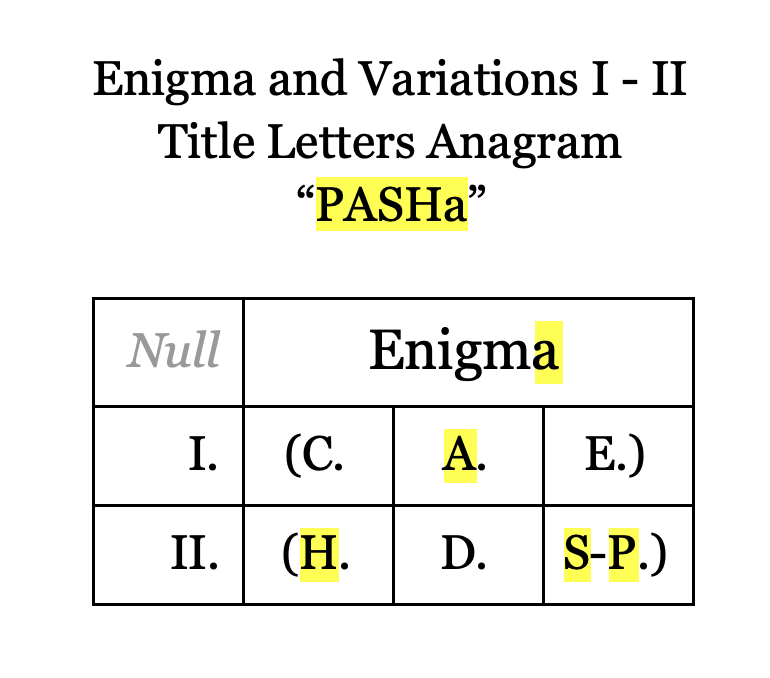
The title of Gordon’s favorite hymn is embedded within the opening titles of the Enigma Variations. Are there any other Gordensque encryptions? During his service at Khartoum, General Gordon went by the title “Gordon Pasha.” Remarkably, it is also feasible to assemble “Pasha” from proximate title letters in the first three movements:


General Gordon was an eccentric and selfless iconoclast, and his shadow looms over key parts of the Enigma Variations. The majority of its titles consist of initials, and Gordon’s initials are encoded by the keys of the opening movement. The Enigma Theme is framed in the parallel keys of G minor and G major. Those two contrasting keys furnish the initials for General Gordon.


There is persuasive evidence that Variation XIII was partly inspired by General Gordon’s murder by Mahdists. In that perplexing movement dedicated to a secret friend, Elgar cites a melodic incipit from Felix Mendelssohn’s concert overture Meeresstille und glückliche Fahrt (Calm Sea and Prosperous Voyage) to depict the “deathly stillness” (Todesstille) of a calm sea so vividly described in Goethe’s original poem. Elgar began composing the Enigma Variations thirteen years after Gordon’s death, the same number assigned as Roman numerals (XIII) to that ominous movement. Like the Enigma Theme, that maritime movement begins and ends in the key of G major. The repetition of that key at the beginning and end of that variation suggests the dual Gs that comprise General Gordon’s initials. There are thirteen letters in “General Gordon” and his popular nickname “Chinese Gordon.”
Gordon was 51 years old when he was savagely cut down at Khartoum in January 1885. In an intriguing parallel, Variation XIII is exactly 51 measures in length. Elgar’s measured gesture towards Gordon’s death is redolent of Psalm 39:4: “Lord, make me know my end and what is the measure of my days; let me know how fleeting I am!” Even more remarkably, the note sequence “DEAD” is played by the contrabass section twice in Variation XIII. The first instance occurs four bars after Rehearsal 55 which marks the beginning of this movement. This first “DEAD” note sequence cadences on a G major chord. The letter of that chord gives the initial for General.


The second instance transpires in the recapitulation four measures after Rehearsal 59. Like the first rendition, this “DEAD” note sequence cadences on a G major chord that provides the second initial for Gordon.


These “DEAD” note sequences are symbolically played by the lowest voice of the string choir. Various scriptural passages place death within the interior of the earth called Sheol. When Korah led a rebellion against Moses (Numbers 39), the Lord judged the rebels by opening up the earth and burying them alive in the depths of Sheol. Isaiah 14:15 also asserts this imagery by referring to death as “the pit.” The encipherment of the word “DEAD” in the bass line alludes to the shadowy depths of death.
The martial flare of the final movement sounds like a march that robustly alludes to Elgar’s military muse. This association is reinforced by the chord sequence at Rehearsal 62 where Elgar introduces the triumphant opening phrase of the main subject. The chord letters beginning one bar before Rehearsal 62 present in order the initials for General George Charles Gordon.


The initial for General is given by the G sustained Major 7 chord in the bar immediately preceding Rehearsal 62. Gordon’s rank as a Major General is suggested by the major mode of that chord. The initial for George is furnished by the sforzando G major chord on the downbeat of Rehearsal 62. The initial for Charles is given by the sforzando C major chord on the third beat of Rehearsal 62. The initial for Gordon is provided by the G major chord on the second beat of the second bar of Rehearsal 62. The initials for “General George Charles Gordon” are presented in order by the sustained chord sequence beginning one bar before Rehearsal 62. The meter in this section is Alla breve or cut time (2/2) with two half note pulses per measure. The semblance between “Alla” and “Allah” is astonishing as Gordon was literally “cut” down in the name of that Mahdist deity.
Elgar furnished commentary for pianola rolls of the Variations released in 1929. These remarks were later published by Novello in a booklet with the title My Friends Pictured Within. In the original draft copy, Elgar commences his remarks about Variation XIV in these words:
Finale; bold and vigorous. in general style. Written at a time when my friends were dubious and generally discouraging as to my musical future . . .
The words general and generally cleverly hint at General Gordon as the covert catalyst for the Variations. Elgar’s commentary remains largely intact with some minor editorial refinements in the published edition.


In his correspondence, Gordon used the apotropaic “D.V.” in brackets concerning possible future events. Those initials represent the Latin phrase “Deo Volente” (God Willing). Those same initials are components in the title of Elgar’s self-portrait, the Finale of the Enigma Variations. The letters “D” and “V” encompass the initial “E” in Variation XIV (E.D.U.). In the old Latin alphabet, the letters U and V are equivalent. Consequently, the sequential initials “D.U.” may also be read as “D.V.” In the final movement that begins as a military march, Gordon’s apotropaic “D.V.” is encoded in two different ways within the title.
Numerous memorials were erected in the aftermath of Gordon’s death. In 1888, a sculpture by Hamo Thornycroft was placed in Trafalgar Square atop an 18-foot pedestal situated between the fountains. The memorial was later relocated to the Victoria Embankment in 1953. In 1892, a mural monument of bronze was placed in the northwest tower chapel near the west entrance of Westminster Abbey. Other statues and memorials were erected in England, Australia, and Khartoum. As Gordon’s head and body were never recovered, a memorial reminiscent of a crusader’s tomb was installed at St. Paul’s Cathedral under the auspices of Gordon’s only surviving brother, William. The monument shows General Gordon in perpetual repose with his right hand resting securely on the Bible. Visible wear on Gordon’s hand shows where pilgrims placed their hands in spiritual solidarity with their fallen hero. Like the grave of Christ, Gordon’s memorial tomb has no body and remains symbolically empty.


With so many monuments honoring General Gordon’s life and death, it is befitting that Elgar would stealthily erect one of his own in the guise of the Enigma Variations. Gordon was surely an enigma among his military peers and contemporaries. Although he excelled on the battlefield as a supreme tactician and commander, he did not covet medals or commendations. Rather than chasing after honors and personal gain, Gordon selflessly donated his time and fortune to care for and educate orphans. As a religious mystic and ecumenical crusader for Christian ideals, Gordon died publicly for his faith. In his defiant last stand, Gordon transformed Khartoum into a fortress that withstood a 10-month siege before collapsing. In combination with Gordon’s Protestant faith inviting repeated comparisons to Luther, this daring action undoubtedly attracted Elgar’s interest in Ein feste Burg as a martial anthem with Christian overtones for his “Gordon” symphony.
Eerily reminiscent of how Gordon was beheaded at Khartoum, Elgar severed the principal Theme from the Variations. He accomplished this unprecedented feat by composing the Enigma Theme as a countermelody to a famous tune that is not heard but may play “through and over” each movement as a counterpoint. The symbolic decapitation of the covert principal Theme from the body of the Variations may be likened to Gordon's fate. Absent the main theme or “face” of the work, one struggles to unmask its true identity. Elgar’s decision to conceal the principal Theme was also likely spurred by his Roman Catholic faith because “A Mighty Fortress” was composed by a renegade priest excommunicated by Pope Leo X.
This overview identified some coded allusions to General Gordon in the Enigma Variations. The Enigma Theme is written in the parallel modes of G minor and G major, two key letters that provide the initials for General Gordon. The title of Gordon’s favorite hymn, “Abide with Me,” lurks behind the titles of the Enigma Variations as a bilingual anagram of proximate title letters. Gordon’s title “Pasha” is also enciphered by proximate title letters in the opening three movements. The stillness of death is sonically portrayed by the out-of-place Mendelssohn quotations in Variation XIII (***). This overt gesture towards mortality is covertly affirmed by the contrabass part that performs the note sequence “D-E-A-D” twice in that movement followed by G major chords that provide the initials for General Gordon. Variation XIII consists of 51 bars, a number that matches Gordon’s age when he was cut down at Khartoum. As a musical tribute to General Gordon, the rousing Finale has the martial flare of a march. Similar to the Enigma Theme, the initials for “General Charles George Gordon” are enciphered by the chord sequence at Rehearsal 82 of Variation XIV. Even Gordon’s favored apotropaic “D.V.” is encoded twice in the title of that concluding movement. As this assessment has shown, General Gordon casts a long and lasting shadow over the Enigma Variations. To learn more about the secrets of the Enigma Variations, read my free eBook Elgar’s Enigmas Exposed. Please help support and expand my original research by becoming a sponsor on Patreon.


About Mr. Padgett

My photo
Mr. Padgett studied violin with Michael Rosenker (a student of Leopold Auer), and Rosenker’s pupil, Owen Dunsford. Mr. Padgett studied piano with Sally Magee (a student of Emanuel Bay), and Blanca Uribe (a student of Rosina Lhévinne). He attended the Stevenson School in Pebble Beach, California, and Vassar College in Poughkeepsie, New York, where he graduated Phi Beta Kappa with a degree in psychology. At Vassar he studied music theory and composition with Richard Wilson. Mr. Padgett has performed for Joseph Silverstein, Van Cliburn, Arnold Schwarzenegger, Maria Shriver, Steve Jobs, Prince Charles, Lady Camilla, Marcia Davenport, William F. Buckley, Jr., and other prominent public figures. His original compositions have been performed by the Monterey Symphony, at the Bohemian Grove, the Bohemian Club, and other private and public venues. In 2008 Mr. Padgett won the Max Bragado-Darman Fanfare Competition with his entry "Fanfare for the Eagles." It was premiered by the Monterey Symphony under Maestro Bragado in May 2008. A member of the Elgar Society, Mr. Padgett is married with five children.