
During railway journeys amuses himself with cryptograms; solved one by John Holt Schooling who defied the world to unravel his mystery.
Robert J. Buckley in his 1905 biography of Sir Edward Elgar
The British composer Edward Elgar was fascinated by phonetic spellings, wordplays, and anagrams. One notable example is the title “Craeg Lea” which he imparted to his Malvern home where his family resided between 1899 and 1904. That atypical moniker is an anagram obtained from the reverse spelling of “Elgar” (Craeg Lea) mingled with the initials from the first names of his daughter Carice, himself, and his wife Alice (Craeg Lea). Elgar challenged Dora Penny to decipher the meaning of his home’s bemusing name. She caught on quickly as recounted in her memoir:
Edward called the place Craeg Lea and challenged me to guess how he had found the name. By some stroke of luck, I realized that the key lay in the unusual spelling of “Craeg” and immediately saw that the thing had been built up anagrammatically from (A)lice, (C)arice, (E)dward ELGAR. I think he was a little annoyed that this mystification had fallen flat.
Elgar’s enthusiasm for word games spilled over into his obsession with cryptography, the discipline of coding and decoding secret messages. His expertise in that esoteric art is amply documented by Craig P. Bauer in his treatise Unsolved! The bulk of its third chapter is devoted to Elgar’s brilliant decryption of an allegedly insoluble Nihilist cipher presented by John Holt Schooling in an April 1896 issue of The Pall Mall Magazine. A Nihilist cipher is a derivative of the Polybius square. Elgar was so delighted with his solution that he bragged about it in his first biography published in 1905 by Robert J. Buckley. Elgar painted the solution in black paint on a wooden box, an appropriate medium as another name for the Polybius square is a box cipher. The historical record is unambiguous. Elgar was an accomplished expert in the field of ciphers.
Elgar’s methodical decryption of Schooling’s conundrum is summarized on a set of nine index cards. On the sixth card, Elgar relates the task of cracking the cipher to “. . . working (in the dark).” His use of the word “dark” as a synonym for a cipher is relevant to this investigation as this same adjective turns up later in the 1899 program note for the premiere of the Enigma Variations. It is an oft-cited passage that warrants revisiting because Elgar lays the groundwork for his melodic riddle:
The Enigma I will not explain – it’s ‘dark saying’ must be left unguessed, and I warn you that the connexion between the Variations and the Theme is often of the slightest texture; further, through and over the whole set another and larger theme ‘goes’, but is not played . . . So the principal Theme never appears, even as in some later dramas – e.g., Maeterlinck’s ‘L’Intruse’ and ‘Les sept Princesses’ – the chief character is never on the stage.
Elgar composed the Enigma Variations in 1898-99. That extraordinary work elevated him from provincial obscurity to international acclaim, transforming his career from an itinerant music teacher to a celebrated composer. The original title appears on the autograph score as “Variations for orchestra composed by Edward Elgar Op. 36”. With the unconventional theme dubbed “Enigma,” the work is popularly referred to as the Enigma Variations. In the 1899 program note and other primary sources, Elgar explains the Theme is called “Enigma” because it is a counterpoint to a famous melody that is not heard but can play “through and over” the Variations. This secret tune is the cornerstone underlying the whole work, a subject that has provoked an intractable debate about the correct solution.
Some contend there is no answer by insinuating Elgar concocted the notion of an absent principal Theme as an afterthought, practical joke, or marketing gimmick. The editors of the Elgar Complete Edition of the Enigma Variations blithely deny the likelihood there could be any covert counterpoints or even cryptograms. Relying on Elgar’s recollection of playing new material at the piano to gauge his wife’s reaction, the editors tout the standard lore that he extemporized the idiosyncratic Enigma Theme, mirabile dictu, without any forethought or planning:
There seems to have been no specific ‘enigma’ in mind at the outset: Elgar’s first playing of the music was hardly more than a running over the keys to aid relaxation. It was Alice Elgar’s interruption, apparently, that called him to attention and helped to identify the phrases which were to become the ‘Enigma’ theme. This suggests it is unlikely that the theme should conceal some counterpoint or cipher needed to solve the ‘Enigma’.
Such a blanket abnegation conveniently relieves them of any obligation to probe for ciphers or cryptograms. Proponents of such an obtuse nihilism extol the validity of their position based on a dearth of evidence for which they never executed a diligent or impartial search. This tautological cul-de-sac is a textbook case of confirmation bias pawned off as scholarship. In the fourth chapter of The Cambridge Companion to Elgar, Christopher Kent meticulously documents how Elgar sketched and accumulated musical ideas in pastoral settings long before ever trying them out on the piano. Those familiar with Elgar’s compositional methods should know better than to proffer the lore that he miraculously improvised the Enigma Theme without advanced planning and preparation.
A more sensible view (adopted by those who take Elgar at his published word) accepts the challenge there is a famous melody lurking behind the Variations’ contrapuntal and modal facade. Regardless of what side is taken in this debate, legacy scholars insist the answer can never be known with absolute certainty because Elgar allegedly took his secret to the grave in February 1934. The intellectual nomenklatura presumes he never wrote down the solution for posterity to discover. Such a staid opinion glosses over or flagrantly ignores Elgar’s documented obsession with cryptography. That incontestable facet of his psychological profile raises the prospect the solution could be meticulously encoded within Enigma Variations’ orchestral score.
A decade of trawling that sublime symphonic masterpiece has netted over one hundred cryptograms in diverse formats that encode a set of mutually consistent and complementary solutions. Although that figure may seem extraordinary, it is entirely consistent with Elgar’s lifelong fascination with ciphers. More significantly, the solutions give definitive answers to the core questions posed by the Enigma Variations. What is the absent melody to which the Enigma Theme is a counterpoint and serves as the melodic foundation for the ensuing movements? Answer: Ein feste Burg (A Mighty Fortress) by Martin Luther. What is the “dark saying” nestled within the Enigma Theme? Answer: A musical Polybius box cipher embedded in its inaugural six bars cordoned off by a strangely positioned double barline. Who is the secret friend and inspiration behind Variation XIII? Answer: Jesus Christ, the Savior of Elgar’s Roman Catholic faith. The cryptographic evidence supporting these discoveries is diverse yet mutually consistent, multivalent, and decisive.
Such a vast trove of ciphers affirms that the Enigma Variations is Elgar’s musical homage to cryptography. The discovery of scores of ciphers within the Enigma Variations score justifies an ongoing search for even more cryptograms. Measure 562 in the Finale is a promising place for cryptograms because of certain distinguishing characteristics. It is framed in the key of E-flat major, a letter that suggests Elgar’s initial (E). Bar 562 is the nineteenth measure of that movement, a sum that mirrors the 19-bar length of the Enigma Theme. Could bar 562 be a nexus of ciphers? And if so, do those cryptograms divulge the identity of the absent principal Theme and Elgar’s anonymous friend depicted in Variation XIII?

Bar 562 “EFB” Ciphers
A diligent cryptanalysis of bar 562 revealed it enciphers the initials for Ein feste Burg in at least five discernable ways. The first and most obvious is the bar number itself. The application of an elementary number-to-letter key (1 = A, 2 = B, 3 = C, etc.) to the numerals five, six, and two converts them to the letters E, F, and B. Those are the initials in the correct sequence for the covert Theme. This cryptogram is called the Bar 562 Number-to-Letter “EFB” Cipher. In isolation, this cipher could be reasonably dismissed as contrived. However, it will be shown how other ciphers in bar 562 encode the same set of initials. From such a vantage point, the bar number fits into a larger pattern of cryptograms that conclusively authenticates it.

A second way that bar 562 encodes the initials “EFB” is by its chord progressions. The key of E-flat major is established by an upward scale run on the concluding beat of bar 561. Bar 562 continues in this mode with a G descending by a melodic major third to E-flat. The second beat of bar 562 is an F minor seventh (F/C/E-fat/A-flat) in root position. The third beat is a B-flat major triad (B-flat/D/F) that continues through the first half of beat four. The latter half of beat four is a B-flat dominant seventh (B-flat/D/A-flat) with the F omitted. The discrete letters of the chord progression in bar 562 are E, F, and B. These chord letters present in order the initials of Ein feste Burg. This cryptogram is known as the Bar 562 Chord Progression “EFB” Cipher.

A third way the initials “EFB” are enciphered in bar 562 is by its orchestration. This cipher employs the sequential number of active staves and converts those sums into their corresponding letters of the alphabet. There are six notes on six staves on the downbeat followed by notes on only two staves. From the second through third beats, notes populate five staves which then decline back to two staves on the fourth beat. When converted into their corresponding letters of the alphabet, the discrete sums of active staves (6, 2, 5) generate F, B, and E. These plaintext letters are an anagram of the initials of Ein feste Burg. This cryptogram is labeled the Bar 562 Active Staves “EFB” Cipher.

A fourth way bar 562 encodes the initials “EFB” is by the predominance of the notes E-flat, F, and B-flat as written and concert pitches. Before addressing this in detail, it is necessary to distinguish between the written and sounding notes for transposing instruments. The F Horns and F Trumpets produce sounding pitches different than their written notes. The F Horn performs a fifth lower than written. The F Trumpet plays a fourth higher than written. When transposed, a nominal note will sound in concert pitch as the actual note. All notes in bar 562 are summarized in the following table with a forward slash dividing written from sounding notes. Notes that provide the initials for Ein feste Burg are highlighted in yellow.

There are 30 noteheads in bar 562 utilizing 8 different written and concert pitches that add up to a grand total of 46. The frequencies and percentages of these written and concert pitches in all active staves are summarized below in descending order:
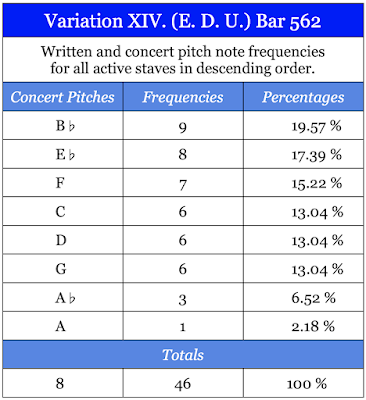
The number 46 stands out because the title of Ein feste Burg comes from Psalm 46. Notes with the highest frequencies are B-flat (9), E-flat (8), and F (7), which collectively comprise 24 of the 46 noteheads or just over 52 percent. The number 24 is conspicuous as that is the precise aggregate of letters in the German title Ein feste Burg ist unser Gott. The three most prevalent notes for both written and concert pitches spell in ascending order spell “FEB,” a short form of “February” that Elgar penned on the cover and last pages of the original and extended Finale. “FEB” is an anagram of the initials of Ein feste Burg. This cunning cryptogram is called the Bar 562 Note Frequencies “EFB” Cipher.
The written and concert notes with the next highest frequencies are C (6), D (6), and G (6). These three note letters present a distinct subset due to their shared prevalence of six. In ascending order, the note letters G and D offer a phonetic spelling of God. The letter C is a homonym of see and sea. Variation XIII is secretly dedicated to Jesus Christ, the Son of God and second person of the Trinity. Elgar cites an incipit of a subordinate theme from Felix Mendelssohn’s overture Calm Sea and Prosperous Voyage (Meeresstille und glückliche Fahrt) in that marine movement. The sea is mentioned in Psalm 46:2-3. Pairing phonetic spellings of God with sea is consistent with Elgar’s covert dedication.
Notes with the lowest frequencies are A-flat (3) and A (1). This pair forms a discrete subset due to their shared note letter. Their frequencies of 1 and 3 may be commingled to form 13, a figure that matches the Roman numerals of Variation XIII. The flat symbol derives from the Italian word bemolle and is a lower case b. Employing this flat symbol, “Ab” and “A” may be merged to spell “AbA.” This is a phonetic realization of “Abba,” the Aramaic word for “Father.”
Mark 14:36 recounts that when Jesus prayed in the Garden of Gethsemane on the eve of his arrest and crucifixion, he addressed God affectionately as “Abba.” The chapter and verse of Mark 14:36 are conspicuous because the opus number of the Enigma Variations is 36, and it has fourteen variations. When read phonetically in ascending order, the notes with the four lowest frequencies (A, A-flat, G, and D) yield the decryption “Abba God.” This expression translates as “Father God.” The combination of the notes “C,” “Ab-A” and “G-D” may be phonetically decrypted as the phrase “See Abba God.” Jesus explains in John 14:9, “Whoever has seen me has seen the Father.” These phonetic anagrams were only revealed by conducting a frequency analysis of the written and concert pitches in bar 562. These phonetic decryptions align with Elgar’s Roman Catholicism and personal correspondence that evinces inventive phonetic spellings.
In addition to giving the initials for Ein feste Burg, the sounding pitches in bar 562 present the initials for its composer. Two concert E-flats played by Trumpets I-II (written B-flat) and Horn I (written B-flat) on the second half of beat one are the first set initials (EE). A second set appears on beat three by Trumpets I-III (written E-flat) and Trombone I (sounding E-flat). Bar 562 is not an isolated case when it comes to unmasking coded versions of Elgar’s initials. This pattern is seen elsewhere such as in bars 640-645 where melodic E-flats in repeating pairs precede the reintroduction of Variation I (C. A. E.) at Rehearsal 73. Some cryptograms from the Enigma Variations contain Elgar’s initials, and those ensconced in bar 562 continue this pattern.
A fifth discernable way that Elgar enciphered the initials “EFB” in bar 562 is based on the last letters of the Italian terms Soli, sf, and Tamb. Soli appears above the Trumpets I-III stave at the outset of bar 562 to indicate a solo line performed by multiple parts. The performance direction sf appears on the downbeat of the Violin I-II, and Viola staves. This is an abbreviation for sforzando and indicates a sudden accent. Tamb is positioned over the percussion stave as part of “Tamb. picc.” a standard abbreviation for Tamburo piccolo (snare drum).
The final letters of sf and Tamb provide the second and third initials of Ein feste Burg. But what about the absent e? The last letter of Soli is i, not e. Remarkably, the pronunciation of i in Soli sounds exactly like the name for the letter e. The i in Soli is a homonym of e. The second Soli note in bar 562 is a concert E-flat. That letter also appears in the performance direction “ten.” which occurs five times in bar 562. The encoding of the covert Theme’s initials by the final letters of three performance terms (Soli, sf, and Tamb.) is called the Bar 562 Telestich Anagram “EFB” Cipher.
Bar 562 English Initials Ciphers
Five performance directions in bar 562 convey the initials for five different English translations of the title Ein feste Burg in the guise of acrostic and mesostich anagrams. The initials for the literal English translation (A Mighty Fortress) appear in the performance terms sf and Tamb as the second and third letters. Those letters are a mesostich anagram of “amf,” the initials of A Mighty Fortress.
A popular translation by Thomas Carlyle in 1831 renders the title as A Safe Stronghold. The first letters of Soli and sf provide the second and third initials of that title. The absent “A” is transparently encoded by the Roman numeral I on the Trumpet staff using an elementary number-to-letter key (1 = A). The second letter of Tamb also furnishes that absent letter. An 1869 translation by Winkworth called A Sure Stronghold has the same three initials as A Safe Stronghold.
A less familiar 1883 translation by L. W. Bacon renders the title of Ein feste Burg as Strong Tower and Refuge is our God. This version appears in the 1883 book The Hymns of Martin Luther. Similar to the original German title, this translation may be truncated to simply Strong Tower.

The first two initials of that English title are given as an acrostic anagram by Soli and Tamb. Those same initials are also supplied as an acrostic anagram by the performance directions sf and ten. The initials for Strong Tower are encoded by two different sets of acrostic anagrams relying on four performance directions: Soli, Tamb, sf, and ten.
The words “Strong Tower” also show up in the more familiar 1851 translation by A. T. Russell as A Strong Tower. Two of those three initials are given as acrostic anagrams by two sets of performance directions (Soli and Tamb, and sf and ten). The remaining “A” is encoded by the Roman numeral I based on a number-to-letter key. The letter “a” also appears in Tamb. The performance terms Soli, sf, and I are positioned at the beginning of bar 562.
A cryptanalysis of five discrete performance directions in bar 562 (Soli, I, sf, ten, and Tamb) found they encipher the initials for five English translations of the title Ein feste Burg. Those five titles are listed below:
- A Mighty Fortress
- A Safe Stronghold
- A Sure Stronghold
- Strong Tower
- A Strong Tower
It was previously shown how bar 562 employs five different methods for enciphering the initials for Ein feste Burg. This presents a remarkable parallel with five sets of English initials for that hymn enciphered in that same measure. Five translations encoded by five performance directions intimate a coded version of Elgar’s initials as the fifth letter of the alphabet is E. This cryptogram is known as the Bar 562 English Initials Ciphers.
Bar 562 “JC” and “GD” Ciphers
An alternate approach to analyzing bar 562 is to add up the number of active instrumental parts in sequence and convert their unique totals into their corresponding letters of the alphabet. Seven instruments play on the downbeat: F Horn I, F Trumpets I-II, Violins I-II, Viola, and Cello. Three instruments perform on the second half of beat one: F Horn I and F Trumpets I-II. Ten instruments are engaged on beats two and three: F Horns I-IV, F Trumpets I-III, and Trombones I-III. Four instruments take part on beat four: F Trumpets I-II and Trombones I-II. The sequence of active instrumental parts generates the sums seven, three, ten, and four.
The corresponding letters for these active instrumental parts (7, 3, 10, 4) in bar 562 are G, C, J, and D. When treated as an anagram, the plaintext may be rearranged as “GD” and “JC”. The first decryption “G-D” is a common phonetic spelling for God. The second solution “JC” presents the initials for Jesus Christ, the secret friend so movingly portrayed in Variation XIII. Elgar was a practicing Roman Catholic when he composed the Enigma Variations in 1898-99. A core tenant of that faith is the belief that Jesus is the Incarnation of God in human form. The encoding of “God” with the initials for Jesus Christ is wholly consistent with that doctrine. This cryptogram is dubbed the Bar 562 Active Instrumentation “JC” and “GD” Anagrams Cipher.
Bar 562 “515” Ciphers
There are subtle allusions to the mystical number “515” in measure 562. Before covering this fascinating subset of ciphers, it is first necessary to address the literary origin of “515”. That special number appears only once in the Divine Comedy by Dante Alighieri. In Canto XXXIII of Purgatorio (Purgatory), the heroine Beatrice assigns the mystical number “five hundred, ten, and five” (Purgatorio 33.43) to a future savior who will rid the church of corruption and slay a menacing giant. In the original Italian, Beatrice describes her eerie prophecy as an “enigma forte” (difficult enigma).
The Enigma Variations harbors multiple coded references to Dante's epic Christian poem. Likewise, there are unmistakable parallels between Canto XXXIII of Purgatorio and Elgar’s hidden melody. That final canto opens with seven maidens singing a hymn with text from the opening verses of Psalm 78. Verse 2 from that chapter reads, “I will open my mouth in a parable; I will utter dark sayings from of old . . .” In his 1899 program note, Elgar deploys “Enigma” and “dark saying” in the same sentence as subtle Dantean overtures. A reference to “psalmody” — the singing of psalms — in Canto XXXIII is significant as the title of Ein feste Burg is taken from Psalm 46.
Measure 562 has certain features that hint at the mystical number 515. On the second beat of bar 562, there are five tenutos (ten.) written over five brass staves:
- F Horns I-II
- F Horns III-IV
- F Trumpets I-III
- Trombones I-II
- Trombone III
This overlapping blend of five “ten.” on five staves intimates the “five,” “ten” and “five” from 515. There are ten accent marks in the brass staves of bar 562. The accent mark is a horizontal wedge that duplicates the Roman numeral V. Ten accent marks that resemble the Roman numeral V also suggests the “ten and five” from 515. These 515 ciphers appear in a bar with a number that begins with 500. The F Trumpet staff has the Roman numerals I, II, and IIII. These may be combined with the accent symbols to generate five renditions of “VIV” with only one residual “I” remaining. These examples add up to seven coded versions of 515 in bar 562.
Another vertical formation of “515” appears on the second beat of bar 562 in the trombone staves where the “ten.” is flanked by two accent symbols that resemble the Roman numeral V. A horizontal line below “ten.” is the tenuto symbol that resembles the Roman numeral I. Another version of this same sequence appears in the F Trumpets staff where an accented B-flat (concert E-flat) is followed by “ten.” on E-flat (concert A-flat) and then an accented C (concert F). It was shown earlier how this combination of written and sounding pitches furnishes the initials for Ein feste Burg. Anagrams of “515” appear as two accent symbols and “ten.” in the staves for the F Horns I-II and F Trumpets I-III. On beats 1 and 2, two accents are followed by “ten” in the F Horns I-II staff. The same pattern appears on the first two beats of the F Trumpets I-III staff. These provide four more coded forms of 515 in bar 562.
The chord progressions in bar 562 also furnish a coded version of 515. The downbeat is a melodic E-flat major followed on beat two with an F minor seventh. This resolves on the third beat is a B-flat major chord. In the context of E-flat, the harmony on the first beat is the tonic chord represented by the Roman numeral I. The B-flat major triad is the dominant of E-flat and is indicated by the Roman numeral V. The F minor seventh is a secondary dominant as F is a fifth above B-flat, the dominant of E-flat major. This chord progression is commonly referred to as “the dominant of the dominant” or “five of five” and is written as “V/V” (five over five) in Roman numeral analysis. The Roman numerals representing these chord progressions are a coded form of VIV or 515. A “ten.” is written over the notes that form the F minor seventh on beat 2 of bar 562. This secondary dominant is represented as V/V. The combination of two Roman numeral fives with “ten.” presents yet another coded allusion to the prophetic number 515. These chord progressions furnish two more coded forms of the number 515.
In all, there are thirteen encoded forms of 515 in this measure that are collectively referred to as the Bar 562 “515” Ciphers. That total is significant because Elgar also enciphers the number 515 in Variation XIII, a movement secretly dedicated to Christ. It was previously observed how the orchestration in bar 562 enciphers the initials for Jesus Christ and a phonetic rendering of God. Decryptions of 515 in the same bar that encodes the initials for Jesus Christ are elegantly consistent with the identical decryptions in Variation XIII. Through these coded references to Christ and the mystical number 515 in Variation XIII, Elgar cryptically offers Jesus as the ultimate solution to Dante’s enigma forte. Remarkably, Elgar answers Dante’s difficult enigma with one uniquely his own and reflective of their mutual faith.
Bar 562 “Soli Deo Gloria" Dedication Cipher
The downbeat of bar 562 displays the performance direction “Soli” above the written melody note D in the Trumpet I-III staff played with a G in the Violins I-II and Viola parts. The combination of “Soli” with the note letters D and G presents a coded form of the Latin dedication “Soli D[eo] G[loria]” (Glory to God alone). Bach and Handel inscribed this dedication on their sacred works. This dedication is often abbreviated as “S. D. G.” Elgar’s stealth dedication to God is encircled by an E-flat in the lowest active staff (cello) and a written D in the highest active staff (Horn I). The pairing of these two note letters from the lowest and highest active staves spells out “ED”, the short form of Edward. This Bar 562 Soli Deo Gloria dedication is cleverly signed by the composer.
Bar 562 Biblical Anagrams Cipher
Bar 562 is bookended by the performance directions Soli and “Tamb. picc.” Soli is written over the F Trumpet I-III staff at the beginning of the bar. “Tamb. picc.” is shown at the end of the Percussion I staff. It is feasible to assemble biblical terms as anagrams from these first and last performance directions in bar 562. The first is psalm assembled from the first and third letters of Soli, the second and third letters of Tamb, and the first letter of picc. The title of the covert Theme originates from Psalm 46. That chapter number is suggested in two ways the orchestration in bar 562. The first way is by six notes in the F Horns I-II staff, and four notes in the F Horns III-IV staff. A second way is by the six notes in the F Trumpets I-III staff combined with the four consecutive chords in the Trombones I-II staff. In both instances, these note sums appear in two adjacent staves.
A second theologically infused term that can be realized as an anagram from these first and last performance directions is lamb. This word is taken from the third letter of Soli and the second through fourth letters of Tamb. When Jesus arrived at the Jordan River to be baptized, John the Baptist proclaimed in John 1:29, “Behold, the Lamb of God, who takes away the sin of the word.” This coded version of “lamb” occurs in the very same bar that enciphers the initials for Jesus Christ with a phonetic spelling of God.
A third biblical term that can be generated as an anagram from these first and last performance directions is baptism. This word is obtained from the first and fourth letters of Soli, all the letters of Tamb, and the first letter of picc. The scriptures link the terms “lamb” and “baptism” because John the Baptist proclaimed Jesus as the “Lamb of God” when Jesus came to be baptized by him in the River Jordan.
The words Soli and ten in the Trumpets I-III staff may be combined to produce the anagrams “Sol” and “teni.” “Sol” is the Latin word for sun, a homonym of soul, and the fifth note (dominant) in solfège. “Teni” is the first word spoken by Jesus to the Samaritan woman at Jacob’s well when he asked her for a drink. This same word is encoded by a musical Polybius cipher in the Enigma Theme’s fifth measure. Multiple commentaries available during the closing decade of the 19th century asserted that Jesus spoke to her in Aramaic. The Pulpit Commentaries dating from 1897 furnishes the following analysis of John 4:
The Samaritan woman therefore saith to him, How is it (compare this “how” with that of Nicodemus. Jesus had at once provoked inquiry, which he was not unwilling to gratify)—How is it that thou, being a Jew? She would have known that he was a Jew by his speech, for the Samaritans were accustomed to turn the sound of sh into that of s; and so, when Jesus said in Jewish Aramaic, Teni lishekoth, “Give me to drink,” while she would herself have said, Teni lisekoth, his speech would betray him.
Another instance is found in The Preacher's Complete Homiletical Commentary on St. John dating from 1892 which also advises that the word teni is Aramaic:
The woman knew He was a Jew probably by His dress, but it may be also by His accent. It has been pointed out that the words of the question asked by Jesus in Aramaic would be תני לי לשׁחת (Teni li lish'ḥoth), whereas the woman would have said לשׂחת (lis'ḥoth) (vide Jud 12:5-6).
While these and other commentaries of Elgar’s era would have reasonably compelled him to believe that teni is Aramaic, the exceptionally talented international correspondent Daniel Estrin confirmed it is actually Hebrew. Charles C. Torrey of Yale University lays out a compelling case that the Gospel of John was originally written in Aramaic, the vernacular of Judea in the first century. It is universally acknowledged that although Jesus and his disciples were Hebrews, they conversed almost exclusively in Aramaic. For this reason, the biblical commentaries correctly report that Jesus spoke to the Samaritan woman in Aramaic. However, the translation given is mistakenly in Hebrew, a language very similar to Aramaic. The correct version of this passage from the Aramaic Peshitta is, “Hav li maya, eshteh,” which means, “Give me water, I will drink.”
The first and last letters of “Soli” may be paired with the last letter of “ten.” to form an anagram of sin. This word is also obtained from the first and last initials of the performance directions sf, I, and ten. John the Baptist employed this term when he announced that Jesus was the sacrificial Lamb of God who takes away the sin of the world. During his earthly ministry, Jesus publicly forgave sin as illustrated by Matthew 9:1-8 and Mark 2:1-12. In 2 Corinthians 5:21, the Apostle Paul further clarifies that Jesus became sin so that humanity could be endowed with the righteousness of God. There is a sound theological footing for associating sin with the ministry of Jesus.
The term “ten.” for tenuto is “net” spelled backward. In the seventh and last parable in Matthew 13:47-50, Jesus likens the Kingdom of Heaven to drawing a net in the sea. This is called the Parable of the Net. There are five “ten.” in bar 562, suggesting the plural form of nets. Simon, Andrew, James, and John answered the call of Christ by leaving their fishing nets to follow him (see Matthew 4:18-22 and Mark 1:16-20). People do not readily abandon their trade and tools without some form of potent persuasion. More details about this recruitment are provided in Luke 5:1-10. Simon and his fellow fisherman had worked all night but caught nothing. As they cleaned their nets on the shore in the morning, Jesus taught from one of their boats before directing them to sail out to the deep and drop their nets for a catch. Peter protested but complied. After they cast their nets, they caught such a prodigious haul of fish that they had to signal for another boat for help. After this miracle, Jesus told his disciples that they would become fishers of men. John 21:1-8 documents that this same miracle was recapitulated after the resurrection of Christ. Nets are elements of the start and finish of Christ’s earthly ministry.
There are five discrete performance directions in bar 562:
- Soli
- ten.
- sf
- An accent symbol that resembles a “V”
- Tamb. picc.
When these terms are treated as an anagram, their eighteen letters and three periods may be reorganized to produce the anagrams “E. F. B.”, “Psalmist” and “Convict.” The initials of Martin Luther’s renowned hymn are “E. F. B.” There are precisely three periods from the abbreviations that conveniently separate those initials. Luther was an accomplished musician who sang and composed psalms, satisfying the definition of psalmist. His most famous composition, Ein feste Burg, was inspired by Psalm 46. Luther was also a convict because the Papal Bull of Excommunication issued by Pope Leo X in January 1521 publicly declared him a heretic and an outlaw. This series of three anagrams obtained from the discrete performance directions in bar 562 provide the initials for the covert Theme and key information that implicates Luther as its composer. The precision and specificity of these anagrams decisively rule out a fortuitous or random formation. Their mutual consistency effectively authenticates the decryption as valid.
Summation
A meticulous cryptanalysis of bar 562 from the Enigma Variations determined that it encodes the initials for Ein feste Burg in at least five different ways. The first is by the application of a basic number-to-letter key to the bar number. The second is via its chord progressions. The third is through the number of active instrumental parts in the orchestration filtered through a number-to-letter key. The fourth is by the predominance of the written and concert notes E-flat, F, and B-flat that comprise 24 of 46 noteheads for just over 52 percent. A fifth way is by a telestich anagram from the last letters of the performance directions Soli, sf, and Tamb. The absent “e” is cleverly provided by the pronunciation of the i in Soli which sounds exactly like the letter e.
Five discrete performance directions in bar 562 (Soli, I, sf, ten. and Tamb.) enciphers the initials for five contrasting English translations of the hymn’s title: A Mighty Fortress (AMF), A Safe Stronghold (ASS), A Sure Stronghold (ASS) Strong Tower (ST), A Strong Tower (AST). When run through a number-to-letter key, the number of active instrumental parts in bar 562 encode the initials for Jesus Christ (JC) accompanied by a phonetic spelling for God (G-D). A frequency analysis of 46 written and concert pitches revealed how they encipher the initials “EFB” and a phonetic decryption of the phrase “See Abba God.”
The downbeat of bar 562 enciphers the dedication “Soli D[eo] G[loria]” using the performance direction Soli with the written notes D and G. Elgar autographed this cipher with the remaining written notes E-flat and D that spell “ED.” Over a dozen permutations of the sacred number “515” are encoded in bar 562, presenting veiled literary allusions to the “enigma forte” prophecy in Canto XXXIII of Purgatorio from Dante’s Divine Comedy. Many of these cryptograms are accompanied by Elgar’s initials (EE).
Performance terms in bar 562 permit anagrams of psalm, lamb, baptism, Sol, teni, sin, and net. Relying on contemporary biblical commentaries, Elgar would have mistakenly thought “teni” was Aramaic rather than Hebrew. These anagrams are associated with Jesus Christ, the anonymous friend depicted in Variation XIII. When all five discrete performance terms in bar 562 are submitted to anagrammitization, they yield the initials of Ein feste burg (E. F. B.) with the correct number of periods in combination with the words palmist and convict. These two words decisively implicate Martin Luther as its author. The anagrammatic solutions in bar 562 are mutually consistent and validate the whole set.
The decryptions in bar 562 are in Aramaic, English, German, and Latin. Remarkably, those four languages encode an acrostic anagram of Elgar: English, Latin, German, and Aramaic. This solution is only unveiled after successfully deciphering numerous cryptograms in bar 562. Elgar collectively autographed the solutions to these ciphers by employing a multilingual tier of encryption. The identical encryption technique is an integral part of a musical Polybius cipher in bars 1-6 of the Enigma Theme. To learn more about the secets of the Enigma Variations, read my free eBook Elgar’s Enigmas Exposed. Please help support and expand my original research by becoming a sponsor on Patreon.


